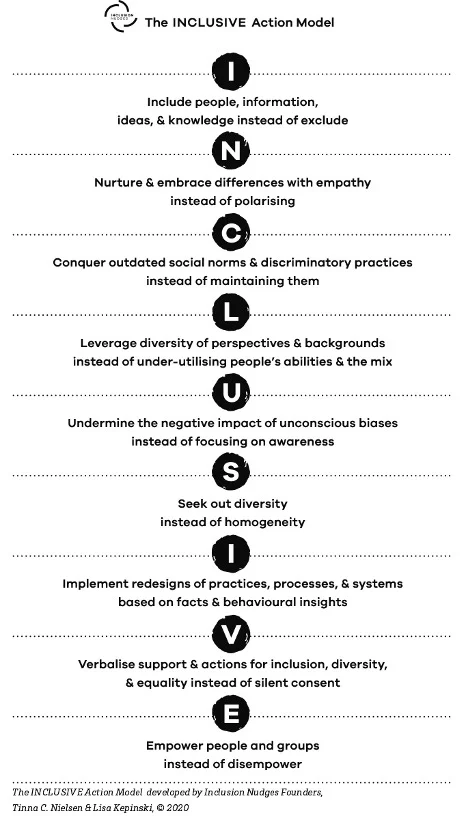
For decades, organizations and communities worldwide have grappled with the persistent challenge of fostering truly inclusive environments. Despite significant investment in diversity, equity, and inclusion (DEI) initiatives, many efforts have yielded incremental progress, often described as taking "three steps forward, one step back." This frustration stems from a fundamental misunderstanding of human behavior, particularly the powerful role of unconscious biases and the inherent gap between intention and action. A new solution, informed by a blend of behavioral economics, psychology, and neuroscience, is emerging: Inclusion Nudges. This innovative approach seeks to redesign systems, processes, and environments to make inclusive behavior the default, transforming organizations, communities, and society at large.
The Enduring Challenge of Traditional DEI Approaches
Since the civil rights movements of the mid-20th century, the imperative for diversity and equality has been recognized globally. Initial efforts often focused on legal compliance, anti-discrimination policies, and awareness training. While these measures were crucial for establishing foundational principles, they frequently fell short of creating deeply ingrained inclusive cultures. Many change agents within multinational corporations and community organizations observed that despite well-intentioned programs and clear rational arguments for diversity, progress remained slow or superficial. The underlying issue, it became clear, was not a lack of knowledge or willpower, but rather the powerful, often unseen, influence of the human mind’s automatic processes.
For example, consider the seemingly absurd scenario presented by proponents of Inclusion Nudges: a group of leaders confidently selecting a senior manager, arguing that "The best qualified candidate is definitely the tallest of them. No doubt. Tall leaders are the best at executing strategy… They are the best leaders." While consciously, no rational leader would explicitly make such a claim, research consistently demonstrates that unconscious associations can lead to precisely this outcome. Studies across various industries and geographies reveal a disproportionate representation of taller individuals in leadership roles. Data indicates that approximately 60% of top leaders are 185 cm (6 ft 1 in) or taller, compared to just 14% of the general population. This "height-leadership effect" extends to higher status, more promotions, and increased income for taller individuals, irrespective of their actual merit or skills. This phenomenon highlights a critical disconnect between rational intent and actual behavior, driven by deep-seated, unconscious cognitive processes.
Understanding the Mind: The Intention-Action Gap
The core of this challenge lies in the dual-system nature of human cognition, a concept popularized by behavioral scientists. Our minds operate using two interdependent modes of thinking:
- The Automatic System: Characterized by being unconscious, fast, instinctive, effortless, associative, and uncontrolled. This system acts like an autopilot, dominating an estimated 90-99% of our daily thoughts, choices, and behaviors. It relies on mental shortcuts, such as associations (perceived connections between elements) and biases (errors in processing information), to make rapid judgments and decisions. While efficient for navigating complex environments, it can lead to flawed conclusions when applied to nuanced social interactions.
- The Reflective System: This system is conscious, slow, effortful, rational, logical, self-aware, rule-following, and controlled. It is the part of our mind we believe is in charge, responsible for deliberate thought and reasoned decisions.
The "intention-action gap" arises when there is a disparity between what our reflective system knows and intends (e.g., hiring based purely on merit, valuing diversity) and what our automatic system does (e.g., unconsciously favoring candidates who fit certain archetypes, overlooking qualified individuals due to implicit biases). This gap means that even individuals who consciously champion fairness and inclusivity may, through their unconscious actions, perpetuate exclusionary practices. Knowledge and willpower alone are often insufficient to bridge this divide, especially in situations marked by ambiguity, complexity, or time pressure, where the automatic system takes over with greater force.
The increasing complexity of modern life, characterized by information overload, the rise of social media echo chambers, and perpetually busy schedules, further exacerbates this reliance on mental shortcuts. This cognitive overload intensifies the automatic system’s dominance, potentially leading to greater homogeneity and exclusion, ironically at the expense of the collective need for diversity and inclusion.
The Emergence of Behavioral Design and Inclusion Nudges
Recognizing these limitations, a new wave of change-makers began to experiment with insights from behavioral sciences. Disciplines such as behavioral economics, nudging theory, psychology, anthropology, linguistics, neuroscience, and complex system theory offered a powerful lens through which to understand and influence human behavior more effectively. This interdisciplinary approach formed the bedrock of Inclusion Nudges.
Nudge theory, popularized by Richard Thaler and Cass Sunstein, posits that by subtly altering the "choice architecture"—the environment in which people make decisions—it is possible to steer individuals towards predictable, desirable behaviors without removing their freedom of choice. This non-intrusive "push" targets the unconscious mind, aligning actions with intentions that might otherwise be overridden by automatic biases.
Inclusion Nudges apply this principle specifically to the realm of diversity, equity, and inclusion. An Inclusion Nudge is defined as a design based on insights from behavioral and social sciences, crafted to steer the unconscious mind towards inclusive behavior by targeting behavioral drivers, judgment and choice processes, and perceptions. The objective is to make inclusion the default, the easy choice, without requiring constant rational effort, threats, or punitive measures.
Three Pillars of Inclusion Nudge Design

The Inclusion Nudges change approach is built upon three distinct yet interconnected types of interventions, each designed to address a specific aspect of the intention-action gap:
1. Show the Hidden Issue and Make People Feel the Need
Human beings are not primarily driven by rational arguments when it comes to behavioral change; they are moved by what they see and feel. Simply telling people they are biased or that diversity is beneficial often fails to create lasting change. Instead, Inclusion Nudges emphasize designing experiences that show the implications of unconscious bias or systemic exclusion, thereby motivating the unconscious mind to engage in change. These are called Feel the Need Inclusion Nudges.
Example: Visualizing Hidden Talent and Networks
One powerful Feel the Need Nudge involves making invisible patterns of exclusion visible. For instance, to address a lack of gender equality in senior executive networks, a visual representation might be created. This visual could list numerous male names associated with formal and informal networks, juxtaposed with a significantly shorter list for women, even when discussing performance. By presenting this stark visual, leaders are confronted with a tangible manifestation of the problem, feeling the implicit need for change without being explicitly told they are biased. This experiential realization fosters buy-in for initiatives like sponsorship programs for underrepresented talent, as leaders feel the urgency to correct the imbalance in their own networks. This approach successfully bypasses rational resistance by appealing directly to the automatic system’s recognition of discrepancy and injustice.
2. Process Designs to Make Inclusion the Norm by Default
While motivation is crucial, it is often not enough. True inclusion requires embedding inclusive practices directly into daily operations, making them automatic and effortless. Process Design Inclusion Nudges achieve this by redesigning the very structures and workflows of an organization or community—from collaboration methods and idea generation sessions to decision-making processes, IT systems, and physical environments. The goal is to mitigate bias and foster inclusive behaviors by default, without needing conscious reflection or continuous reinforcement.
Example: "Share with a Peer" for Enhanced Group Collaboration
A common challenge in group settings is the suppression of diverse perspectives due to conformity pressures, power dynamics, or a lack of psychological safety. To address this, a Process Design Nudge might introduce a "Share with a Peer" step. Before a general group discussion, individuals are asked to first share their thoughts and ideas with one or two peers in a smaller, more intimate setting. This simple process change serves multiple purposes:
- It ensures that all voices are heard, even those of quieter individuals, before ideas are potentially influenced by dominant personalities or majority opinions.
- It helps individuals articulate and solidify their thoughts, increasing their confidence to share in the larger group.
- It allows for early clarification of misunderstandings.
- Crucially, it fosters a sense of psychological safety, making it easier for diverse perspectives to emerge and be valued.
By embedding this step into meeting protocols, inclusion becomes an automatic part of the collaborative process, enhancing decision-making and fostering a more equitable culture. Other process designs include structured interview formats, anonymized CVs, and standardized performance review criteria.
3. Frame Perceptions to Alter Understanding and Support Action
The way information is presented, problems are described, or language is used profoundly shapes human perceptions, judgments, and subsequent behaviors. Frame Perceptions Inclusion Nudges strategically alter these frames to counteract stereotypes, negative narratives, or limiting focuses, thereby influencing how people perceive issues, individuals, data, and merits. By subtle shifts in framing, it becomes possible to increase inclusion as the norm.
Example: Reversing Numbers to Reveal Hidden Populations
Traditional metrics might highlight a large majority, inadvertently rendering a minority invisible. A Frame Perceptions Nudge could involve "reversing the numbers." Instead of stating, "90% of our leadership team is male," one might frame it as, "Only 10% of our leadership team are women, meaning 90% of our talent pool is underrepresented at the top." This simple linguistic shift changes the mental anchor, drawing attention to the overlooked group and the systemic consequences of their underrepresentation. It moves the focus from a perceived norm to a noticeable deficit, making the "hidden people" visible and fostering a sense of urgency for change. Other framing techniques include priming specific positive associations, appealing to shared identity, or altering the perceived "anchor" of a thought process to promote more inclusive interpretations.
Broader Implications and Impact
The adoption of Inclusion Nudges represents a paradigm shift in how organizations approach DEI. This behavioral science-driven methodology moves beyond mere awareness to tangible, actionable design, leading to more sustainable and impactful change. The implications are profound:
- Enhanced Organizational Performance: A growing body of research consistently links diversity and inclusion to improved financial performance, increased innovation, better problem-solving, and higher employee engagement. Companies in the top quartile for racial and ethnic diversity are 35% more likely to have financial returns above their respective national industry medians. For gender diversity, the likelihood is 15% higher.
- More Effective Decision-Making: By mitigating unconscious biases and ensuring a wider range of perspectives are heard (as with Process Design Nudges), organizations make more robust and informed decisions, avoiding costly groupthink.
- Stronger Talent Acquisition and Retention: Inclusive environments attract and retain diverse talent. When candidates perceive a genuinely inclusive culture, they are more likely to join and stay, reducing turnover costs and strengthening the talent pipeline.
- Ethical and Societal Advancement: Beyond business benefits, Inclusion Nudges contribute to a more just and equitable society. By systematically dismantling the behavioral roots of discrimination and exclusion, they foster environments where every individual can thrive.
- Empowerment of Change Agents: This approach provides concrete, evidence-based tools for individuals and teams to drive change, making the process less daunting and more effective, thus sustaining the motivation of those leading the charge.
The Inclusion Nudges Global Initiative: A Movement of Shared Knowledge
Inclusion Nudges is not merely a set of techniques; it is a global change initiative and community founded on principles of sharing, reciprocity, and open source. The creators, Lisa and Tinna, observed a pervasive tendency in the social change sector for practitioners to discuss what they do, but rarely how they do it effectively. This lack of practical, detailed guidance left many inspired but disempowered.
Driven by a commitment to accelerate inclusive change, the Inclusion Nudges initiative was established to openly share detailed, step-by-step descriptions of effective behavioral designs. Through guidebooks, action guides, and online platforms, the initiative provides accessible "how-to" information, breaking down complex behavioral science into actionable strategies.
- Sharing: The initiative thrives on collaboration and co-creation. Practitioners are invited to share their own successful Inclusion Nudge designs and experiences. These contributions are then documented, analyzed with behavioral insights, and disseminated to the wider community, creating a continuously evolving library of proven interventions.
- Reciprocity: This movement is built on the understanding that collective action amplifies individual impact. By exchanging examples, offering peer support, and promoting these resources within networks, individuals contribute to a virtuous cycle of learning and implementation, accelerating social change.
- Open Source: In a radical departure from proprietary models, the Inclusion Nudges concept and approach are shared under a Creative Commons License. This commitment to open access ensures that knowledge is not hoarded or restricted by cost, but freely available to anyone globally who seeks to foster inclusion. This philosophy underscores the belief that widespread access to effective tools is paramount for achieving a truly inclusive world.
The call to action is clear: by integrating these types of behavioral designs into daily actions, individuals and organizations can make inclusion a natural, effortless, and integrated part of their work, interactions, and decisions. This bottom-up, collaborative approach, empowered by robust behavioral science, offers a tangible path to making inclusion the norm—everywhere, for everyone. As communities and societies navigate increasing complexity and diversity, the strategic application of Inclusion Nudges provides a powerful, evidence-based framework for unlocking true human potential and fostering equitable outcomes.