Americans are navigating an increasingly complex and fragmented information landscape, facing challenges ranging from the proliferation of inaccurate news and stark political divides in news sources to the burgeoning influence of artificial intelligence. In response to these evolving dynamics, a recent comprehensive study by the Pew Research Center, conducted under the auspices of the Pew-Knight Initiative, sought to understand how individuals themselves define what it means to be a "good news consumer." The findings reveal a diverse array of perspectives, underscoring the significant agency and responsibility individuals now hold in curating and validating the information they encounter.
This research builds upon prior investigations into Americans’ relationship with news, highlighting the overwhelming volume of information and the competing demands for public attention and trust. By directly asking Americans to articulate their understanding of responsible news consumption, the study provides valuable insights into the strategies, attitudes, and awareness people employ to make sense of the modern media environment.
The Pew-Knight Initiative: Fostering Informed Communities
The Pew-Knight Initiative is a collaborative effort dedicated to advancing research on how Americans engage with civic information, form their beliefs, and participate in their communities. This initiative is a joint venture between the Pew Research Center, a nonpartisan fact tank committed to informing the public about societal trends, and the John S. and James L. Knight Foundation, a social investor focused on strengthening informed and engaged communities. Together, they support critical research that illuminates the intricate connections between media, information, and democratic participation.
Defining the "Good News Consumer": A Spectrum of Perspectives
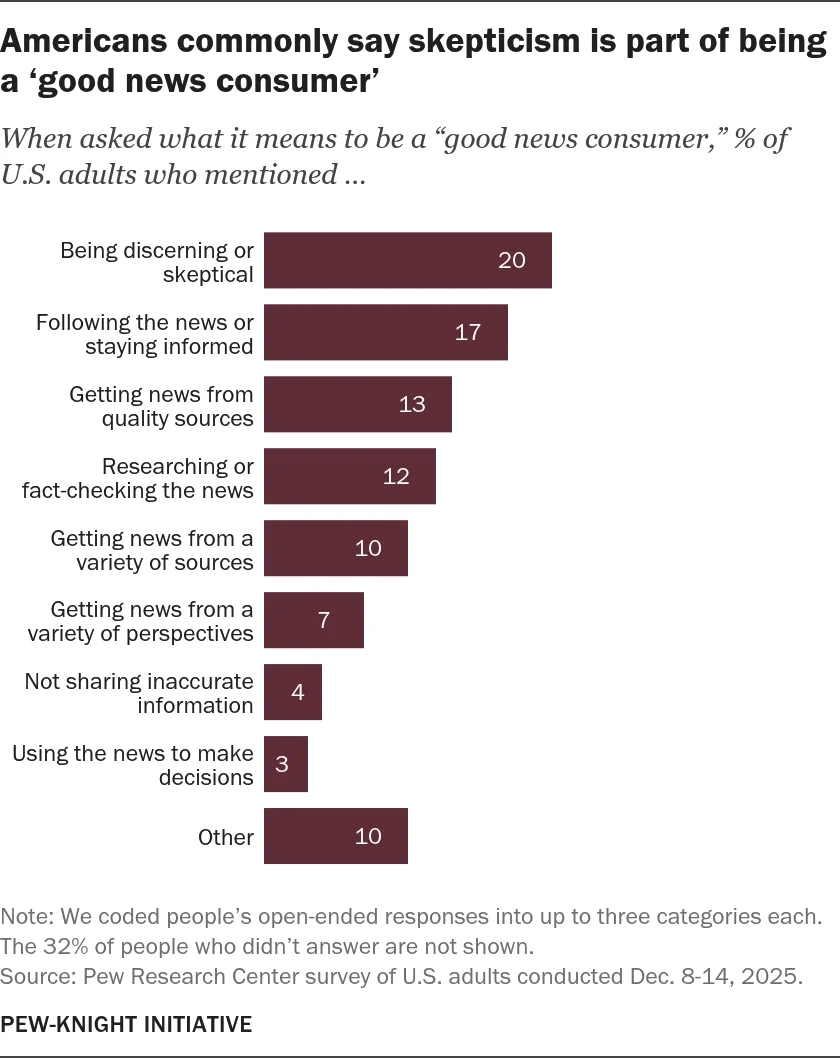
The Pew Research Center’s survey, which involved 3,560 U.S. adults surveyed from December 8-14, 2025, revealed that the concept of a "good news consumer" is multifaceted. Responses to an open-ended question about this definition were manually categorized into several key themes, reflecting the varied approaches Americans take to staying informed.
The Primacy of Skepticism and Discernment
A significant finding is the prominent emphasis Americans place on skepticism and critical thinking. Twenty percent of respondents highlighted the importance of being discerning or skeptical when consuming news. This sentiment was often expressed through phrases like "taking things with a grain of salt" and the cautionary advice, "don’t believe everything you hear." Concerns about "propaganda" also emerged, indicating a heightened awareness of potential manipulation within the information ecosystem.
Further underscoring this point, an additional 12% of respondents emphasized the need for active research and fact-checking. This involves a proactive approach to verifying information, which can include consulting multiple sources, conducting online searches, and critically evaluating the claims made by news organizations and official entities. The survey also revealed that a substantial majority of Americans—82%—report engaging in some form of personal research to verify news accuracy at least occasionally. This suggests a widespread recognition of the need for individual diligence in an era where misinformation can spread rapidly.
The Value of Consistent Engagement
Another frequently cited characteristic of a good news consumer is the commitment to staying informed regularly. Seventeen percent of participants indicated that following the news on a daily basis or making an effort to stay abreast of current events is crucial. This emphasis on consistent engagement aligns with the understanding that staying informed is an ongoing process, not a sporadic endeavor.
However, the importance placed on regular news consumption appears to be influenced by age. While approximately half of all U.S. adults (47%) consider it extremely or very important to receive news regularly, this view is less prevalent among younger adults. This finding resonates with broader trends in news consumption, where a significant portion of the population, particularly younger demographics, encounters news incidentally rather than actively seeking it out. This shift towards passive news discovery presents ongoing challenges for news organizations aiming to cultivate an engaged and informed citizenry.
Evaluating the Credibility of Sources
A discerning news consumer, according to 13% of respondents, actively evaluates the quality and credibility of their news sources. This involves seeking out reputable news outlets and those perceived as having high standards for reporting, accuracy, fairness, and balance. The challenge, as highlighted by the research, is the highly polarized nature of trust in news sources. Political affiliation significantly influences perceptions of which outlets are trustworthy, and no single news organization is widely trusted across the U.S. adult population. This fragmentation of trust complicates the pursuit of objective and reliable information for many Americans.
The Importance of Breadth and Diversity in Information Intake
In light of the varying levels of trust in individual news outlets, it is logical that a substantial segment of Americans—10%—identified consuming news from a variety of sources as a hallmark of a good news consumer. This perspective emphasizes the benefit of cross-referencing information from multiple platforms and formats to gain a more comprehensive understanding of events.
Focus group discussions conducted as part of this study provided further qualitative insights into this theme. Participants frequently articulated the need to "double-check, verify, gather news from multiple types of media and from multiple sources, and then draw your own conclusion." This process of synthesizing information from diverse origins is seen as essential for forming an informed opinion.
Furthermore, a related but distinct perspective, cited by 7% of respondents, focuses on the importance of accessing a variety of viewpoints. This involves actively seeking out different sides of an issue to avoid confirmation bias and to develop a more nuanced understanding of complex topics. The aspiration is to gather facts from a broad spectrum of perspectives, ensuring that one’s understanding is not limited to a single narrative.
Post-Consumption Responsibilities
While the majority of responses centered on the intake and processing of news, a smaller but significant portion of Americans highlighted actions taken after consuming news. Four percent of respondents emphasized the responsibility of not sharing inaccurate information. This reflects a growing awareness of the viral nature of misinformation on social media and the ethical obligation to ensure accuracy before disseminating content. Comments like "make sure you get everything right before you post something" illustrate this sentiment.
Focus group participants also shared personal anecdotes about the consequences of sharing information without adequate verification, acknowledging past habits of sharing content without fully reviewing it. This points to a developing understanding of the digital footprint and the impact of individual sharing practices on the broader information environment.
Additionally, 3% of respondents indicated that a good news consumer utilizes news to inform their decision-making and personal development. This includes being well-informed for civic duties, such as voting. The ability to make informed choices about representation was specifically cited as a key outcome of effective news consumption.
Broader Context and Implications: Navigating the Information Age
The findings of this Pew Research Center study are particularly relevant given the ongoing transformations in the media landscape. The rise of artificial intelligence, for instance, is poised to further complicate the production and consumption of news. While AI offers potential benefits in terms of content generation and personalization, it also raises concerns about the creation of sophisticated deepfakes, the amplification of misinformation, and the potential displacement of human journalists. The research on what Americans consider a "good news consumer" provides a baseline understanding of public expectations and responsibilities in this rapidly evolving technological environment.
The stark political divides in news consumption, as documented in previous Pew Research Center studies, also underscore the challenges highlighted in this report. When individuals primarily consume news that aligns with their existing political beliefs, the ability to engage with diverse perspectives and critically evaluate information can be compromised. This creates echo chambers and filter bubbles, further entrenching partisan divides and hindering productive public discourse.
The Pew-Knight Initiative’s ongoing work aims to shed light on these complex issues. By understanding how Americans conceptualize responsible news consumption, researchers and policymakers can better develop strategies to foster media literacy, promote critical thinking skills, and support a more informed and engaged citizenry. The findings suggest a public that is increasingly aware of the challenges and eager to equip themselves with the tools to navigate the modern information environment, albeit with a wide range of approaches and priorities.
Methodology: A Rigorous Approach to Understanding Public Opinion
The insights presented in this report are derived from a robust research methodology employed by the Pew Research Center. The primary data source is a survey of 3,560 U.S. adults conducted online from December 8 to 14, 2025. Participants were members of the Pew Research Center’s American Trends Panel, a nationally representative survey panel designed to reflect the views of the full U.S. adult population.
To gain a deeper, qualitative understanding of the issues, the research team also conducted nine online focus group discussions with 45 U.S. adults between June 10 and June 18, 2025. While these focus groups do not represent the entire U.S. population, they provide valuable context and illustrative quotes that enhance the interpretation of the survey data. Quotes from the focus groups were lightly edited for clarity, spelling, and punctuation.
The analysis involved categorizing the 2,563 open-ended responses from the survey into distinct themes. The research team also provided links to the survey questionnaire, detailed topline responses, and the full methodology for transparency and further inquiry. This multi-method approach ensures a comprehensive and nuanced understanding of Americans’ perceptions of what constitutes a good news consumer in the contemporary media landscape.
The Pew-Knight Initiative, funded by The Pew Charitable Trusts and the John S. and James L. Knight Foundation, continues to be a vital resource for understanding the evolving relationship between Americans, their news, and their communities. This latest research offers a critical snapshot of public sentiment, informing ongoing efforts to support a healthy and functioning information ecosystem.