Artificial intelligence (AI) has transitioned from a speculative future concept to a pervasive force reshaping diverse sectors, from the intricacies of medicine and the evolving landscape of work to the creative frontiers of entertainment. This profound integration of AI into daily life is mirrored by a significant surge in public engagement, with Americans increasingly adopting AI-powered tools like chatbots and smart home devices. A comprehensive new survey by the Pew Research Center reveals that approximately half of U.S. adults now utilize AI chatbots, a notable increase from previous years, underscoring AI’s accelerating presence in the American household and consciousness.
The Pew Research Center’s latest investigation into Americans’ relationship with artificial intelligence aims to provide a granular understanding of AI adoption, usage patterns, and public sentiment. The study delves into the growing prevalence of chatbots, such as ChatGPT, Gemini, and Copilot, and the integration of AI features into smart home devices, including smartwatches and voice assistants. Furthermore, it probes public perceptions regarding the broader societal and personal implications of AI, capturing a snapshot of American attitudes towards this transformative technology.
The Rise of AI Chatbots: Adoption and Application
The data indicates a substantial uptick in the use of AI chatbots. In 2024, only a third of U.S. adults reported having ever used an AI chatbot. By early 2026, this figure has climbed to 49%, with nearly half of all American adults now engaging with these sophisticated conversational AI tools. This rapid adoption rate suggests that AI chatbots are rapidly moving from novelty to mainstream utility.
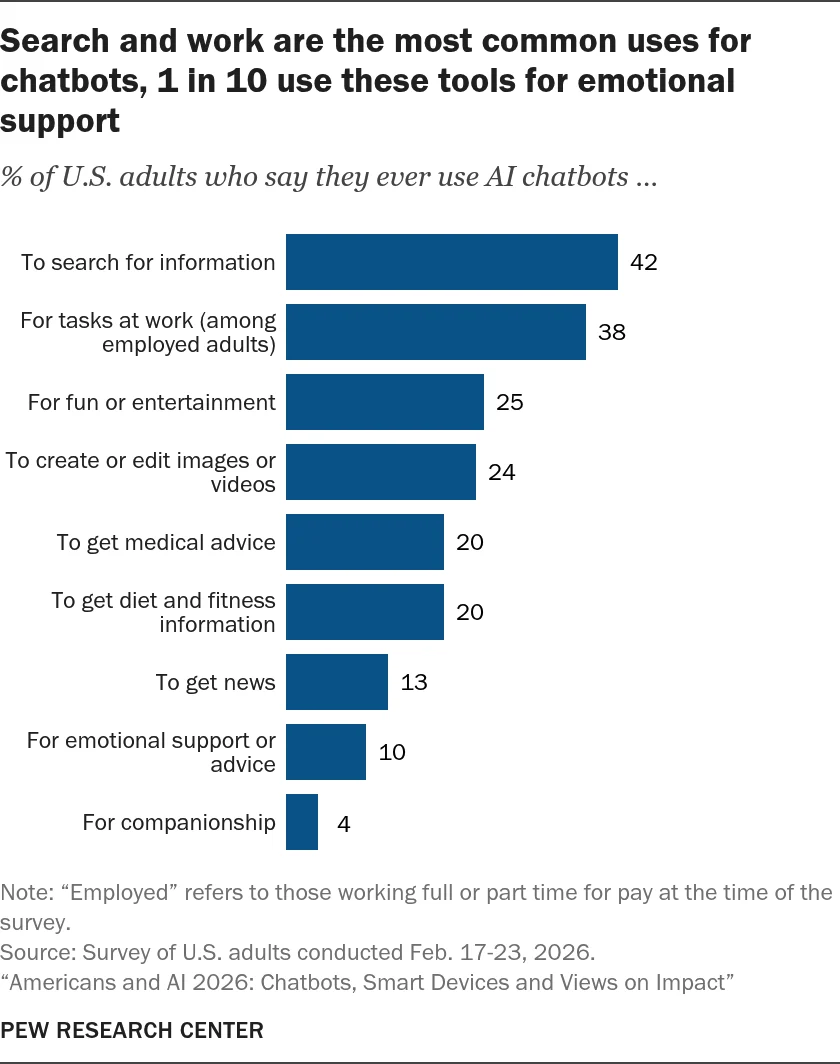
The applications of these AI chatbots are as varied as the users themselves. The survey highlights that "searching for information" is the most common reason Americans turn to chatbots, cited by 42% of users. This practical application underscores the utility of AI in navigating the vast digital information landscape. Following closely, 38% of employed adults report using chatbots for "tasks at work," signaling AI’s growing role in professional productivity and efficiency.

Beyond informational and work-related uses, AI chatbots are also finding their way into personal and creative domains. A quarter of users (25%) employ them for "fun or entertainment," while 24% leverage them for "creating or editing images or videos," indicating a burgeoning use in creative endeavors. The use of AI for health-related queries is also significant, with 20% seeking "medical advice" and another 20% using them for "diet and fitness information." While the reliability of AI for medical advice remains a subject of ongoing discussion and caution, its use in this domain reflects a growing reliance on digital tools for health information.
Interestingly, 13% of users report using chatbots to "get news," a trend that raises questions about the future of news consumption and the potential for AI to shape information diets. In a more sensitive area, 10% of users turn to chatbots for "emotional support or advice," and a smaller but notable 4% use them for "companionship." These figures point to a complex evolution in how individuals seek connection and emotional well-being, with AI tools beginning to play a role, albeit a controversial one, in these deeply human aspects of life.
Frequency of Chatbot Engagement

The frequency with which Americans engage with AI chatbots reveals a spectrum of usage. Approximately a quarter of U.S. adults (24%) report using chatbots on a daily basis, a significant commitment to integrating these tools into their routine. This daily usage breaks down further: 12% use them several times a day, and 4% use them almost constantly, indicating a high level of reliance for some users.
Another quarter of adults (25%) use chatbots several times a week or less, suggesting occasional but consistent engagement. However, a substantial portion of the population, 51%, still does not use AI chatbots at all, indicating that while adoption is growing, it has not yet reached universal penetration.
Dominance of ChatGPT and Emerging Competitors

Since its public debut in late 2022, ChatGPT has been a dominant force in the AI chatbot landscape. The Pew Research Center’s data shows a dramatic increase in its adoption. In 2023, only 18% of U.S. adults reported using ChatGPT. By 2025, this figure had risen to 34%, and in early 2026, it stands at 44%. This represents more than a doubling of its user base since the initial survey in 2023.
While ChatGPT continues to lead, other chatbots are gaining traction. Google’s Gemini is used by 24% of U.S. adults, followed by Microsoft’s Copilot at 17%, and Meta AI at 14%. Smaller but still significant shares use Grok (8%), Claude (6%), and Character.ai (3%). The increasing diversity of available chatbots suggests a maturing market, offering users a range of functionalities and specializations.
Demographic analyses reveal significant age-related differences in AI chatbot usage. Adults under 50 are approximately twice as likely to report using ChatGPT compared to those aged 50 and older (57% vs. 28%). This disparity highlights a generational divide in the adoption and integration of AI technologies, likely influenced by factors such as digital literacy, early exposure, and perceived relevance.

AI-Enabled Smart Devices: Integration into Daily Life
Beyond chatbots, AI is increasingly embedded in a variety of smart devices that have become commonplace in American households. These devices offer convenience and new forms of human-computer interaction, but also raise important questions about data privacy and security.
Smartwatches, such as Apple Watches and Google Pixel Watches, are a notable example. Approximately 37% of U.S. adults report owning a smartwatch, while a majority (61%) do not. This indicates a significant, though not yet majority, adoption rate for wearable AI-powered technology.

Smart home devices represent another frontier of AI integration. Roughly one-third of U.S. adults (35%) report owning a smart speaker, like Amazon Echo or Apple HomePod, making it the most common type of AI-enabled smart home device surveyed. Other smart home devices with AI capabilities are less prevalent but still represent a notable segment of the market. About 18% of U.S. adults have a smart doorbell, such as a Ring device, offering features like motion detection and remote viewing. Robot vacuums with AI functionality are owned by 13% of adults, and 11% have smart thermostats that can learn user preferences and optimize energy usage.
AI Search Summaries: A New Information Paradigm
The way Americans consume information is also being reshaped by AI, particularly through AI-generated summaries that appear at the top of search engine results. A substantial majority of U.S. adults, 60%, report reading these AI summaries. This widespread adoption suggests that AI is fundamentally altering how people access and process information online.

However, 30% of adults state they do not read these summaries, and 10% are unsure. This division in usage patterns could lead to differing levels of information intake and comprehension among the populace, potentially creating new forms of information disparity.
Public Perception: Navigating the Impact of AI
As AI technology continues its rapid advancement, public sentiment is a critical barometer of its societal integration. The Pew Research Center’s findings reveal a complex mix of optimism and apprehension regarding AI’s future impact.

Productivity, Creativity, and Well-being: Americans are more inclined to believe that AI chatbots enhance their productivity and knowledge than hinder them. Thirty percent of U.S. adults feel chatbots help their productivity, and a similar percentage (28%) believe they help them stay informed. In terms of creativity, 21% report that chatbots aid their creative processes, compared to 11% who feel they detract from it.
However, the impact on personal well-being is viewed more cautiously. Only 8% of adults believe chatbots improve their happiness, while 5% feel they decrease it. Similarly, for relationships, a mere 6% believe chatbots help, while 7% feel they hurt. In both these areas, a significant portion of respondents feel chatbots neither help nor hurt, suggesting a perceived neutrality or lack of substantial impact on these personal dimensions for the majority.
Societal and Personal Impact Over the Next Two Decades: Looking ahead, American views on AI’s long-term impact are tinged with more concern than optimism. Forty percent of U.S. adults predict that AI will have a negative impact on society over the next 20 years, while only 16% anticipate a positive impact. A substantial 31% foresee an equally positive and negative effect, indicating a widespread ambivalence or recognition of AI’s dual nature.

On a personal level, the outlook is slightly more positive but still leans towards caution. Thirty-one percent expect AI to have a negative impact on their own lives, whereas 23% anticipate a positive impact. Again, a considerable 27% believe the impact will be equally positive and negative. These figures underscore a public consciousness aware of both the potential benefits and risks of AI.
Generational Perspectives: Notably, younger adults, while being more frequent users of AI, are not necessarily more optimistic about its impact. Adults under 30 are more likely than older adults to express concern about AI’s negative effects on society and their personal lives. Specifically, 48% of those aged 18-29 believe AI will negatively impact society, compared to 37% of those 50 and older. On a personal level, 37% of younger adults fear a negative impact, versus 28% of older adults. This suggests that increased exposure does not automatically translate to greater optimism, and perhaps even fuels greater awareness of potential downsides.
Pace of AI Advancement and Data Security Concerns: A significant majority of Americans, 63%, believe that AI is advancing "too quickly." Only 19% feel it is progressing at the "right pace," and a mere 2% think it is moving "too slowly." This sentiment indicates a public desire for more measured and perhaps more controlled development of AI technologies.

Compounding these concerns are deep-seated worries about data security. A striking 71% of U.S. adults believe that the increased use of AI will make their personal information "less secure." Only 3% feel it will make their information more secure, while 10% believe it will make no significant difference. This widespread apprehension about data privacy in the age of AI suggests a critical need for robust security measures and transparent data handling practices.
Regulation and Corporate Responsibility: Trust and Skepticism
The public’s apprehension about AI’s rapid development and data security implications extends to their views on oversight and ethical development. Majorities express a lack of confidence in both governmental and corporate efforts to manage AI effectively.

Government Regulation: Confidence in the U.S. government’s ability to regulate AI effectively is low, with 67% of adults expressing "not too much or no confidence." This sentiment has seen a slight increase since 2024, when 62% shared this view.
A significant partisan divide exists regarding government regulation. In 2026, 74% of Democrats and Democratic-leaning independents express low confidence, a notable increase from 54% in 2024. Conversely, confidence among Republicans and Republican-leaning independents has slightly decreased, with 61% expressing low confidence in 2026, down from 70% in 2024. This represents a notable shift, with Democrats now expressing greater skepticism about government oversight than Republicans.
Corporate Responsibility: Similar levels of skepticism are directed towards the private sector. Fifty-nine percent of U.S. adults lack confidence in U.S. companies to develop and use AI responsibly. This figure has remained relatively stable since 2024. However, partisan differences have emerged. In 2026, 65% of Democrats express low confidence in companies’ responsible AI development, up from 59% in 2024. In contrast, confidence among Republicans has declined, with 53% expressing low confidence in 2026, down from 60% in 2024. This indicates a growing divergence in how each party perceives corporate accountability in the AI sphere.

Conclusion
The Pew Research Center’s 2026 survey paints a vivid picture of an American public increasingly engaged with artificial intelligence, yet also grappling with its profound implications. The widespread adoption of AI chatbots and smart devices signals a new era of technological integration, offering tangible benefits in information access, work efficiency, and daily convenience. However, this embrace is tempered by significant public concerns regarding the speed of AI development, its potential negative impacts on society and personal lives, data security, and the adequacy of regulatory and corporate oversight. As AI continues to evolve at an unprecedented pace, understanding these nuanced public perceptions will be crucial for navigating its responsible development and ensuring its benefits are broadly shared while its risks are effectively mitigated. The data suggests a society at a critical juncture, where the promise of AI must be carefully balanced with the imperative for caution, ethical consideration, and robust governance.