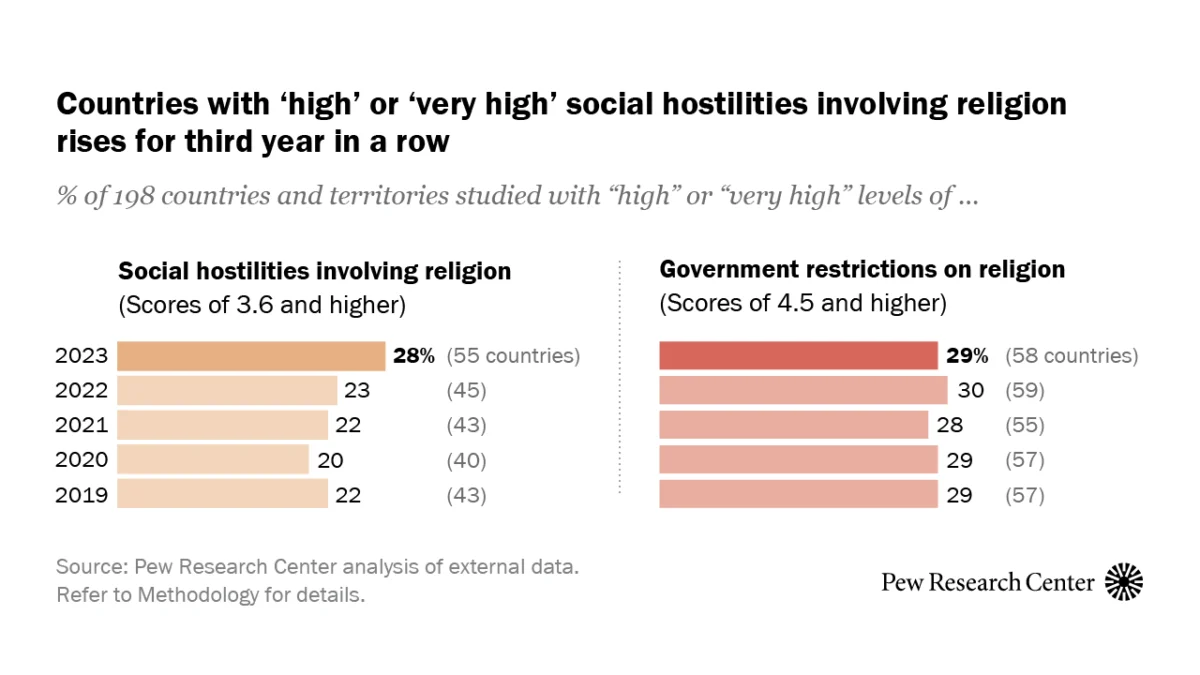
In 2023, sub-Saharan Africa stood as a notable exception to a global trend of increasing government restrictions and social hostilities related to religion. It was the sole major region worldwide where median levels of both governmental restrictions and social hostilities involving religion saw a decrease. This finding emerges from the Pew Research Center’s 16th annual report, which meticulously analyzes the landscape of religious freedom across 198 countries and territories. The report utilizes two distinct indexes: the Government Restrictions Index (GRI) and the Social Hostilities Index (SHI), each encompassing a comprehensive set of indicators derived from publicly available and widely cited sources.
The research methodology employed by the Pew Research Center is robust, involving an annual review of information from esteemed sources such as the U.S. State Department, the U.S. Commission on International Religious Freedom, the United Nations, and leading independent non-governmental organizations including Freedom House, Amnesty International, and Human Rights Watch. This commitment to diverse and credible data ensures a comprehensive and nuanced understanding of the complex interplay between government policies, societal attitudes, and religious freedom globally.
This particular analysis was produced as part of the Pew-Templeton Global Religious Futures project, an initiative dedicated to examining religious change and its societal impacts worldwide. Funding for this project is provided by The Pew Charitable Trusts and the John Templeton Foundation.
Regional Divergence in Religious Freedom Trends
While sub-Saharan Africa experienced a welcome decline in both governmental restrictions and social hostilities, the same cannot be said for other major global regions. In stark contrast, Europe, Asia and the Pacific, and the Middle East and North Africa all witnessed an increase in median levels of both government restrictions and social hostilities. The Americas, the fourth major region studied, presented a mixed picture: median government restrictions remained stable, while social hostilities saw a slight upward tick.
Globally, the overall median scores for all 198 countries and territories across the five regions remained steady for the third consecutive year. The Government Restrictions Index (GRI) held at 3.0 out of a possible 10, and the Social Hostilities Index (SHI) remained at 1.6 out of 10. The GRI is designed to capture 20 indicators of how government officials, laws, and policies impinge upon religious freedom. The SHI, conversely, focuses on 13 indicators of religious hostilities perpetrated by private individuals, groups, and organizations, including terrorist entities.
Government Restrictions on Religion: A Growing Concern in Key Regions

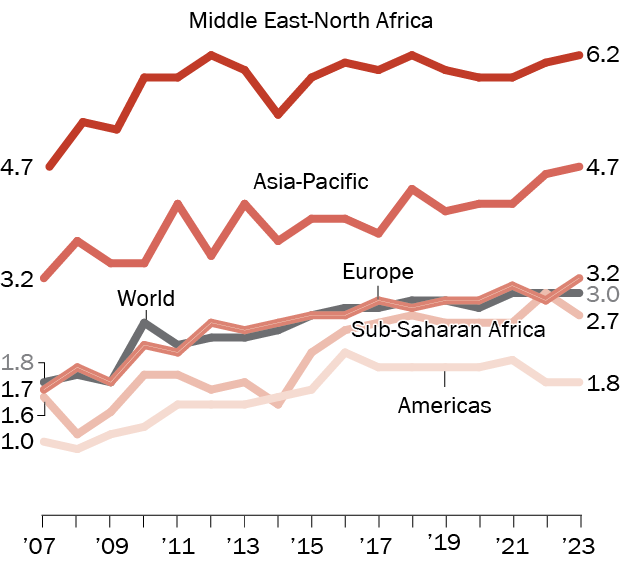
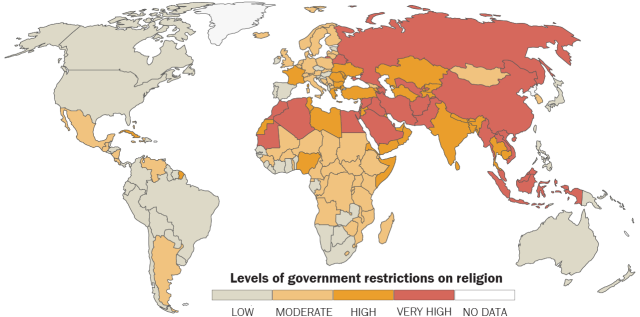
The report highlights a concerning trend in several regions regarding government restrictions on religion. For the first time since the study’s inception in 2007, median GRI scores in Europe, the Asia-Pacific region, and the Middle East-North Africa region reached or surpassed their previous highs.
Middle East and North Africa: Persistent High Levels of Restriction
The Middle East and North Africa region continued to exhibit the highest median GRI scores globally, with a slight increase from 6.1 in 2022 to 6.2 in 2023. This score is on par with previous peaks observed in 2012 and 2018, indicating a sustained environment of governmental control over religious practices. A significant contributing factor to this elevated score is the widespread nature of government harassment. In 2023, all 20 countries within this region reported at least one instance of government harassment of religious groups, encompassing both verbal and physical intimidation, according to the study’s sources.
Furthermore, the region saw an increase in restrictions related to religious attire. In 2023, ten countries imposed such restrictions, up from eight in 2022. For instance, Jordan reportedly hindered Jewish travelers at border crossings if their attire revealed their religious affiliation. One specific account cited a traveler being denied entry for refusing to conceal side curls, a common practice among some Orthodox Jewish men. Jordanian authorities allegedly advised other travelers that displaying religious identifiers like a kippah (skullcap) could be unsafe.
Morocco, while not a new development, maintained its 2017 ban on the import, production, and sale of burqas, citing security reasons for identification purposes. This policy, impacting women’s religious dress, was extended to security forces and public service roles, although private individuals could still wear them.
Asia-Pacific: Reaching New Heights of Restriction
The Asia-Pacific region, encompassing 50 countries and territories, recorded its highest median GRI score since 2007, rising from 4.6 in 2022 to 4.7 in 2023. This region includes nations with some of the world’s highest GRI scores, such as China, Iran, Afghanistan, and Indonesia.
In 2023, nine countries in this region actively sought to eliminate the presence of specific religious groups. Vietnam, for example, reportedly pressured followers of Duong Van Minh, predominantly from the ethnic Hmong community, to renounce their faith through intimidation and harassment. Following the death and funeral of Duong Van Minh in 2021, authorities allegedly entered followers’ homes, destroying their altars. By 2023, the Vietnamese government claimed to have eradicated the "Duong Van Minh evil-way religion’s influence" in several provinces.
Myanmar’s military continued its targeted actions against Rohingya Muslims, a campaign previously described as genocide and crimes against humanity by international bodies and governments, including the U.S. State Department.
The region also experienced an increase in government harassment of religious groups, with 46 countries reporting such incidents in 2023, up from 44 in 2022. Additionally, the number of countries where governments used violence against religious minorities rose from 26 to 28.
Europe: A Significant Rise in Restrictions
Europe’s median GRI score also climbed, from 2.9 in 2022 to 3.2 in 2023, marking the highest median score since the study’s commencement in 2007. This increase is partly attributed to a rise in the number of European countries where governments reportedly failed to protect religious groups or provide redress for religious discrimination, jumping from 16 countries in 2022 to 24 in 2023.
In Norway, leaders of the Jewish community expressed frustration over inadequate police responses to harassment incidents and a reluctance to prosecute under antisemitism or hate crime statutes. Similarly, in Germany, Jehovah’s Witnesses reported that authorities allegedly did not take hate crimes against their proselytizing activities seriously, with police reportedly showing little interest in investigating their complaints.
More than half of the countries in Europe (25 out of 45) reported incidents of physical harassment by governments against religious groups, an increase from 22 countries in 2022.
Sub-Saharan Africa and the Americas: A Contrasting Landscape
In contrast to the escalating trends elsewhere, sub-Saharan Africa’s median GRI score declined from 3.0 in 2022 to 2.7 in 2023. This decrease was partly due to a reduction in the number of countries experiencing physical harassment by governments against religious groups, falling from 30 to 26.
The Americas region maintained a stable median GRI score of 1.8 out of 10 between 2022 and 2023, the lowest among all five regions studied. This stability suggests a consistent, albeit low, level of governmental interference with religious freedom in the region.
Social Hostilities: A Widespread Concern
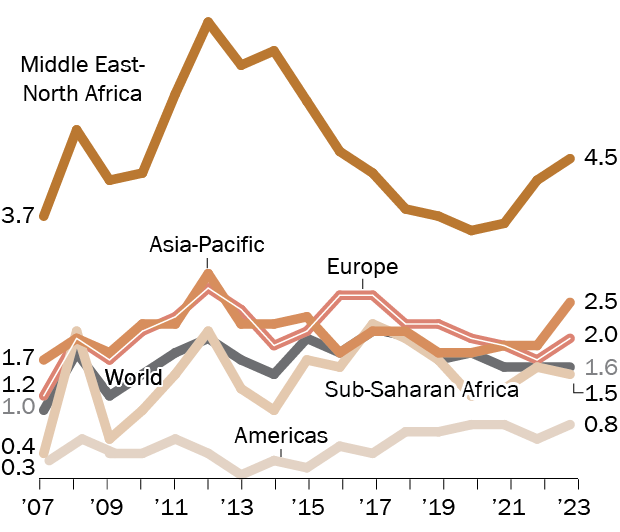
While sub-Saharan Africa saw a decrease in social hostilities, four other major regions experienced an increase in 2023: the Americas, Asia-Pacific, Europe, and the Middle East-North Africa region.
Middle East-North Africa: Escalating Mob Violence
The median SHI score in the Middle East and North Africa rose to 4.5 in 2023, up from 4.2 in 2022. This rise was significantly influenced by an increase in mob violence related to religion, with seven countries experiencing such incidents, compared to only two in the previous year.
A particularly concerning instance occurred in the Palestinian territories, where an attack by a Palestinian gunman on individuals from the Jewish settlement of Har Bracha was followed by retaliation from approximately 400 Israeli settlers who attacked the Palestinian town of Huwara. This resulted in casualties, injuries, and property destruction. Both incidents, occurring in the West Bank, were categorized as social hostilities due to their religious and ethno-religious dimensions.
In Tunisia, the historic El Hamma Synagogue was targeted by hundreds of rioters who set fire to the building and vandalized it with graffiti, reportedly in protest of a hospital bombing in Gaza. Authorities had not made arrests in connection with this attack by year’s end.
Asia-Pacific: A Significant Surge in Hostilities
The Asia-Pacific region witnessed a substantial increase in social hostilities, with its median SHI score climbing from 1.9 in 2022 to 2.5 in 2023. This is the second-highest score recorded for the region since 2007, surpassed only by a peak of 2.9 in 2012.
The number of countries experiencing mob violence against religious groups in the Asia-Pacific region more than doubled, from three in 2022 to eight in 2023. In Sri Lanka, violent clashes erupted at the disputed Kurunthoormalai archaeological site, claimed by both Buddhists and Hindus. Sinhalese protesters, including Buddhist monks, attempted to halt a Hindu ceremony, leading to police intervention.
Armenia also reported mob violence against Jehovah’s Witnesses, with a large group of protesters attempting to disrupt a regional meeting by blasting noise and throwing objects at attendees.
Europe: Terrorist Activity on the Rise
Europe’s median SHI score increased from 1.7 in 2022 to 2.0 in 2023. This rise was partly fueled by an increase in religion-related terrorist activity, with five more countries experiencing such incidents compared to the previous year, though these typically involved fewer than three casualties.
In Belgium, a Tunisian national fatally shot two Swedish citizens and injured another at a soccer match, claiming allegiance to the Islamic State (ISIS) and citing Quran burnings in Sweden as motivation. In France, an individual attacked a tourist near the Eiffel Tower, claiming revenge for events in Gaza and the killing of Muslims in Afghanistan, and reportedly pledging allegiance to ISIS. These attacks are categorized as religion-related if perpetrators target a religious group or claim religious motivations.
The Americas: Persistent Low Levels, Emerging Concerns
The median SHI score for the Americas saw a modest increase from 0.6 to 0.8, matching previous peaks in 2020 and 2021. Despite this increase, the Americas continues to have the lowest median score among all regions. The rise is partly attributed to an increase in countries where religious groups were involved in or funded "conversion therapy" programs that employed violence to coerce individuals into heterosexual behavior. In Guatemala, for instance, reports indicated that conversion therapy centers, partly funded by evangelical churches, used tactics such as electroshock therapy and coerced sexual acts against LGBTQ+ individuals.
Sub-Saharan Africa: A Solitary Decline
Sub-Saharan Africa was the only region to experience a decline in median social hostilities, with its SHI score dropping slightly from 1.6 to 1.5. This region was unique in showing decreases in both the GRI and SHI. However, it still contained the country with the world’s highest SHI score: Nigeria, which recorded 9.0 in 2023, up from 8.7 the previous year.
Nigeria experienced a rise in deaths from attacks by militant groups like Boko Haram and ISIS-West Africa, which targeted both Christians and Muslims. Violent clashes between predominantly Muslim herders and Christian farmers over land and resources also had an ethno-religious component. Furthermore, Nigerian bandits and criminal gangs engaged in attacks against religious groups.
The Pew Research Center’s annual report serves as a critical barometer for understanding the global state of religious freedom, highlighting regional disparities and evolving challenges faced by religious communities worldwide.