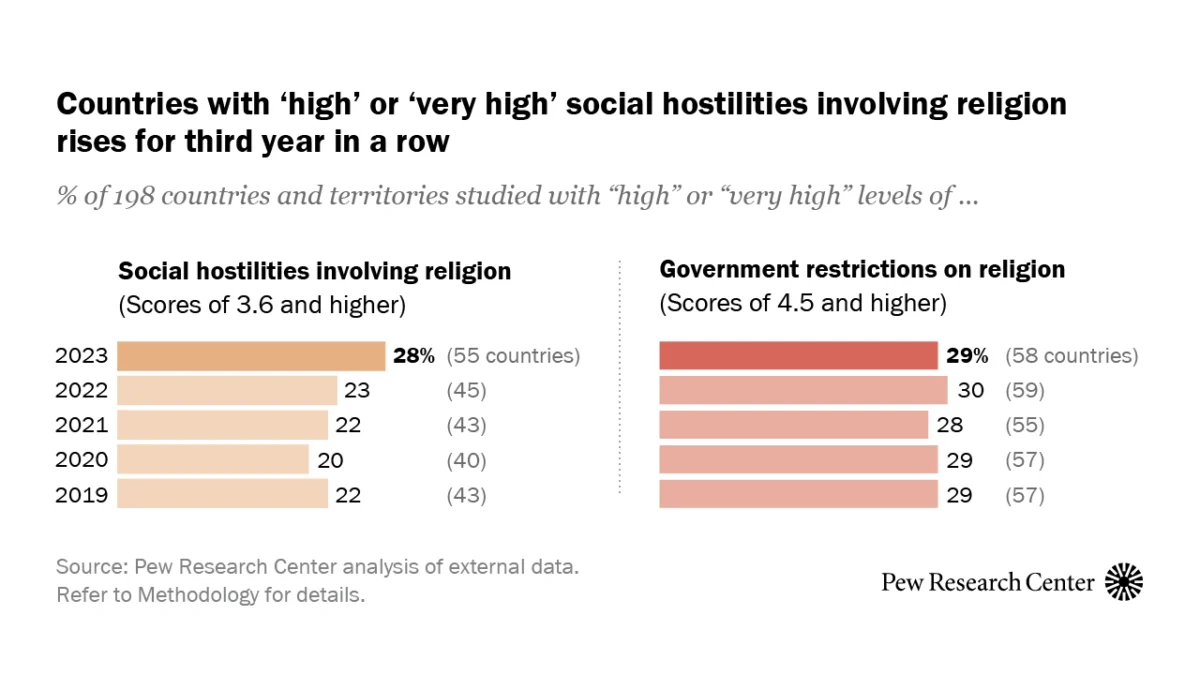
A comprehensive new report from the Pew Research Center, a subsidiary of The Pew Charitable Trusts, reveals a concerning global trend: an increase in the number of countries experiencing elevated levels of social hostilities involving religion in 2023. This finding emerges from the Pew-Templeton Global Religious Futures project, a multi-year initiative dedicated to analyzing religious change and its profound impact on societies worldwide. The project receives vital funding from The Pew Charitable Trusts and the John Templeton Foundation (grant 63095).
The report, meticulously compiled and analyzed by a dedicated team of researchers, coders, and editorial staff, paints a complex picture of the state of religious freedom and social harmony across the globe. While specific details of the "elevated levels" are to be elaborated upon in the full report, the overarching conclusion signifies a growing challenge in fostering interfaith understanding and peaceful coexistence in numerous nations. This analysis delves into the potential drivers behind this rise, contextualizes it within historical trends, and explores the multifaceted implications for global stability and human rights.
Understanding Social Hostilities Involving Religion
Social hostilities involving religion, as defined by the Pew Research Center’s methodology, encompass a range of actions and attitudes that express animosity or discrimination towards religious groups. These can include everything from verbal abuse and discrimination in employment or housing to more severe manifestations such as mob violence, religiously motivated vandalism, and government-imposed restrictions on religious practices. The Pew Research Center’s framework for measuring these hostilities typically involves analyzing government policies, societal attitudes, and incidents of religiously motivated conflict reported in reputable sources.
The increase in countries experiencing elevated levels suggests a widening of these adverse conditions, impacting a greater proportion of the global population. This escalation can be attributed to a confluence of factors, including rising nationalism, the weaponization of religious identity for political gain, economic anxieties that can fuel scapegoating, and the pervasive influence of misinformation and hate speech amplified by digital platforms.
A Chronology of Rising Tensions
While the report specifically focuses on 2023, the trend it identifies is not entirely new. For years, various international bodies and human rights organizations have documented the growing pressures faced by religious minorities and communities in different parts of the world.
- Early 2000s: Following significant global events, a rise in religiously motivated extremism began to manifest, leading to increased scrutiny and, in some cases, repression of certain religious groups by governments concerned about security.
- 2010s: The refugee crisis and accompanying political shifts in several regions contributed to an uptick in anti-immigrant sentiment, often intertwined with religious prejudice. The rise of social media also played a role in the rapid dissemination of divisive narratives.
- Late 2010s – Early 2020s: Geopolitical instability, coupled with economic downturns in certain areas, exacerbated existing societal fault lines. Reports from organizations like the United Nations and various NGOs highlighted increasing restrictions on religious freedom and instances of religiously motivated violence in several countries.
- 2023: The year in focus for the Pew report. The specific data for 2023, to be detailed further, indicates a statistically significant increase in the number of nations where social hostilities involving religion reached a critical threshold. This suggests that the underlying causes that have been simmering for years may have reached a tipping point in a greater number of countries.
Supporting Data and Regional Focus
The Pew Research Center’s Global Religious Futures project has a history of producing in-depth analyses of religious demographics and trends. While the specific data points for the 2023 report are not fully detailed in the introductory material, previous Pew research provides a strong foundation for understanding the scope of these issues. For instance, earlier analyses have highlighted:
- Government Restrictions on Religion: A significant percentage of the world’s population lives in countries with high levels of government restrictions on religious practice. This can range from outright bans on certain faiths to bureaucratic hurdles that impede religious organizations.
- Social Hostilities: Similar to government restrictions, a substantial portion of the global population experiences high levels of social hostilities. This includes everyday discrimination, harassment, and violence.
- Regional Variations: Historically, regions such as the Middle East and North Africa, South Asia, and parts of sub-Saharan Africa have been identified as areas with particularly high levels of both government restrictions and social hostilities. The 2023 report’s findings likely build upon and potentially expand these areas of concern.
The report’s methodology is crucial for understanding its conclusions. The Pew Research Center typically employs a rigorous quantitative approach, analyzing a wide array of data points collected from government reports, academic studies, news media, and non-governmental organizations. This allows for a standardized and comparable assessment across diverse national contexts. The "elevated levels" likely signify that a country has surpassed a predefined threshold of incidents and severity, indicating a concerning environment for religious freedom and interfaith relations.
Potential Drivers and Contributing Factors
The rise in social hostilities involving religion is a complex phenomenon with multifaceted causes. Several key drivers are likely at play in the countries experiencing this escalation:
- Rise of Populism and Nationalism: In many parts of the world, populist and nationalist movements have gained traction, often emphasizing a singular national identity that can marginalize religious minorities. This can lead to policies and rhetoric that favor the majority religion or ethnic group, fostering an environment of exclusion for others.
- Political Polarization and Identity Politics: Increased political polarization often leads to the entrenchment of identity politics, where religious affiliation can become a primary marker of political allegiance or opposition. This can inflame tensions and make compromise difficult.
- Economic Disparities and Scapegoating: Economic hardship and inequality can create fertile ground for scapegoating. Religious minorities are sometimes blamed for economic woes, leading to increased discrimination and hostility.
- Geopolitical Conflicts and Proxy Wars: Ongoing conflicts, particularly those with sectarian dimensions or where religious identity is exploited by external actors, can spill over into increased social hostilities within affected countries.
- Spread of Misinformation and Hate Speech: The digital age, while connecting people, has also facilitated the rapid spread of misinformation, conspiracy theories, and hate speech targeting religious groups. This can radicalize individuals and fuel real-world hostility.
- Weak Governance and Rule of Law: In countries where governance is weak, and the rule of law is not consistently applied, perpetrators of religious-based discrimination and violence may face little accountability, emboldening further hostilities.
Official Responses and International Reactions
While the Pew report itself is a product of research and analysis, the findings it presents are likely to elicit responses from various stakeholders. It is reasonable to infer that such a report would prompt reactions from:
- Governments: Those countries identified as having elevated levels of social hostilities may face international scrutiny and pressure to address the issues. Governments that are committed to religious freedom might use the report to advocate for policy changes or to highlight areas where they need support.
- International Organizations: Bodies such as the United Nations, its Human Rights Council, and various intergovernmental organizations focused on religious freedom are likely to take note of the findings. The report could inform their ongoing monitoring, reporting, and advocacy efforts.
- Religious Leaders and Organizations: Leaders of various faiths, particularly those representing minority groups, are likely to voice their concerns and call for greater protection and interfaith dialogue. Organizations dedicated to religious freedom advocacy will undoubtedly use the report to bolster their campaigns.
- Civil Society Groups: Non-governmental organizations working on human rights, religious freedom, and interfaith relations will likely integrate the report’s findings into their advocacy and educational programs.
Historically, reports of this nature have spurred calls for:
- Enhanced Protection of Religious Minorities: Governments are urged to implement stronger legal protections and enforcement mechanisms to safeguard religious minorities from discrimination and violence.
- Promotion of Interfaith Dialogue: Initiatives aimed at fostering understanding and cooperation between different religious communities are often emphasized as a crucial strategy for mitigating tensions.
- Combating Hate Speech and Misinformation: Efforts to counter the spread of divisive narratives, particularly online, are seen as essential for preventing radicalization and reducing hostility.
- Strengthening Governance and Rule of Law: Ensuring that legal frameworks are fair and that justice is applied equally to all citizens, regardless of their religious affiliation, is a fundamental requirement.
Broader Impact and Implications
The increase in countries experiencing elevated levels of social hostilities involving religion has significant implications for both national and international stability:
- Humanitarian Concerns: At its core, this trend represents a humanitarian crisis, impacting the safety, dignity, and fundamental rights of millions of individuals. It can lead to displacement, persecution, and the erosion of social cohesion.
- Threat to Global Peace and Security: Persistent religious tensions can destabilize regions, fuel extremism, and contribute to wider conflicts. This can have ripple effects on international relations and security.
- Economic Consequences: Societies marked by religious hostility often suffer from reduced investment, brain drain, and hampered economic development. Fear and instability deter both domestic and foreign economic activity.
- Erosion of Democratic Values: The suppression of religious freedom and the rise of religiously motivated discrimination are antithetical to the principles of democracy, pluralism, and human rights that underpin many modern societies.
- Challenges for International Cooperation: Addressing global challenges, from climate change to pandemics, requires a degree of international trust and cooperation. When countries are consumed by internal religious strife, their capacity to engage effectively on the global stage is diminished.
The Pew Research Center’s work, made possible by the Pew Charitable Trusts and the John Templeton Foundation, is crucial for shedding light on these complex issues. The detailed research, compiled by individuals such as Samirah Majumdar (Primary researcher), Alan Cooperman, Vivian Jacobs, and Anne Fengyan Shi (Research team), with the diligent efforts of coders like Jordan L. Carreiro and editorial contributions from Jeff Diamant and David Kent, provides the empirical basis for understanding and addressing the growing challenges to religious harmony worldwide. The communications and web publishing team, including Hannah Taber and Maya Pottiger, ensures these vital findings reach a broad audience.
As the world navigates an increasingly complex geopolitical landscape, the findings of this report serve as a stark reminder of the enduring importance of religious freedom, interfaith understanding, and the active pursuit of peaceful coexistence. The ongoing work of the Pew-Templeton Global Religious Futures project is indispensable for informing policy, guiding advocacy, and fostering a more informed global dialogue on these critical matters.
The recommended citation for this report is: Majumdar, Samirah and Vivian Jacobs. 2026. “More Countries Had Elevated Levels of Social Hostilities Involving Religion in 2023.” Pew Research Center. doi: 10.58094/cv0d-0488. Further related reports can be accessed on pewresearch.org/topic/religion/.