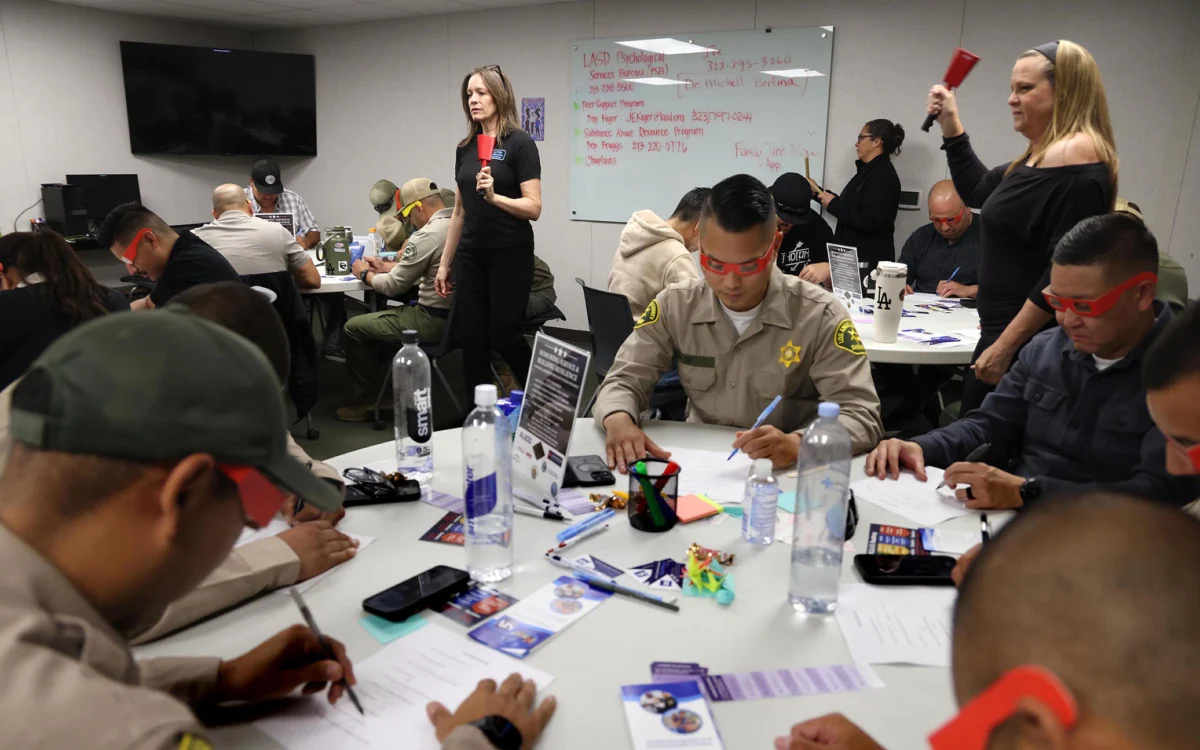
In a City of Industry classroom, Kate Movius, founder of the consultancy Autism Interaction Solutions, orchestrated an immersive experience for Los Angeles County sheriff’s deputies. The goal was to foster empathy and understanding for the sensory overwhelm that many individuals with Autism Spectrum Disorder (ASD) experience. Deputies were handed pop trivia quizzes and instructed to wear vision-distorting prism glasses while attempting to write with their nondominant hands. The environment was deliberately heightened with abrupt table pounding and random flashing of overhead lights, culminating in the jarring sound of a cowbell. This exercise aimed to simulate the sensory overload that can incapacitate individuals with autism, hindering their ability to process incoming stimuli.
"So what can you do to assist somebody, or de-escalate somebody, or get information from someone who suffers from a sensory disorder?" Movius posed to the disoriented deputies afterward. "We can minimize sensory input… That might be the difference between them being able to stay calm and them taking off." This hands-on approach is part of a growing movement across the United States to equip law enforcement agencies with the knowledge and tools necessary to recognize behaviors associated with autism and ensure that interactions with neurodevelopmentally diverse individuals conclude safely.
Equipping Officers with Essential Tools for Interaction
Following the sensory simulation, Movius, alongside City of Industry Mayor Cory Moss, distributed bags containing donated resources designed to facilitate effective communication and de-escalation. These kits included noise-damping headphones to mitigate auditory input, a whiteboard for visual communication, a set of communication cards featuring words and images for pointing, and fidget toys to help individuals self-regulate and reduce anxiety.
Movius, also the parent of a 25-year-old man with autism, emphasized the critical need for law enforcement to consider the possibility of neurodevelopmental disabilities during encounters. "The thing about autistic behavior when it comes to law enforcement is a lot of it may look suspicious, and a lot of it may feel very disrespectful," she stated. "Responding officers, she said, ‘are not coming in thinking, ‘Could this be a developmentally disabled person?’ I would love for them to have that in the back of their minds.’"
Understanding Autism Spectrum Disorder: A Spectrum of Challenges
Autism Spectrum Disorder is a complex developmental condition characterized by a wide range of manifestations, varying significantly from one individual to another. Core challenges typically revolve around difficulties in social communication and interaction, alongside differences in sensory processing.
For individuals with autism, encounters with law enforcement, inherently stressful, can trigger involuntary responses that may be misinterpreted. These can include intense or absent eye contact, repetition of phrases or questions, temporary speech loss, or a sudden urge to flee. Such behaviors, if not understood in the context of autism, can be misconstrued as intoxication, defiance, or guilt by officers unfamiliar with the condition.
Rising Autism Rates and Increased Law Enforcement Encounters
The prevalence of autism diagnoses in the United States has seen a significant increase, with the Centers for Disease Control and Prevention (CDC) reporting a near fivefold rise since tracking began in 2000. Experts attribute this surge to evolving diagnostic criteria and improved identification efforts. Currently, the CDC estimates that approximately 1 in 31 U.S. 8-year-olds has autism, with California reporting an even higher rate of about 1 in 22 children.
This growing population of individuals with autism is statistically more likely to be stopped by law enforcement compared to their neurotypical peers. While federal data indicates that about 15% of all individuals aged 18 to 24 in the U.S. have been stopped by police, a specific study revealed that 20% of individuals with autism in the 21-25 age range have had similar encounters. These interactions often stem from reports of unusual behavior or direct officer observation.
Tragic Consequences: When Misunderstandings Lead to Violence
The ramifications of these misunderstandings can be devastating, with several high-profile cases highlighting the tragic outcomes of poorly handled interactions between law enforcement and individuals with autism.
In 2021, Los Angeles County sheriff’s deputies shot and permanently paralyzed Isaias Cervantes, a deaf 22-year-old man with autism. His family had called 911 seeking assistance in transporting him to a hospital after he became distressed about a shopping trip and exhibited agitated behavior, including pushing his mother. According to a county report, Cervantes resisted as two deputies attempted to handcuff him, leading to one deputy firing his weapon.
More recently, in 2024, Ryan Gainer, a 15-year-old, was shot and killed by San Bernardino County sheriff’s deputies outside his Apple Valley home. His family had contacted 911 seeking support due to his agitated state.
In Pocatello, Idaho, last year, 17-year-old Victor Perez, a non-speaking teenager, was shot by police after he did not respond to shouted commands. He died from his injuries in April. These incidents underscore the critical need for specialized training that addresses the unique communication and behavioral patterns of individuals with autism.
A Longstanding Call for Awareness: From FBI Bulletins to Modern Training
The need for law enforcement to adapt their approach when interacting with individuals with autism has been recognized for decades. As early as 2001, the FBI published a bulletin advising officers to adjust their strategies. The bulletin cautioned against interpreting an autistic individual’s failure to respond to orders or questions as a lack of cooperation or a justification for increased force. It also highlighted the potential for individuals with autism to confess to crimes they did not commit or to respond to the last option presented in a series of choices.
Despite these early warnings, a recent review of multiple studies by Chapman University researchers revealed a significant gap in training. While up to 60% of officers reported having been on calls involving a person with autism, only 5% to 40% had received any formal training on the condition. This disparity has spurred a wave of initiatives by universities, nonprofits, and private consultants to develop comprehensive curricula for law enforcement agencies nationwide.
The Core Principle: Slowing Down and Understanding
The primary objective of these training programs, as emphasized by Kate Movius during the November session, is to significantly slow down interactions. Individuals with autism often require additional time to process auditory information and formulate verbal responses, particularly in unfamiliar or high-stress environments.
Movius strongly advocates for a waiting period of at least 20 seconds after posing a question before repeating it or issuing further instructions. While this pause may feel uncomfortably long to officers accustomed to rapid exchanges, it can be crucial for a person struggling with sensory processing to respond. Each subsequent question or command issued within that initial window, such as "What’s your name? Did you hear me? Look at me. What’s your name?" can further diminish the likelihood of a comprehensible response.
Voices from the Autism Community: Sharing Lived Experiences
The training sessions often incorporate testimonials from individuals with autism and their families, offering deputies direct insight into their experiences. Mayor Cory Moss shared how his son, Brayden, then 17, along with other teenagers and young adults with autism, provided written or spoken statements to be read to the deputies. The diversity of communication styles – from fluent verbal expression to communication through signs and notes – illustrated the vast spectrum of autism and the varied ways individuals experience and express themselves.
"This population is so diverse. It is so complicated. But if there’s anything that we can show (deputies) in here that will make them stop and think, ‘Hey, what if this is autism?’… it is saving lives," Mayor Moss articulated, underscoring the life-saving potential of informed and compassionate policing.
Critiques and Concerns: Is Training Enough?
While the efforts to train law enforcement are gaining momentum, some disability advocates express caution, suggesting that isolated training sessions may not be a sufficient solution to ensure consistently safe outcomes. Judy Mark, co-founder and president of the nonprofit Disability Voices United, shared her experience of training thousands of officers on safe autism interactions. However, she ceased these efforts after the tragic shooting of Isaias Cervantes, now advising families concerned about the safety of a child with autism to call an ambulance instead of law enforcement.
"I have significant concern about these training sessions," Mark stated. "People get comfort from it, and the Sheriff’s Department can check the box." This perspective highlights a concern that such training might be perceived as a perfunctory measure rather than a deep-seated shift in policing practices.
The Value of Preparedness: A Step Towards Safer Encounters
Despite these valid concerns, proponents of the training argue that even brief preparation is preferable to none. They point to anecdotal evidence, such as a letter received by Kate Movius from a father whose son with profound autism, having slipped away at the beach, entered an unlocked police vehicle. The officer, though initially surprised, successfully de-escalated the situation and helped the young man reunite with his family, an outcome attributed to the father having previously attended Movius’s training.
The ongoing efforts to bridge the gap in understanding between law enforcement and the autism community represent a critical step in fostering safer and more humane interactions. As autism prevalence continues to rise, the imperative for effective, comprehensive training that prioritizes empathy, de-escalation, and a recognition of neurodiversity becomes increasingly vital. The goal is not just to equip officers with knowledge, but to cultivate a mindset that views potential behavioral differences through a lens of understanding rather than suspicion, ultimately safeguarding vulnerable individuals and fostering trust within the community.