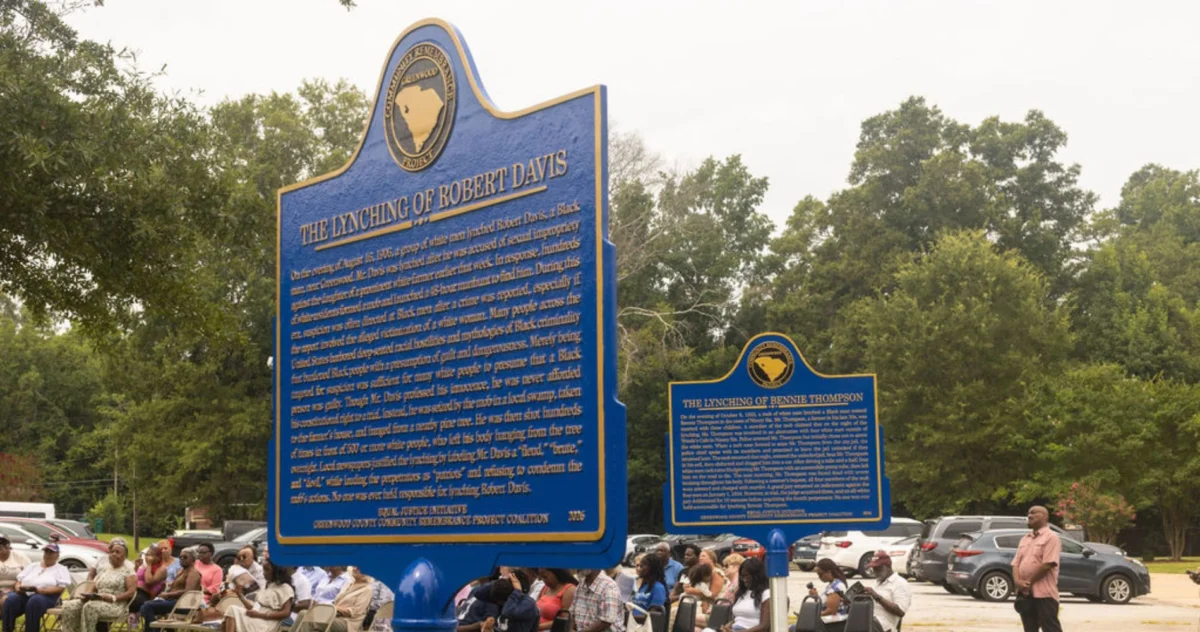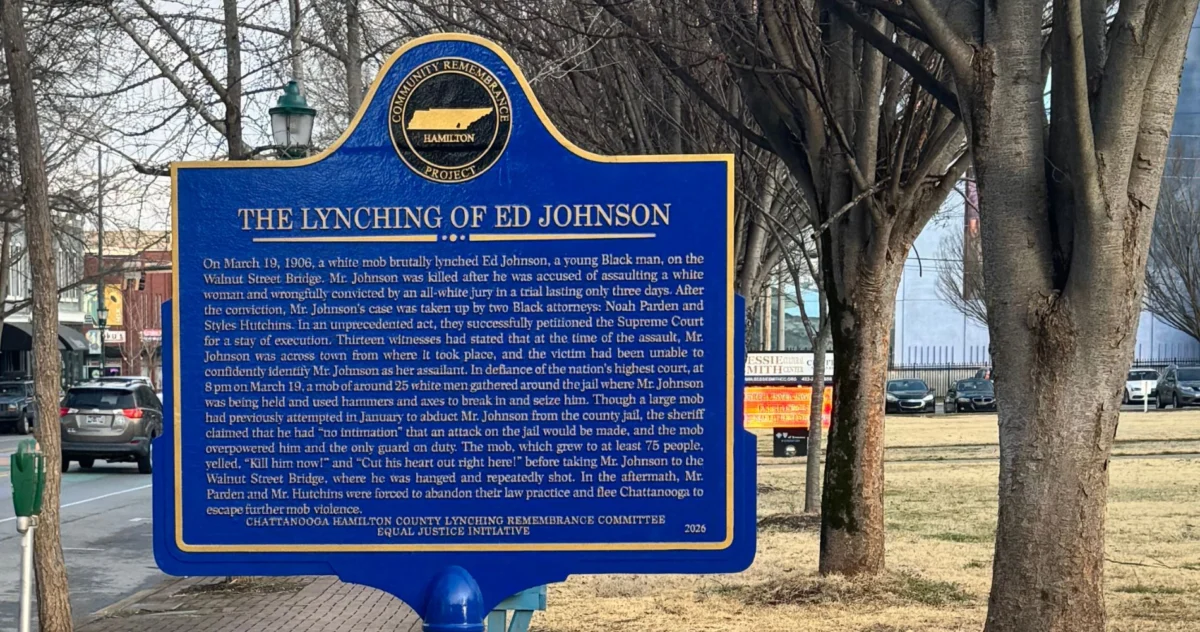
Last week, in a poignant ceremony marking a significant stride in the ongoing national reckoning with racial injustice, local community members, in collaboration with the Equal Justice Initiative (EJI), dedicated a historical marker in Hamilton County, Tennessee. The installation memorializes Ed Johnson, a young Black man brutally lynched by a white mob in 1906, a tragic event that defied a stay of execution from the United States Supreme Court. This act of remembrance serves as a powerful testament to the enduring impact of racial terror and a call for continued truth-telling.
The dedication ceremony, held on February 26 in downtown Chattanooga, Tennessee, was hosted by the Bessie Smith Cultural Center, an institution deeply rooted in the preservation and celebration of African American history and culture. Paula Wilkes, president of the center, welcomed attendees alongside Eric Atkins from the Unity Group, a prominent community figure actively involved in historical preservation and educational outreach, particularly in marginalized communities. The event brought together a diverse group of citizens, civic leaders, and descendants, all united by a shared commitment to confronting the past and building a more equitable future.
A Commitment to Preserving History and Fostering Unity
The Bessie Smith Cultural Center, established in 1983, has long been a cornerstone of the Chattanooga community. It functions not only as an educational institution but also as a vibrant hub for local events that utilize art, education, research, and entertainment to amplify Black voices and narratives. Its involvement in the Ed Johnson marker project underscores its dedication to illuminating overlooked chapters of history and fostering community engagement around critical social issues.
Eric Atkins, whose advocacy for historical preservation spans years, has been a driving force behind local efforts to remember victims of racial violence. His prior collaboration with EJI in 2017 involved a powerful soil collection ceremony, honoring Ed Johnson and other lynching victims from Chattanooga. This earlier event laid foundational groundwork for the more permanent historical marker, symbolizing a growing momentum within the community to acknowledge its difficult past.
During the somber yet hopeful ceremony, the Rev. Ernest Reid of the Second Missionary Baptist Church led attendees in a prayer that honored the victims of the past while simultaneously invoking a spirit of unity and reconciliation for the future. His words resonated with the collective sentiment of the gathering, emphasizing the spiritual and moral imperative of remembrance.
Paula Wilkes, addressing the attendees, articulated the profound significance of the marker: “By naming what happened here, we honor Ed Johnson’s humanity and affirm that remembrance is a necessary step toward justice and healing. May this marker remind us not only of the past we must confront, but of the responsibility we carry forward.” Her remarks highlighted the dual purpose of the memorial: to acknowledge historical atrocity and to inspire contemporary action towards justice.
Brandon McRae, a Community Remembrance Project Team Member, offered remarks on behalf of EJI, expressing gratitude for the local community’s dedicated efforts and their collective resolve in bringing the project to fruition. His words underscored EJI’s philosophy that local engagement is vital for meaningful historical reckoning. Echoing this sentiment, Alexa LeBoefu, Hamilton County Economic and Community Development Director, and Carmen Elliot, a representative for Chattanooga Mayor Tim Kelly, both spoke to the positive impact of confronting and sharing history on community development and their commitment to sustaining educational initiatives.
Mr. Atkins provided a heartfelt account of the project’s evolution, noting, “This has been five and a half years in the making. We have to love together, we have to pray together, we have to stand together. Together is the only way we are at our best as a community.” His words encapsulated the arduous journey and the collaborative spirit that transformed a historical wound into a catalyst for collective healing and strength.
The Lynching of Ed Johnson: A Brazen Defiance of Justice
The story of Ed Johnson is a chilling illustration of the systemic racial injustice that plagued the American South during the Jim Crow era, particularly the violent suppression of Black lives and rights. On March 19, 1906, Johnson, a young Black man, was brutally lynched by a white mob on the Walnut Street Bridge in downtown Chattanooga. His murder followed a deeply flawed legal process, beginning with an accusation of assaulting a white woman.
Johnson was wrongfully convicted by an all-white jury after a trial that lasted a mere three days, a stark indicator of the prevailing racial bias within the justice system of the time. The evidence against him was tenuous at best. Thirteen witnesses provided alibis, stating Johnson was across town at the time of the alleged assault, and the victim herself was unable to confidently identify him as her assailant. Despite these significant doubts, the machinery of racial prejudice moved swiftly towards a predetermined outcome.
In an unprecedented and courageous act, two Black attorneys, Noah Parden and Styles Hutchins, took on Johnson’s case. They successfully petitioned the U.S. Supreme Court for a stay of execution, a remarkable legal victory that temporarily halted the state’s plan to carry out the death sentence. This intervention by the nation’s highest court was a rare instance of federal oversight challenging state-level racial injustice, foreshadowing later civil rights battles. The Supreme Court’s intervention, led by Justice John Marshall Harlan, who ordered a federal investigation into the conduct of the state court, elevated Johnson’s case to national prominence.
However, the pursuit of justice was brutally cut short. In flagrant defiance of the Supreme Court’s order, a mob of approximately 25 white men gathered around the county jail where Johnson was held at 8 p.m. on March 19. Using hammers and axes, they forcibly broke into the facility, overpowering the sheriff and the sole guard on duty. Despite a prior attempt by a large mob in January to abduct Johnson from the same jail, the sheriff later claimed he had "no intimation" that such an attack would occur, a statement that underscores the systemic complicity or willful negligence often observed in such cases.
The mob, which swelled to at least 75 individuals, seized Johnson. Eyewitnesses reported hearing yells of "Kill him now!" and "Cut his heart out right here!" as he was dragged to the Walnut Street Bridge. There, he was hanged and repeatedly shot, his life extinguished by a community that prioritized racial terror over the rule of law and human dignity. The subsequent investigation into this contempt of court by the Supreme Court, known as United States v. Shipp, resulted in the conviction of the sheriff and several deputies for contempt, a landmark ruling that, while not bringing Johnson’s killers to justice, represented a rare instance of federal accountability for state officials who failed to protect Black citizens from mob violence.
The aftermath of Johnson’s lynching was equally devastating for his legal defenders. Mr. Parden and Mr. Hutchins, having bravely challenged the prevailing racial order, were forced to abandon their law practices and flee Chattanooga to escape further mob violence, their careers and lives threatened by their pursuit of justice.
Lynching in America: A Systemic Tool of Racial Terror
Ed Johnson’s story is not an isolated incident but a chilling example of a widespread campaign of racial terror that gripped the United States, particularly the South, for decades after the Civil War. Between 1865 and 1950, more than 6,500 Black people were victims of mob violence and lynching across the country, according to research by the Equal Justice Initiative. These acts were not merely random violence but a deliberate and systemic method of enforcing white supremacy, maintaining racial hierarchy, and instilling fear within the Black community.
The pretexts for lynching were often flimsy or fabricated, with approximately 25% of lynchings involving allegations of "assault" or inappropriate behavior between a Black man and a white woman. This particular accusation was a potent catalyst for mob violence, fueled by pervasive racial stereotypes that cast Black men as inherently violent and sexually aggressive, posing a threat to white womanhood. This racist trope served to justify unspeakable atrocities and maintain strict racial segregation.
The definition of "assault" in this era was often stretched to encompass any perceived transgression by a Black man against a white woman, no matter how minor. This could range from merely looking at or accidentally bumping into a white woman to smiling, winking, or even simply being perceived as "disagreeable." Such accusations, devoid of evidence or due process, regularly ignited violent mobs, resulting in summary executions designed to terrorize and control.
A deeply disturbing aspect of this era was the complicity, and at times active participation, of law enforcement. It was common for lynch mobs to seize their victims directly from jails, prisons, courtrooms, or even out of police custody. Police officials rarely used force to resist white lynch mobs intent on killing Black people; indeed, in many documented cases, law enforcement personnel were found to be complicit or even active participants in these heinous acts. This systemic failure of the state to protect Black citizens underscored the deep-seated racial bias embedded within the legal and social structures of the time.
Ed Johnson was one of at least five documented victims of racial terror lynching killed in Hamilton County between 1865 and 1950. Across the state of Tennessee, EJI has documented more than 375 victims, a staggering figure that speaks to the pervasive nature of this violence within the state. Each name represents a life brutally cut short and a community terrorized.
The Community Remembrance Project: A Path Towards Healing
The historical marker for Ed Johnson is a vital component of EJI’s broader Community Remembrance Project. This ambitious initiative seeks to confront the legacy of racial terror lynching by collecting soil from lynching sites, erecting historical markers like the one dedicated in Chattanooga, and developing the Legacy Sites in Montgomery, Alabama, which include The Legacy Museum and the National Memorial for Peace and Justice.
EJI’s fundamental belief is that genuine healing and reconciliation within communities can only begin when society bravely confronts the truth of its racial violence. By creating physical spaces of remembrance and fostering public dialogue, the project aims to educate the public about the history of racial injustice, acknowledge the victims, and inspire a commitment to justice in the present. The historical markers serve as tangible reminders of a painful past, forcing communities to grapple with their history and understand its enduring impact on contemporary society.
The dedication of the Ed Johnson marker in Chattanooga is more than just an unveiling of a plaque; it is an act of collective memory, a public acknowledgment of a grievous wrong, and a commitment to ensuring such atrocities are never forgotten. It invites residents and visitors alike to reflect on the complexities of American history, the courage of those who fought for justice, and the ongoing work required to achieve true equality and reconciliation. By shining a light on stories like Ed Johnson’s, communities like Chattanooga take a crucial step towards healing old wounds and building a future founded on truth, justice, and respect for the humanity of all.