The discourse surrounding diversity, equity, belonging, and inclusion (DEBI) has become ubiquitous in modern organizational and societal conversations. Yet, despite widespread recognition of its importance, efforts often falter, generating reactions ranging from disinterest to active resistance. A core, often overlooked, reason for this disconnect lies not in the intent but in the fundamental framing and definition of these crucial terms. The outcomes of DEBI initiatives are profoundly impacted by how these concepts are articulated, understood, and subsequently acted upon within an organization. This article delves into the intricate relationship between language, perception, and action in DEBI, drawing on insights from the Inclusion Nudges change approach to reveal inherent barriers and propose effective strategies for cultivating a truly inclusive environment.
The immediate, visceral reactions that terms like "diversity," "equity," and "inclusion" can provoke are a significant indicator of this definitional challenge. Imagine the internal monologues: "Oh, diversity isn’t my issue! It only applies to people from minority groups, not me!" or "I am the one being discriminated against. Don’t ask me how to fix it – it’s your problem." These sentiments, observed over decades of DEBI work, highlight a pervasive misinterpretation that cripples progress. Some perceive DEBI as a burden ("not my day job"), others as a selective benefit ("attract some diversity talent" meaning only minorities or women), and some even as a zero-sum game where promoting one group necessitates excluding another ("If we are going to promote women and minorities, then we have to exclude others"). These patterns reveal underlying perceptions that act as hidden tripwires, inadvertently undermining the very goals they aim to achieve.
The genesis of these skewed perceptions can often be traced to the historical trajectory and initial positioning of DEBI efforts. In the mid-20th century, early initiatives largely focused on affirmative action, aiming to redress historical injustices by increasing representation for historically marginalized groups. While vital at the time, this approach sometimes led to the perception of "quotas" or "preferential treatment," creating a sense of resentment among majority groups who felt unfairly disadvantaged. The focus was often on "fixing the minority" or "fixing the women," with programs tailored exclusively for these groups. This often meant organizations developed strategies and set diversity targets for specific demographics but failed to engage the entire workforce. For instance, gender equality programs frequently targeted women without addressing the systemic biases or involving men in the solution, inadvertently reinforcing the idea that women were the "problem" to be fixed.
This narrow framing inadvertently created an "us versus them" dichotomy, missing a critical focus: engaging all people—majority and minority—in a shared journey of cultural transformation. It neglected the essential task of changing implicit norms and redesigning systems that perpetuate discriminatory practices. The outcome was often an emphasis on assimilation rather than genuine inclusion, where differences were tolerated but not fully integrated or valued. This definitional approach, centered on "fixing the difference," fosters division and reinforces existing biases, inadvertently working against the intentions of achieving the manifold benefits of true diversity.
The power of language in shaping human perception and behavior is well-documented by science. Language is not merely a tool for communication; it fundamentally shapes our thoughts, emotions, and cultural realities. The priming effect, for instance, demonstrates how exposure to certain words can unconsciously influence subsequent behavior. A classic study illustrated this by showing participants words associated with the elderly (e.g., "wrinkle," "forgetful"); subsequently, these participants walked slower than a control group exposed to neutral words. Similarly, attempts to counter stereotypes can backfire if poorly phrased. Stating "girls are as good as boys at math" inadvertently reinforces the underlying stereotype that boys are inherently better, rather than dismantling it. Words carry immense power, capable of reinforcing or challenging entrenched beliefs.
Beyond cognitive priming, words also trigger powerful emotional responses that drive unconscious thinking, decision-making, and behavior. One significant barrier in DEBI work is the "fear of loss." When diversity is perceived as a zero-sum game—one group’s gain necessitating another’s loss—efforts toward equity can trigger loss-aversion bias, a well-established psychological phenomenon. This bias makes individuals inherently resistant to change and prone to defending the status quo, especially when they perceive a threat to their power, privilege, or resources. For individuals in historically dominant groups, the idea of "equality" might be unconsciously equated with "giving up" something, leading to defensive reactions and disengagement.
Furthermore, vague or poorly defined DEBI terms can activate innate tribal mentalities and an instinctive fear of the "unknown." When interacting with individuals from perceived "out-groups," unconscious anxieties can arise, influencing behavior to unintentionally exclude their knowledge or insights. Conversely, with "in-group" members, there’s a greater propensity for trust and acceptance of shared information. This tribalism, an evolutionary trait, impacts how we process information and shapes our mental models, making it harder to embrace perspectives that challenge familiar norms.
Perhaps one of the most insidious emotional impacts in DEBI work is shame. The language used, even with the best intentions, can inadvertently trigger feelings of blame or guilt. Individuals may feel ashamed for past unwitting discriminatory actions or for benefiting from privilege while witnessing inequality without knowing how to effect change. This emotional response often manifests as unconscious micro-aggressions or passive resistance, creating a significant impediment to genuine dialogue and progress. These examples underscore how words, if left unaddressed and undefined, can create an "absurd reality," limiting the achievement of even the most well-intentioned DEBI goals.
The paradox often observed in organizations is that while terms like diversity, equity, belonging, and inclusion are widely used, their formal definitions are rarely articulated. This vacuum leaves individuals to construct their own interpretations based on personal experiences, social constructs, and pre-existing knowledge, leading to a fragmented and inconsistent understanding across an organization. What "diversity" means to one person (e.g., only "women") can be vastly different from another’s perception. Similarly, "inclusion" might be reduced to organizing "diversity networks" for some, while for others, it means actively leveraging diverse perspectives in decision-making. "Equity" might simply equate to "minority hiring targets." While these interpretations are not entirely incorrect, they represent a partial scope that fails to capture the comprehensive intent of these concepts. Without a common framework, expecting aligned actions and behaviors becomes an "absurd reality," inevitably stalling progress.
Recognizing this critical gap, the Inclusion Nudges global initiative advocates for a deliberate and thoughtful approach to defining these terms, not just as abstract concepts but as guiding stars for desired outcomes. Their definitions are crafted to be universal, action-oriented, and inclusive, aiming to transcend the common pitfalls and foster widespread engagement.
Diversity: The Mix of All of Us. This definition broadens diversity beyond specific demographics or "minority" groups. It encompasses all people, recognizing the myriad differences in demographic traits, backgrounds, multiple identities, unique experiences, perspectives, knowledge, abilities, and ideas. By framing diversity as "the mix of all of us," it becomes universally relevant, fostering a sense of shared ownership rather than isolating specific groups.
Equity: The Fairness Frame for the Mix. Equity is positioned as the active pursuit of fairness. It is about ensuring equal access to opportunities and fair treatment for all, proactively eliminating discriminatory practices, systems, laws, policies, social norms, and cultural traditions. This definition emphasizes a balancing of power and rectifying existing inequalities, recognizing that fairness often requires targeted interventions to achieve equal outcomes. It shifts the focus from merely treating everyone the same to providing what each individual needs to succeed, acknowledging historical and systemic disadvantages.
Belonging: I Feel Valued as a Part of the Mix. Belonging centers on the individual’s experience: feeling welcomed, safe, seen, heard, and valued enough to bring their full, authentic self to any setting. It implies that structures and cultures exist to ensure fairness, removing the burden of "covering" or downplaying personal traits. This definition highlights belonging as a result of well-executed diversity, equity, and inclusion efforts, emphasizing its role in fostering psychological safety and enabling individuals to thrive.
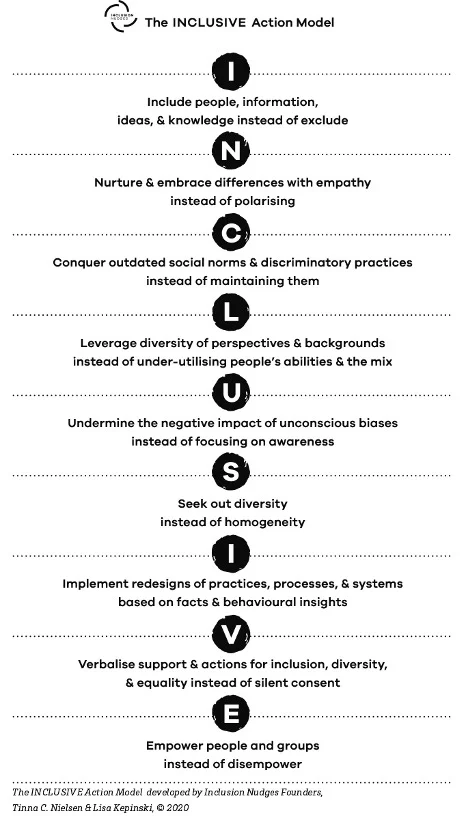
Inclusion: Welcoming and Applying the Mix. Inclusion is defined by action and mindset. It’s about fostering the structures, systems, processes, culture, behaviors, and mindsets that embrace and respect all people and their diversity. Crucially, it involves actively seeking out and applying diverse knowledge, perspectives, information, and ideas. Inclusion means challenging exclusionary norms, speaking up against bias, and ensuring all people can participate and contribute to their fullest potential. It is the active process of welcoming and leveraging the rich "mix of all of us."
While articulating and communicating these definitions is a vital first step, it is insufficient on its own. Rational understanding, residing in the conscious mind (System 2 thinking), often fails to translate into inclusive behaviors, which are largely driven by unconscious processes (System 1). This is why merely stating definitions in a strategy document or on a website often falls short. The true challenge lies in engaging "the people it’s about" in defining what DEBI means to them, grounded not in abstract terms, but in concrete actions.
A more effective approach involves facilitating a collaborative process where all stakeholders contribute to setting and validating definitions for their specific group or organization. Crucially, this process should be framed not around words, but around actions. By engaging people in identifying behaviors they perceive as inclusive, inviting, respectful, empathetic, and that make them feel included, valued, and empowered, organizations can achieve several critical outcomes. First, the resulting definitions are contextually relevant and resonate deeply with the workforce. Second, by involving individuals in the development process, they gain ownership and are inherently onboarded into the change initiative. This approach is inherently inclusive, leveraging the diversity of perspectives within the group to build a shared foundation.
Once these inclusive behaviors are identified, the next step is to make them visible and actionable. Rather than consigning them to spreadsheets or abstract policy documents, these diverse, real-life examples and personal stories should be actively shared through communication materials. Displaying them on factory floors, office walls, meeting rooms, and public spaces reinforces their relevance and demonstrates how inclusion manifests in tangible ways. The key is to present these as specific, observable actions, avoiding the overuse of the umbrella term "inclusion." For internal communications, highlighting one example at a time, emphasizing that peers and colleagues are already practicing these behaviors, can leverage social proof. For instance, stating "8 out of 10 of your colleagues are doing X" can powerfully nudge others towards similar actions.
Ultimately, the goal is to "achieve inclusion without talking about inclusion." Over time, through consistent reinforcement of action-oriented examples, a shared understanding of DEBI will organically take root. While formal definitions may be necessary for strategic documents or KPIs, the focus should shift from buzzwords to outcomes. Instead of saying "inclusion," organizations can frame it as "how work gets done here" or "how people experience being in the group." Challenging oneself to articulate desired outcomes without using the DEBI lexicon—for example, "we need the thinking from everyone for new solutions" or "we need our systems designed to enable our most objective decision-making"—can bypass resistance and foster a positive, resource-oriented perception.
This approach creates positive associations with DEBI concepts, making them integral to the organizational culture rather than a standalone initiative. It tackles the fundamental challenge of translating definitions into reality, enabling thousands of individuals to move in the same direction, despite their diverse understandings and reactions. This is precisely the premise behind the Inclusion Nudges change approach, which provides practical tools and strategies for designing interventions that subtly guide behavior towards inclusive norms.
By consciously reframing and redefining diversity, equity, belonging, and inclusion, organizations can move beyond performative gestures and foster environments where these principles are deeply embedded in daily operations. It requires a shift from abstract rhetoric to tangible actions, from top-down mandates to collaborative definition-setting, and from focusing on perceived deficits to celebrating collective strengths. This strategic use of language and a focus on behavioral design are critical for making inclusion the norm—everywhere, for everyone.