Unconscious bias awareness training, once heralded as the cornerstone of diversity, equity, and inclusion (DEI) initiatives, is facing increasing scrutiny for its documented ineffectiveness and potential to backfire. Despite its global proliferation and the emergence of a multi-billion dollar industry built around its promise, a growing body of research and real-world experience suggests that these interventions often fail to achieve lasting behavioral change, and in some cases, may even exacerbate the very biases they aim to combat. This revelation compels a critical re-evaluation of current strategies, advocating instead for systemic design solutions that embed inclusivity by default, rather than relying on awareness alone.
The widespread adoption of unconscious bias training (UBT) emerged as a prominent response to escalating calls for greater equity and social justice within organizations and society at large. Following seismic social movements like #MeToo, which highlighted pervasive issues of sexual harassment and gender inequality, and #BlackLivesMatter, which brought racial injustice and systemic discrimination to the forefront, companies worldwide rapidly integrated UBT into their corporate training curricula. This surge was often driven by a genuine desire to address perceived inequities, but also, in many instances, by a strategic imperative to demonstrate commitment to DEI principles, sometimes serving as a defensive shield against public criticism or internal employee grievances. The pattern became remarkably familiar: a discrimination complaint, a public outcry, or a push for greater diversity would invariably lead to the declaration, "Let’s implement unconscious bias training across the organization!" The prevailing mindset was that increased awareness would naturally lead to corrected behavior, effectively "fixing" the problem. However, this optimistic outlook has frequently clashed with persistent realities, leaving many to question why, despite significant investment, progress remains elusive.
The core issue lies in a fundamental misunderstanding of how human cognition operates and how biases are formed and perpetuated. Proponents of UBT often appeal to the conscious, rational mind—what psychologists Daniel Kahneman and Amos Tversky termed "System 2" thinking. This system is responsible for deliberate thought, logical reasoning, and conscious decision-making. UBT typically provides knowledge, statistics, and examples designed to make individuals aware of their implicit biases and the mechanisms through which stereotypes can influence judgments and actions. The assumption is that once people are consciously aware of their biases, they will be able to override them.
However, the vast majority of human cognitive functioning, including the processing of social information and the generation of biases, occurs in the unconscious, automatic "System 1." This system is fast, intuitive, and operates below the level of conscious awareness, relying on heuristics and mental shortcuts to process vast amounts of information efficiently. Training that is predominantly knowledge-based and appeals to System 2 is fundamentally addressing the wrong cognitive system if the goal is lasting behavioral change. Simply knowing about bias, or having good intentions, does not automatically diminish the pervasive influence of the unconscious mind.
Indeed, research indicates that attempting to consciously monitor and correct for unconscious biases can have paradoxical and even detrimental effects. One significant challenge is "mental overload." The cognitive effort required to be constantly aware of and actively counteract one’s unconscious biases can be exhausting. When individuals experience mental overload, their reliance on System 1 thinking—and thus on ingrained biases and stereotypes—actually increases. This creates a vicious cycle where the very act of trying to be less biased through conscious effort makes individuals more susceptible to their unconscious prejudices.
Furthermore, studies have shown that UBT can, counterintuitively, enhance existing biases and stereotypes. Research published by the American Psychological Association (APA) and other peer-reviewed journals suggests that merely making people aware of common stereotypes can inadvertently strengthen them. By presenting examples of biased thinking, some individuals may internalize these biases or become more likely to recognize and thus reinforce them in their own perceptions.
A 2020 study published in Personality and Social Psychology Bulletin revealed another alarming backlash effect. This research indicated that making individuals in privileged positions aware of racial prejudice and systemic inequality in contemporary society did not necessarily alter their deeply held misconception that society is largely fair to all. Instead, for some, it strengthened this belief and even led to a more optimistic—and often inaccurate—perception of past inequalities. In essence, awareness, in this context, backfired by reinforcing rather than challenging existing societal narratives.
Another unintended consequence of UBT is the phenomenon of "moral licensing." Attending training on diversity and inclusion can create a self-perception of being "one of the good people" who is not discriminatory or biased. This positive self-image can, however, trigger an unconscious psychological mechanism where having performed a "moral deed" (like attending training) gives individuals "license" to act less morally or inclusively in subsequent situations. For example, studies have shown that people who strongly express disagreement with sexist statements might then be more likely to hire a man over an equally qualified woman for a job, or even make sexist comments, because they feel secure in their "non-sexist" self-image. Similarly, individuals who condemn racist statements have been observed to unconsciously discriminate against racial minorities in later interactions. This effect demonstrates how an intervention designed to foster inclusivity can inadvertently lead to the very opposite of its stated goals.
The very language used in these trainings, such as "Unconscious Bias Awareness Training" or "Inclusion & Diversity Training," can also trigger counter-productive emotional responses. Terms implying a need for "fixing" can activate anxiety and defensiveness ("I am going to be fixed"). Discussions around privilege can evoke loss-aversion ("I’ll lose privilege, status, and power") or even resentment and a desire for "revenge" ("Now, I’ll get them and show them how wrong they are"). Conversely, some participants might leave with an inflated sense of control over their biases ("Now, I know my bias and control it"), leading to over-optimism that neglects the persistent influence of System 1. Moreover, when individuals are told that bias is "natural" or that "everyone has stereotypes," it can decrease their motivation to actively change their own biased behaviors, fostering a sense of complacency or fatalism.
While the critical analysis of UBT highlights its shortcomings, it is important to acknowledge any positive, albeit limited, effects. Such sessions can create a shared experience, offering participants a common language to discuss sensitive issues related to discrimination and exclusion. Moments of "aha!" can prompt self-reflection and the identification of previously unseen patterns of bias in organizational processes or interpersonal interactions. This shared understanding can potentially ease conversations about root causes that need addressing. However, studies consistently show that any positive shifts in attitudes or intentions generated by UBT are typically short-lived, often dissipating within days or weeks, failing to translate into sustained behavioral change within organizations. This transient impact underscores that while awareness might be a starting point, it is far from a sufficient solution for systemic de-biasing.
Given the inherent limitations of awareness-based approaches, a paradigm shift is urgently needed. The solution lies not in attempting to fundamentally change how the human mind works—an impossible task—but rather in designing environments and processes that mitigate the influence of unconscious bias by default. This involves appealing directly to the unconscious System 1, which governs automatic behavior, rather than solely relying on the conscious System 2.
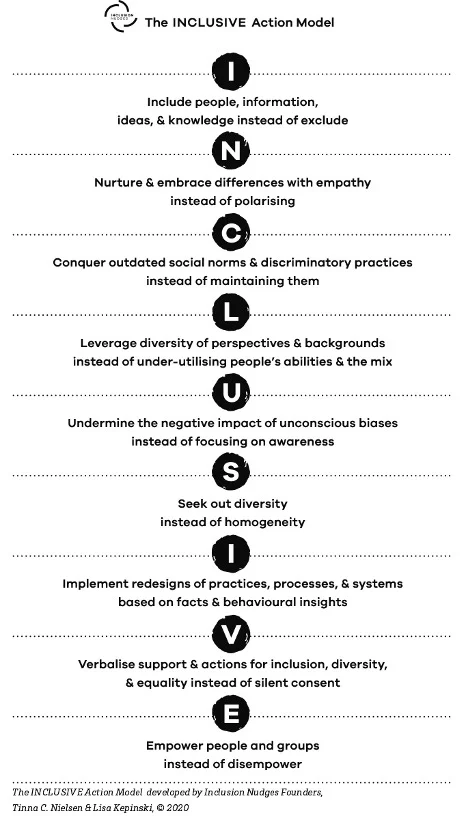
This approach is epitomized by the concept of "Inclusion Nudges." An Inclusion Nudge is a carefully designed action or modification to a process or environment that influences the unconscious mind, making it easier and more automatic for individuals to act inclusively in their daily activities. These actions are practical applications derived from insights in behavioral and social sciences, nudge theory, and a deep understanding of the hidden barriers to achieving true inclusion. By "nudging" the unconscious mind, these designs steer behavior towards inclusivity without requiring constant conscious effort, rational arguments, threats, or punishments, while still respecting freedom of choice. Crucially, they often involve minimal cost yet yield profound differences in combatting biases and fostering equitable realities.
A compelling example of an Inclusion Nudge in action is the widespread adoption of blind auditions by symphony orchestras since the 1970s. This innovative practice emerged from internal questioning within orchestras about the predominant demographic of their musicians, which was overwhelmingly white and male. The solution was simple yet revolutionary: musicians auditioned behind a screen, preventing the selection committee from seeing candidates. This anonymization process removed visual cues that could trigger gender, racial, or age biases. The results of initial pilot programs were startling: the number of women selected into orchestras increased by an astonishing 50%, and the ethnic diversity of selected candidates also saw a radical shift. This success led to the permanent implementation of blind auditions in most major symphony orchestras worldwide, ensuring that evaluations are based solely on musical merit, free from superficial prejudices. Some orchestras have even gone further, placing carpets behind the screens to muffle the sound of shoes, recognizing that even subtle auditory cues can unconsciously prime gender biases and skew how committee members perceive the music performance.
The orchestra example serves as powerful evidence that systemic design changes, rather than individual awareness, are the most effective path to de-bias. This principle, validated by over four decades of evidence, demonstrates that by designing processes that remove opportunities for bias to influence decisions, organizations can achieve genuinely equitable outcomes. While the anonymization of candidates is slowly gaining traction in other sectors, particularly with the advent of technological platforms that facilitate blind resume reviews or interview processes, its slow adoption despite overwhelming evidence remains a perplexing challenge.
The implication for organizations is clear: the significant financial and human capital currently invested in often ineffective unconscious bias awareness training could be far more effectively allocated towards designing inclusive systems and processes. This requires a shift in focus from attempting to "fix" individuals to creating environments where inclusive behavior is the default and the norm. By leveraging insights from behavioral science to implement Inclusion Nudges, organizations can systematically minimize the impact of cognitive shortcuts and build truly equitable cultures. The call to action is urgent: accelerate the adoption of proven design-based interventions to make inclusion a pervasive reality for everyone, everywhere.