This is the 16th time Pew Research Center has measured restrictions on religion around the globe. This report, which includes data for the year ending Dec. 31, 2023, generally follows the same methodology as previous reports.
Pew Research Center employs two comprehensive 10-point indexes—the Government Restrictions Index (GRI) and the Social Hostilities Index (SHI)—to meticulously assess and rate the levels of religious restrictions across 198 countries and self-governing territories. This detailed report meticulously analyzes the year-over-year changes in these restrictions, with a specific focus on the calendar year 2023. The methodology, refined over sixteen years of research, aims to provide a quantifiable, objective, and transparent measure of how governments and societal groups impact the practice of religion worldwide.
Understanding the Measurement Framework
The research methodology is built upon a robust framework designed to capture the multifaceted nature of religious freedom and its curtailment. Two primary indexes are utilized:
-
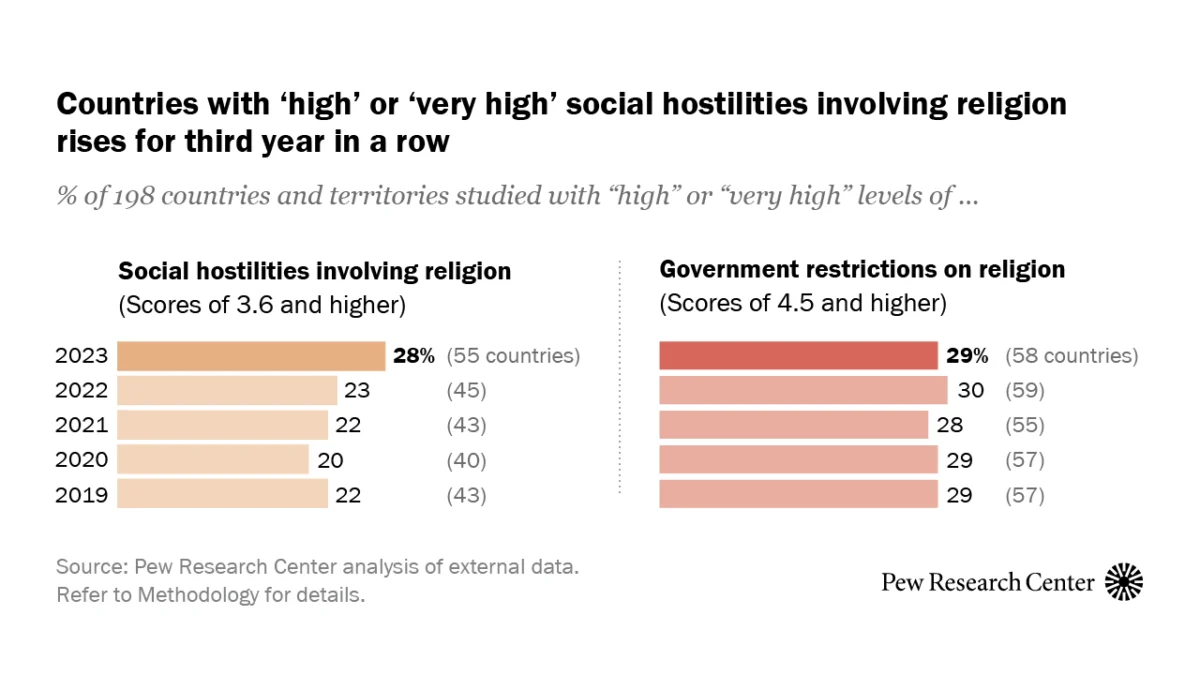
Government Restrictions Index (GRI): This index is constructed from 20 distinct indicators that detail the ways national and local governments impede religious freedom. These indicators encompass a range of governmental actions, from administrative hurdles and legal discrimination to coercion and overt force. The GRI scores range from 0 (very low levels of government restrictions) to 10 (very high levels of restrictions). The 20 items contributing to the GRI are coded on a scale from 0 to 1.0 point, with partial points awarded for lesser degrees of restriction. The sum of these variables is then divided by two to yield the final GRI score, ensuring a maximum possible value of 10. For the calendar year 2023, the GRI demonstrated a scale reliability coefficient of 0.91, indicating a high degree of internal consistency and statistical validity for the index.
-
Social Hostilities Index (SHI): Complementing the GRI, the SHI is based on 13 indicators that measure infringements on religious beliefs and practices by private individuals and societal groups. This includes religiously motivated crimes, mob violence, and organized efforts to obstruct the growth or operation of particular religious communities. The SHI also scores range from 0 (very low impediments to religious beliefs and practices) to 10 (very high impediments). The 13 indicators are coded on a scale from 0 to 1.0 point, with partial points for lesser degrees of hostility. The sum of these variables is divided by 1.3 to achieve the 0-10 scale for the SHI. A reliability coefficient of 0.87 was recorded for the SHI in 2023, affirming its robustness as a measurement tool.
Beyond these two core indexes, the study also meticulously counts the number and types of documented incidents of religion-related violence, including acts of terrorism and armed conflict, providing further context to the overall landscape of religious freedom.
Categorizing Change: Numerical and Percentile Approaches
The Pew Research Center’s analysis categorizes the direction and magnitude of changes in restrictions in two primary ways: numerically and by percentile.
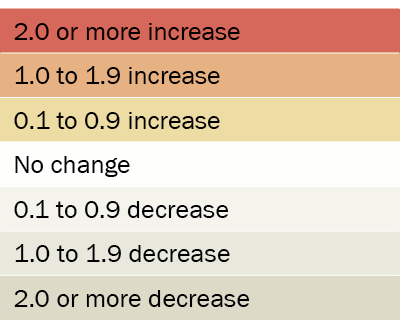
Numerical Categorization of Change: Countries are grouped based on the size of the numeric change in their GRI and SHI scores from one year to the next. These categories include:
- Increases of 2.0 points or more
- Increases of 1.0 to 1.9 points
- Increases of 0.1 to 0.9 points
- No change
- Decreases of 0.1 to 0.9 points
- Decreases of 1.0 to 1.9 points
- Decreases of 2.0 points or more
The report details how overall changes in restrictions are calculated. When a country’s GRI and SHI scores move in the same direction (both increase or both decrease), the greater of the two changes dictates the categorization. If scores move in opposite directions, the difference between the amounts of change determines the grouping. If a score remains unchanged on one index, the change on the other index is used for classification.
Percentile Classification of Levels: The study also classifies the overall levels of government restrictions and social hostilities by percentiles, using the year ending in mid-2007 as a baseline. This classification helps to contextualize a country’s score within the global distribution:
- Very High: Top 5% of scores on each index.
- High: The next highest 15% of scores.
- Moderate: The following 20% of scores.
- Low: The bottom 60% of scores.
These percentile thresholds, established from the mid-2007 data, are consistently applied to all subsequent years, enabling a longitudinal analysis of religious freedom trends. For instance, scores between 6.6 and 10.0 on the Government Restrictions Index were classified as "very high" based on the baseline data. Similarly, scores between 7.2 and 10.0 on the Social Hostilities Index fell into the "very high" category.
A Rigorous Methodology: Ensuring Objectivity and Reproducibility
The methodology employed by the Pew Research Center for assessing religious restrictions has been developed and refined over many years, building on foundational work by researchers like Brian J. Grim and Professor Roger Finke. The core objective is to create quantifiable, objective, and transparent measures.
Extensive Data Sourcing and Verification: The research process involves coding data from more than a dozen published cross-national sources, including reports from U.S. government agencies, international organizations, and non-governmental entities. Crucially, Pew Research Center coders focus solely on specific, well-documented facts, deliberately excluding opinions or commentary. To ensure accuracy and reliability, the Center implements rigorous data verification checks, including:
- Double-blind coding: Coders work independently, unaware of each other’s ratings to prevent bias.
- Interrater reliability assessments: Consistency among coders is systematically checked.
- Reconciliation protocols: Carefully monitored procedures are in place to resolve discrepancies between coders.
Distinguishing Perpetrators and Scope: A significant aspect of the coding process involves differentiating between government and private actors responsible for religion-related violence and restrictions. The methodology also quantifies the widespread nature and intensity of these restrictions within each country, providing a nuanced understanding of the situation on the ground.
Tracking Change Over Time: A particularly valuable contribution of the indexes is their ability to chart changes in religious restrictions over time. This longitudinal capability allows for the identification of trends, shifts in policy, and the impact of societal developments on religious freedom.

Global Reach: The 198 Countries and Territories Studied
The study encompasses 198 countries and self-governing territories, representing over 99.5% of the global population. This includes 192 United Nations member states as of 2023, along with six additional territories: Kosovo, Hong Kong, Macao, the Palestinian territories, Taiwan, and Western Sahara. The inclusion of these territories is for analytical purposes, reflecting their distinct de facto situations, and does not imply any official stance on their international political status.
The methodology consciously avoids adjusting for variations in country size, population, wealth, ethnic diversity, religious composition, or form of government. This ensures that all nations are assessed against the same objective criteria, preventing biases that might arise from assuming different levels of restriction are "expected" in countries with varying characteristics. For example, poorer nations are not scored differently than wealthier ones, and democracies are not assessed more leniently or harshly than authoritarian regimes.
Navigating Complex Geopolitical Contexts
The report acknowledges the complexities of geographic naming conventions and political statuses. Names used in the report largely align with common English-language usage in the United States, even when alternative names exist (e.g., East Timor instead of Timor-Leste).
Western Sahara Coding: Western Sahara, a non-self-governing territory recognized by the UN, presents a unique coding challenge. As Morocco administers parts of the territory under its own constitution and laws, the report considers Moroccan government policies and actions when assessing government restrictions on religion in Western Sahara. This reflects Morocco’s de facto control and is not an endorsement of its territorial claims. Social hostilities involving religion in Western Sahara and Morocco are coded separately.
Information Sources: A Comprehensive Approach
For the 2023 data collection, Pew Research Center identified 19 widely available and frequently cited sources on government restrictions and social hostilities involving religion. These sources include reports from U.S. government entities, various non-governmental organizations, and European and UN bodies.
New and Updated Sources: The study incorporates several new sources for 2023, reflecting the evolving landscape of human rights reporting. These include:
- Freedom House reports ("Freedom in the World" and "Freedom on the Net"): These have replaced Human Rights First reports and provide crucial data on both general freedoms and online restrictions impacting religious groups.
- Uppsala University’s Armed Conflict Database: This database offers valuable information on the impact of religion-related armed conflicts, supplementing other data.
- Human Rights Without Frontiers’ "Freedom of Religion or Belief" newsletters: These have replaced the Hudson Institute’s "Religious Freedom in the World" publication.
U.S. Court Cases and Commission Reports: For 2021-2023, researchers consulted a database of religious freedom cases in U.S. courts compiled by the American Civil Liberties Union (ACLU), focusing solely on factual information. Additionally, data from the U.S. Commission on International Religious Freedom was used to inform coding on individuals detained for their beliefs.
Previous Sources and Their Availability: The report also notes previous sources that were unavailable for the 2023 data collection period. Notably, the Global Terrorism Database (GTD), previously used for religion-related terrorism, was not accessible. In its absence, information was drawn from other established sources like the International Crisis Group’s CrisisWatch Database and U.S. State Department reports. The Worldwide Incident Tracking System (WITS), a U.S. government database, is also no longer available online. Amnesty International reports, absent for the 2018 data due to updates, were utilized for the 2023 report. Similarly, the U.S. Department of Justice’s "Religious Freedom in Focus" newsletters were unavailable for recent years, and the U.S. State Department’s "Report on International Religious Freedom" was unavailable for Western Sahara for several recent years. The U.K. Foreign & Commonwealth Office annual reports were also not available for 2023.
Despite these variations in source availability, Pew Research Center staff continuously monitor the impact of source information variability. Their analysis indicates no evidence of overall informational bias, suggesting that the changes in reported restrictions are more likely due to actual shifts in global religious freedom rather than methodological artifacts.
The Coding Instrument: A Detailed Questionnaire
Pew Research Center staff developed a detailed coding instrument, akin to a survey questionnaire, to guide coders in systematically extracting factual information from the various sources. This instrument allows for the generation of numerical measures on restrictions and helps identify the intersection of government actions with societal tensions and private acts of intimidation. The complete coding instrument, detailing the specific questions used, is available in the appendix of the full methodology report.
Coders meticulously reviewed all available sources for each country, assessing whether each source provided critical information, supporting details, or no relevant data. For countries with populations exceeding one million, multiple sources of information were consistently available. Smaller nations typically relied on the U.S. State Department reports as their primary source.
A particular challenge arises in coding for the United States, as it is not included in the U.S. State Department’s annual "Reports on International Religious Freedom." Consequently, coders for the U.S. also consult reports from the Department of Justice and the FBI, alongside all other primary and secondary sources, including those from international organizations.
The Coding Process: Ensuring Accuracy and Reproducibility
The coding process is characterized by stringent training protocols and rigorous quality control measures to ensure objectivity and reproducibility.
Training and Double-Blind Coding: Coders undergo intensive training covering research objectives, information sources, and methodology. Countries are then double-blind coded by two independent coders. Their initial ratings are entered into an electronic coding instrument. Coders begin with the most comprehensive source for a country and then consult other sources for additional information.
Reconciliation and Data Verification: After individual coding is complete, a research analyst compares the scores. Discrepancies are thoroughly discussed with coders and reconciled to arrive at a single, agreed-upon score for each question and country. This data is then compiled into a master file.
Year-over-Year Comparison and Instrument Monitoring: Following data collection for all countries, coders and researchers compare the 2023 scores with those from the previous year. Changes are analyzed to ensure they are substantive and not due to coder error. The coding instrument itself is continuously monitored for potential flaws, with a focus on maintaining precision, comprehensiveness, and objectivity to ensure reliable replication of coding by others. Efforts are made to minimize changes to the instrument itself, ensuring that observed changes in restrictions accurately reflect real-world shifts rather than methodological alterations.
Handling Contradictions and Bias: In instances where sources contradict each other, the source providing the most specific and well-documented evidence is prioritized. Coders are instructed to disregard broad generalizations and focus on reports with clear, precise factual details, including names, dates, and locations.
Interrater Reliability: A crucial metric for assessing the consistency of coding is interrater reliability. Across all variables for the 198 countries and territories, the interrater reliability score was 0.72, a figure generally considered good and indicative of reliable coding.
Cross-Validation: In previous years, the reliability of coded data has been further tested by comparing it with similar, albeit more limited, datasets from sources like the Association of Religion Data Archives (ARDA) and the Hudson Institute. These cross-validation efforts have revealed very few significant discrepancies, with changes made only when further review of primary and secondary sources warranted it.
Methodological Refinements and Specific Coding Considerations
The methodology has evolved to enhance accuracy and address specific challenges.
Social Harassment and Intimidation: Since data covering 2017, the calculation of social harassment and intimidation has been refined. Six components now encompass SHI Q.1.a. For "harassment/intimidation," "limited" instances are coded as 0.5 points and "widespread" instances as 1.0 point. "Limited" signifies infrequent or isolated incidents, while "widespread" indicates presence in certain regions, potential for spread, impact on multiple groups, a substantial uptick in cases, or a possible campaign against a religion. The other five components are coded as "Yes" (1.0 point) or "No" (0 points). This update resulted in minor score changes for a subset of countries.
Consolidation to a New Database: In earlier years, data was collected at the province level for some indicators, then aggregated to the country level. Following the publication of the August 2011 report, Pew Research Center integrated all province- and country-level data into a single database. This consolidation involved reviewing and correcting any discrepancies between province files and country-level sums, resulting in minor adjustments to index scores.
Changing Time Period of Analysis: This report covers the calendar year 2023, marking the 13th time Pew Research Center has analyzed restrictions within a calendar year. Previous reports focused on July 1 to June 30 periods. The shift to calendar years aligns with the reporting cycles of most primary and secondary sources. While this transition meant that some incidents from the latter half of 2010 were not directly reported, ongoing impacts of significant events were captured through careful review.
Religion-Related Terrorism and Armed Conflict: Terrorism and war significantly impact religious groups. While not included in the GRI to maintain focus on direct government actions, these are factored into the SHI through specific questions on religion-related terrorism and armed conflict. Other measures within both indexes capture the spillover effects of such conflicts on societal tensions. "Religion-related terrorism" is defined as premeditated, politically motivated violence against noncombatants by subnational groups with identifiable religious ideology or motivation. "Religion-related war or armed conflict" involves sustained armed conflict where religious rhetoric justifies force or where combatants identify primarily by religion.
Coding of Specific Territories and Conflicts: The report details specific coding decisions for territories and ongoing conflicts, including:
- Crimea: Incidents in Crimea are coded as part of Russia’s GRI and SHI scores, reflecting de facto control, not de jure status.
- Ukraine: For events starting in 2022, restrictions in Russian-invaded regions of Ukraine (Donetsk, Kherson, Luhansk, Mykolayiv, and Zaporizhzhya oblasts) are included in Russia’s GRI score, while social hostilities are coded under Ukraine’s SHI.
- Israel and Palestinian Territories: Israeli government actions in both Israel and Palestinian territories are coded under Israel’s GRI. Palestinian Authority actions are coded under the Palestinian territories’ GRI. Social hostilities are coded based on location, with East Jerusalem classified as Palestinian territories and West Jerusalem as Israel. Hamas actions are coded as religion-related terrorism on the SHI.
- Somalia: Since 2013, actions by the al-Shabab rebel group have been coded as social hostilities rather than government restrictions, reflecting a decrease in their territorial control.
- Yemen: Since 2016, Houthi rebel actions have been coded as government restrictions due to their significant governmental control.
Coding by Nationality or Ethnicity: Incidents are not coded as religiously motivated solely based on the nationality or ethnicity of those involved. Religion must be indicated as a motivating factor or the target of the action must be clearly religious or connected to religion.
Displacement Coding: Since 2016, displacement figures for religion-related conflict or terrorism are conservatively estimated using UNHCR and IDMC data, focusing on newly displaced individuals in countries with active religion-related conflict.
Country Constitution Audit: A review of country constitutions between 2007-2014 led to minor amendments in GRI scores for several countries, with minimal impact on overall trends.
Potential Biases and Limitations
The Pew Research Center acknowledges potential biases in its data sources. North Korea, for instance, is not included due to the lack of independent observer access, preventing the collection of specific, timely information. The study addresses the possibility that countries limiting outsider access might obscure their records, but notes that multiple sources and cross-validation methods help mitigate this risk.
Conversely, the report considers whether countries with freer access to information might appear to have worse scores simply due to more available data. Analysis suggests that reporting on problems in freer-access countries is not disproportionately inflated. However, for religion-related violence and intimidation, freer-access countries do report more issues. Measures within the SHI are designed to be less susceptible to reporting bias by capturing general social trends and attitudes alongside specific incidents.
The study also clarifies that while it provides data on the number of countries where specific religious groups face harassment, it does not assess the severity or frequency of this harassment. Therefore, the results should not be interpreted as definitively ranking which religious group faces the most persecution globally.
Conclusion: An Ongoing Commitment to Understanding Religious Freedom
This comprehensive methodology report underscores Pew Research Center’s commitment to providing rigorous, data-driven insights into the complex and dynamic global landscape of religious restrictions and social hostilities. By employing a robust framework, diverse information sources, and meticulous analytical processes, the Center aims to offer an objective and reliable assessment of religious freedom worldwide, enabling a deeper understanding of the challenges and trends shaping this critical aspect of human rights. The continuous refinement of these methods ensures that the research remains relevant and impactful in an ever-changing world.