The American political landscape, a perpetually dynamic terrain, has once again been charted by the Pew Research Center’s latest National Public Opinion Reference Survey (NPORS). Released following extensive data collection from January 30 to June 18, 2026, this comprehensive report offers a granular look at the partisan affiliations of U.S. adults, revealing subtle yet significant shifts since the survey began tracking these trends in 2020. The findings illuminate the evolving allegiances of the American public and highlight how these affiliations manifest across key demographic segments, providing crucial insights for understanding the nation’s political trajectory.
Understanding the Metrics: The Nuance of Partisan Affiliation
Before delving into the specifics of the 2026 findings, it is essential to understand how Pew Research Center measures partisan affiliation. The NPORS, a foundational component of the Center’s ongoing research into American society, is designed to establish benchmark estimates on critical topics, including political and religious leanings. The 2026 survey involved 5,511 U.S. adults, employing a rigorous methodology that includes address-based sampling and a multi-mode data collection protocol (web, mail, and phone interviews) to ensure broad representation.
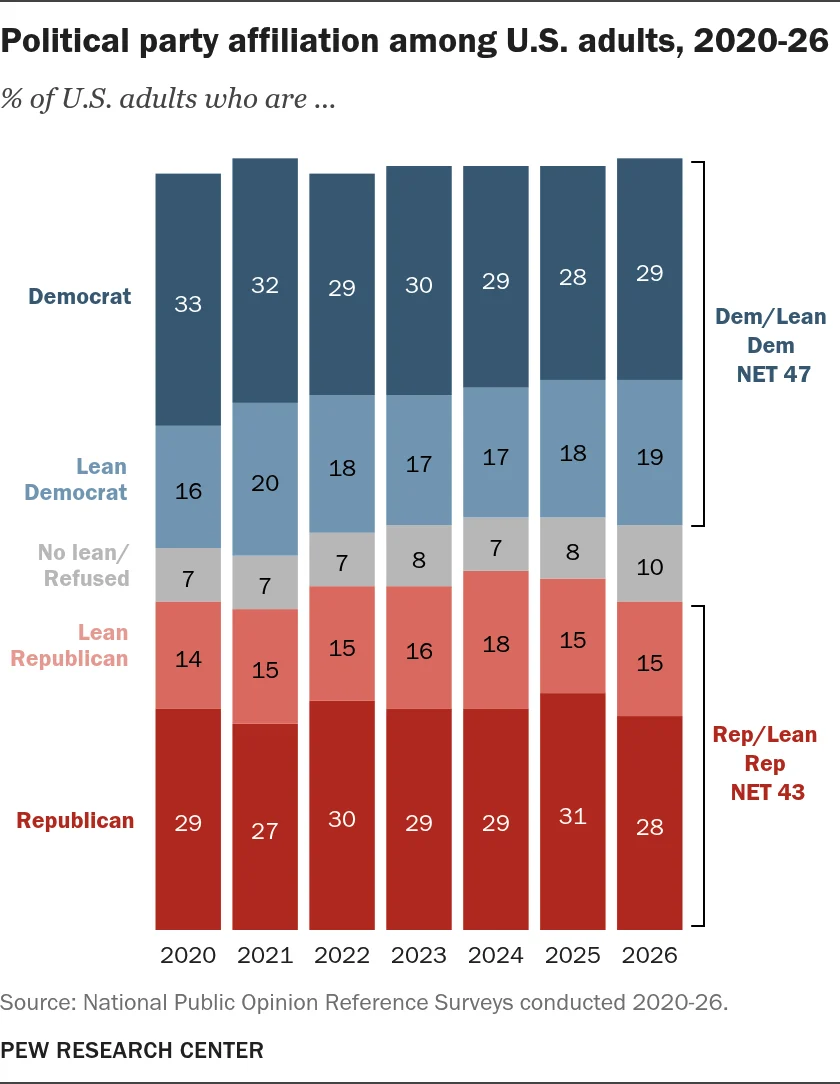
A key aspect of Pew’s approach is the inclusion of "leaners" in their partisan affiliation analysis. While a significant portion of Americans identify directly as Republican (28%) or Democrat (29%), a substantial segment, 44%, categorize themselves as independents or "something else." Crucially, most of these independents express a preference, or "lean," toward one of the two major parties. The data indicates that 15% of all adults lean Republican, and 19% lean Democratic. Pew’s research consistently demonstrates that these leaners’ political views and behaviors more closely resemble those of the partisans they lean toward, making their inclusion vital for a comprehensive understanding of the nation’s political divisions. Consequently, throughout this analysis, references to Republicans and Democrats encompass these individuals who lean toward a particular party.
The NPORS fact sheet, along with detailed methodology documents and dataset links, are publicly available, offering transparency and enabling further research. This current analysis builds upon the foundation laid by previous reports, including the April 2024 publication "Changing Partisan Coalitions in a Politically Divided Nation," which provided a deeper dive into partisan trends among registered voters using data from the American Trends Panel and historical telephone surveys.
The Current State of Play: A Narrow Democratic Edge
The most striking finding from the 2026 NPORS is the continued, albeit narrow, advantage held by the Democratic Party in overall partisan affiliation. Currently, 47% of U.S. adults identify with or lean toward the Democratic Party, while 43% align with or lean toward the Republican Party. This represents a four-percentage-point lead for Democrats.
This modest edge is notably similar to the partisan balance observed in 2020, the final year of President Donald Trump’s first term. However, it signifies a departure from the period between 2022 and 2025, during which the public was more evenly divided, with the two parties nearly mirroring each other in affiliation. The 2026 data suggests a slight rebalancing, with Democrats regaining a more discernible, though still slender, lead.
The Democratic Party’s advantage in 2026 is primarily driven by its stronger performance among "leaners." While the core partisan identification remains close, the distribution of those who express a leaning toward a party has tipped the scales. This highlights the importance of these independent-leaning voters as a critical bloc that can influence the overall partisan landscape.
A Snapshot in Time: Partisan Affiliation Trends (2020-2026)
The NPORS data, collected annually from 2020 to 2026, provides a valuable longitudinal perspective on partisan shifts:
- 2020: A period of close division, with Republicans at 42% (29% identified, 14% lean) and Democrats at 49% (33% identified, 16% lean).
- 2021: A slight shift, with Democrats holding a more pronounced edge: Republicans at 42% (27% identified, 15% lean), Democrats at 52% (32% identified, 20% lean).
- 2022: A move towards parity: Republicans at 45% (30% identified, 15% lean), Democrats at 47% (29% identified, 18% lean).
- 2023: Continued near-even split: Republicans at 45% (29% identified, 16% lean), Democrats at 47% (30% identified, 17% lean).
- 2024: A slight uptick in Republican leaners: Republicans at 47% (29% identified, 18% lean), Democrats at 46% (29% identified, 17% lean).
- 2025: A marginal increase in Republican identification: Republicans at 46% (31% identified, 15% lean), Democrats at 46% (28% identified, 18% lean).
- 2026: The current snapshot, showing Democrats with a four-point lead: Republicans at 43% (28% identified, 15% lean), Democrats at 47% (29% identified, 19% lean).
This timeline illustrates the fluidity of partisan affiliation. The period from 2022 to 2025 saw a remarkable equilibrium, a rarity in recent American political history. The slight Democratic advantage in 2026, driven by an increase in Democratic leaners, suggests that while the overall partisan identification remains closely contested, the nuances of how individuals align are key to understanding the current balance of power.
Demographic Divides: Where Partisanship Differs
The NPORS data also provides critical insights into how partisan affiliation varies across key demographic groups, revealing persistent and evolving divides:
Partisanship by Gender
The gender gap in American politics remains a consistent feature, and the 2026 data reinforces this trend. Men are now 11 percentage points more likely than women to affiliate with the Republican Party. Conversely, women are 9 percentage points more likely than men to identify with the Democratic Party.

While the Republican Party maintains a 6-point advantage among men, this is a narrower margin compared to the period between 2022 and 2025, though it is wider than in 2020 and 2021. This suggests a slight convergence within the male electorate, though the overall gendered pattern of affiliation persists.
Partisanship by Race and Ethnicity
Significant partisan differences emerge when examining affiliation by race and ethnicity. The Democratic Party continues to command stronger support among Black, Asian, and Hispanic adults. Across these demographic groups, the data indicates modest shifts away from the Republican Party since 2025, a trend that follows a period where Republicans had made some inroads.
In contrast, White Americans continue to demonstrate a stronger inclination towards the Republican Party than the Democratic Party. This persistent pattern underscores the distinct partisan identities that have developed within different racial and ethnic communities.
Partisanship by Education
Education level has become a powerful predictor of partisan affiliation, a dynamic that has solidified in recent years. Adults with a four-year college degree or higher education are now more likely to identify with or lean toward the Democratic Party. Conversely, adults without a college degree are more evenly divided between the two major parties. This divergence highlights how educational attainment has become a significant marker in the nation’s political segmentation.
Partisanship by Age Group and Generational Cohort
Age and generational cohort reveal distinct patterns of partisan alignment:
-
Age Groups: U.S. adults under the age of 50 currently lean Democratic. Those aged 50 to 64 tend to lean Republican, while individuals aged 65 and older are more evenly divided in their partisan affiliations. The youngest adult cohort, aged 18 to 29, exhibits a partisan balance that is remarkably similar to the balance seen among those in the same age bracket in 2022, prior to the midterm elections. This stability in the youngest demographic’s leanings, despite the intervening years, is noteworthy.
-
Generational Cohorts: Analyzing partisanship by generational cohort, which tracks the same groups of people as they age, offers a different perspective. The partisan balance within some older cohorts, such as those born in the 1960s (currently aged 57 to 66), has remained relatively stable. However, other groups have experienced more pronounced shifts. Notably, the Democratic Party has reasserted a significant edge among those born in the 1990s (currently aged 27 to 36) and those born in the 1980s (currently aged 37 to 46). This represents a notable shift from the previous year, indicating a resurgence of Democratic affiliation among these younger and middle-aged cohorts.
The Pew Research Center meticulously defines generational cohorts based on birth decade. For instance, the 1940s cohort includes individuals born between January 1, 1940, and December 31, 1949. Data is presented for cohorts where at least 80% of their members in 2026 are 18 years or older, ensuring sufficient sample size for reliable analysis.
Partisanship by Age and Gender Combined
When age and gender are considered together, a more nuanced picture emerges. Men, across all age groups, continue to show a greater likelihood of aligning with the Republican Party. Consistent with the broader gender gap, women in every age bracket are less Republican than their male counterparts of the same age.
Interestingly, significant age-related differences in partisanship are less pronounced among men. However, among women, those under 50 are more inclined to affiliate with the Democratic Party than women aged 50 and older. This suggests that while the gender divide is a pervasive factor, the influence of age on women’s partisan leanings is more pronounced.
It is important to note that sample sizes for these more granular subgroup analyses can be relatively small, particularly for younger demographics. This can lead to greater uncertainty and larger margins of error, requiring careful interpretation of any observed shifts. The Pew Research Center provides detailed margin of error tables for these analyses, enabling researchers and the public to gauge the statistical significance of the findings.
Broader Implications and Future Outlook
The findings from the 2026 NPORS offer several critical takeaways for understanding the current state and future trajectory of American politics. The narrow Democratic advantage, while not a seismic shift, suggests a potential recalibration after a period of near-equilibrium. The increased reliance on "leaners" for this advantage underscores the importance of mobilizing and persuading independent voters.
The persistent demographic divides—by gender, race, ethnicity, education, and age—paint a picture of a deeply segmented electorate. These divisions are not merely statistical curiosities; they represent fundamental differences in lived experiences, values, and policy priorities that are likely to shape electoral outcomes and policy debates for years to come.
The data on generational cohorts is particularly instructive. The shifting allegiances within younger and middle-aged cohorts, with a resurgence of Democratic affiliation, could signal future electoral advantages for the party, provided these trends hold. Conversely, the continued Republican strength among White Americans and older age groups indicates strong, enduring bases of support.
The Pew Research Center’s commitment to regular, in-depth polling through the NPORS provides an invaluable resource for academics, policymakers, journalists, and the public. As the nation navigates an increasingly complex political environment, these data-driven insights serve as essential tools for comprehending the shifting sands of American partisanship and their profound implications for the country’s future. Further research, building on these findings, will undoubtedly explore the underlying causes of these shifts and their potential impact on upcoming elections and the broader political discourse.