A recent survey by the Pew Research Center in January 2026 reveals that 60% of U.S. adults believe abortion should be legal in all or most cases, while 38% hold the opposing view that it should be illegal in all or most cases. This public opinion data comes nearly four years after the Supreme Court’s landmark decision in June 2022 to overturn Roe v. Wade, which eliminated the federal constitutional right to abortion and returned the authority to regulate or ban the procedure to individual states. This shift has profoundly altered the legal and accessibility landscape of abortion care across the nation.
The Pew Research Center’s analysis draws upon extensive historical data from two leading organizations: the U.S. Centers for Disease Control and Prevention (CDC) and the Guttmacher Institute. This research aims to provide a comprehensive overview of abortion in the United States, covering its prevalence, methods, demographics of those seeking the procedure, and safety. The data cited predominantly predates the Supreme Court’s 2022 decision, offering a crucial baseline for understanding the impact of this pivotal legal change.
Understanding the Data Sources
Pew Research Center’s examination of abortion statistics relies on decades of data collection by both governmental and independent research bodies. The CDC’s "abortion surveillance" reports, published annually since 1974, are based on voluntary data submissions from state health agencies. However, it is important to note that the CDC has not received abortion data from all states, notably California, since the mid-1990s, which can lead to underestimations in their national totals.
In contrast, the Guttmacher Institute, a private, nonprofit research organization that advocates for reproductive rights, conducts national surveys of abortion providers. Since 1973, Guttmacher has surveyed every known provider of abortion services—including clinics, hospitals, and physicians’ offices—every three years for much of the past half-century. Their methodology aims for comprehensive data collection. Following the overturning of Roe v. Wade, Guttmacher has transitioned to publishing monthly figures based on a sample of providers to capture more immediate trends. It’s crucial to acknowledge that these two data sets, while both valuable, employ different methodologies and thus yield distinct figures.
The Volume of Abortions in the U.S.: A Complex Picture
Determining the precise annual number of abortions in the United States is a complex undertaking due to the differing methodologies of the CDC and the Guttmacher Institute.
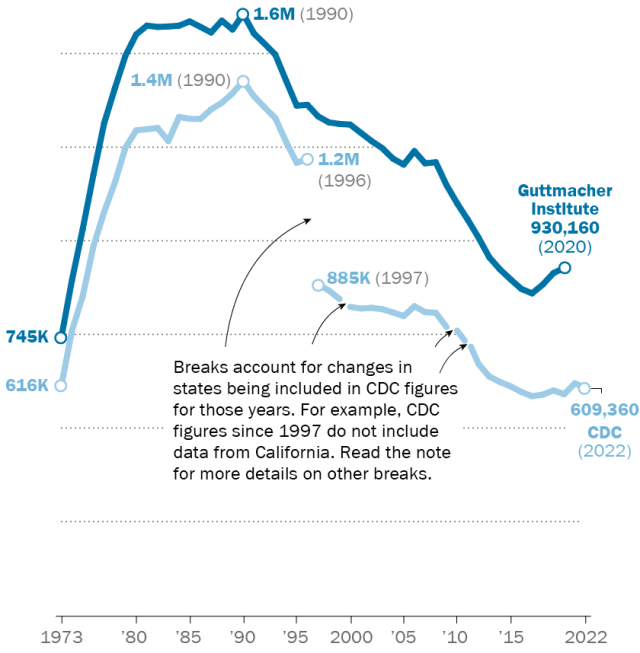
The CDC reported 613,383 abortions in the 46 states and the District of Columbia that provided data for 2022. This figure represents a decrease from 625,978 in 2021 but an increase from 597,355 in 2020. Data for 2023, the first full year after the overturning of Roe v. Wade, was anticipated in November 2025 but has not yet been published, delaying a comprehensive analysis of its immediate impact on national abortion numbers.
The Guttmacher Institute, using its provider-based survey method, reported 930,160 abortions in 2020 across all 50 states and the District of Columbia. This was an increase from 916,460 in 2019 and 885,800 in 2018. As mentioned, Guttmacher now provides monthly data, which is not directly comparable to their previous triennial national tallies.

It is important to underscore that both the CDC and Guttmacher figures encompass only legal, induced abortions performed within clinical settings or involving abortion pills dispensed by certified facilities. They do not account for abortions obtained outside of these formal structures, such as through the self-management of pills acquired without clinical oversight.
Historical Trends: A Long-Term Decline
The number of legal abortions in the U.S. initially surged following the Supreme Court’s 1973 decision in Roe v. Wade, which legalized the procedure nationwide. The peak was observed in the late 1980s and early 1990s, with annual figures nearing 1.4 million according to the CDC and approximately 1.6 million according to Guttmacher.
Since that peak, there has been a general and consistent decline in the number of abortions. A CDC analysis characterized this trend as "a slow yet steady pace," occurring even as the population of women of reproductive age (15-44) has increased. Guttmacher data suggests that by 2020, the number of abortions had fallen by 40% compared to 1991. Similarly, CDC figures for 2022 show a 37% decrease from 1991, when comparing the same jurisdictions that reported data in both years.
The CDC’s adjusted figures, which ensure consistent state reporting for long-term comparisons, indicate 609,360 legal abortions in 2022. While the overall trend has been downward, there have been intermittent fluctuations. The mid-2000s and the late 2010s saw temporary upticks. Since 2017, CDC data has shown year-to-year variability, while Guttmacher reported an 8% increase in abortions between 2017 and 2020.
Abortion Rates: A Declining Trend
When accounting for population changes, the abortion rate in the U.S. has also seen a general decline since 1980. Guttmacher reported a rate of 14.4 abortions per 1,000 women aged 15 to 44 in 2020, a significant drop from 29.3 per 1,000 in 1981.
The CDC’s data echoes this long-term trend. For 2022, the agency reported 11.2 abortions per 1,000 women aged 15 to 44, compared to 25 per 1,000 in 1980. It is noteworthy that these CDC figures for 2022 exclude data from California, Maryland, New Hampshire, New Jersey, and the District of Columbia, whereas the 1980 data included all states and D.C.
Recent years show a more stable pattern in abortion rates. Guttmacher data indicates a slight increase between 2017 and 2020, while CDC data has shown the rate fluctuating between 11.0 and 12.0 since 2014.
The Rise of Medication Abortion
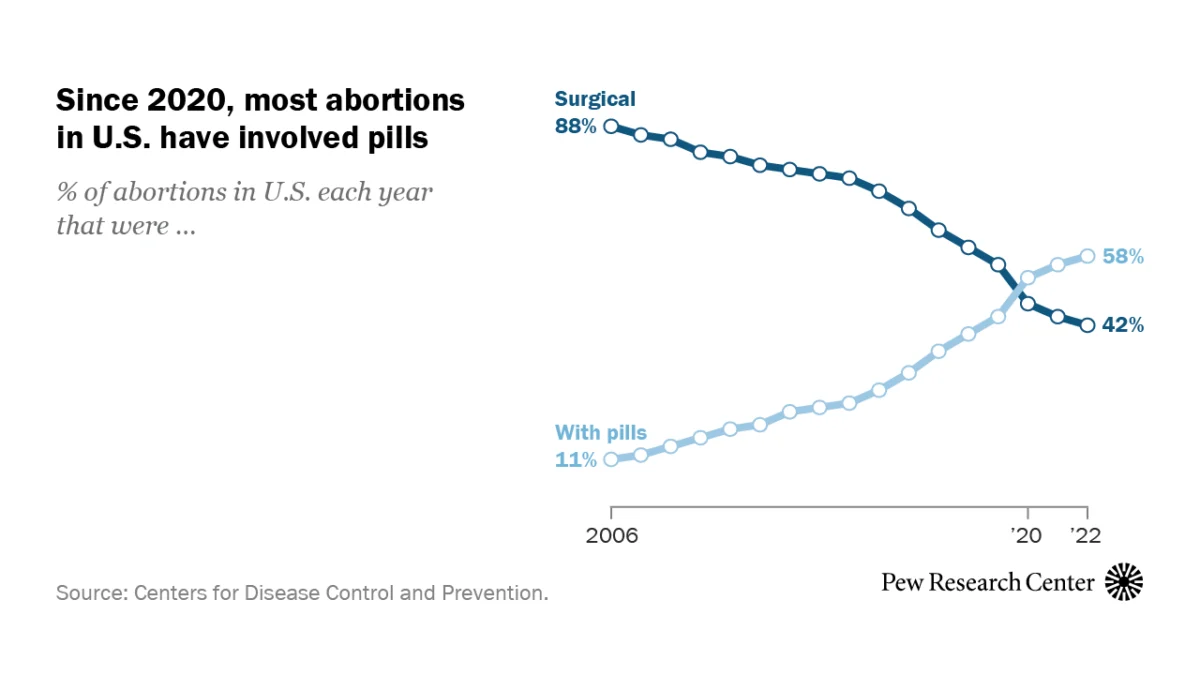
The methods used for abortion have also evolved. The CDC categorizes abortions into two primary types: surgical and medication abortions, which involve the use of pills. Surgical abortions, typically performed in the first trimester, often utilize suction procedures. For abortions in the second trimester, dilation and evacuation techniques are more common.
Medication abortion, utilizing a two-pill regimen (mifepristone and misoprostol), has gained prominence since the FDA approved abortion pills in 2000. Mifepristone blocks hormones essential for pregnancy continuation, while misoprostol induces uterine contractions to expel the pregnancy. The FDA considers this combination safe and effective for up to 10 weeks of gestation.
The increasing accessibility and acceptance of medication abortion have led to a significant shift in national abortion practices. By 2020, Guttmacher data indicated that 53% of U.S. abortions involved pills, a substantial rise from 39% in 2017. The CDC reported that in 2022, 58% of abortions in the jurisdictions that provided this data involved medication abortion. This trend does not encompass instances where abortion pills are obtained and used outside of clinical settings. Research published in the Journal of the American Medical Association in 2024 indicated a notable increase in medication abortions outside of clinical settings in the six months following the Supreme Court’s 2022 decision.
Shifting Provider Landscape
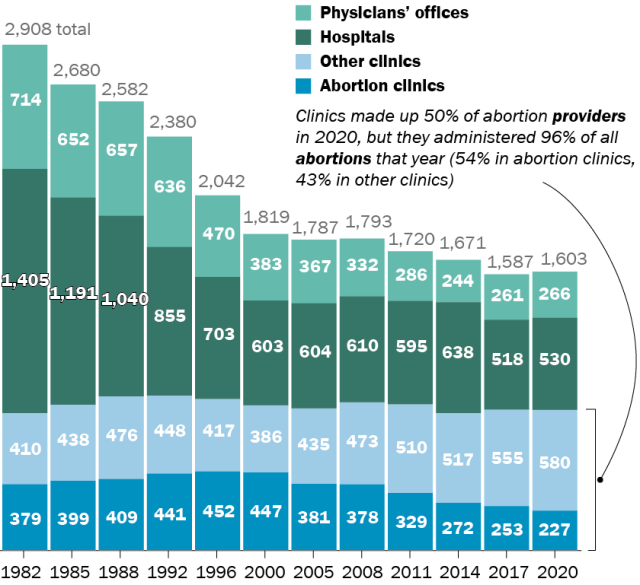
The number of facilities providing abortion services has also undergone significant changes. According to the Guttmacher Institute, in 2020, there were 1,603 abortion-providing facilities in the U.S., comprising 807 clinics, 530 hospitals, and 266 physicians’ offices. This represents a substantial decrease from 1982, when Guttmacher reported 2,908 such facilities, including 1,405 hospitals. The decline in hospital-based abortion services has been a major contributor to the overall reduction in provider numbers.
Clinics have become increasingly central to abortion provision. While they constituted half of all abortion providers in 2020, they were the site for 96% of all abortions performed that year. This marks a significant shift from the mid-1970s, when approximately half of all abortions occurred in clinics.
The landscape of clinics has contracted since the Supreme Court’s 2022 decision. Guttmacher reported a decrease from 807 clinics in 2020 to 753 by December 2025. This trend reflects the impact of state-level restrictions and closures on access to abortion care.
Inter-State Abortion Care and Demographics
The overturning of Roe v. Wade has amplified the significance of inter-state abortion care. In 2022, the year of the Supreme Court’s decision, approximately 16.5% of clinical abortions in the jurisdictions reporting to the CDC were performed on individuals who resided in a different state than the provider. This figure was an increase from 10.9% in 2021, suggesting a growing trend of patients traveling for care. This contrasts sharply with the pre-Roe era, when 44% of abortions in 1972 were performed on individuals from out of state, a number that rapidly declined to 13% by 1974 as legal access expanded nationwide.
The demographics of women seeking abortions continue to be a subject of detailed statistical analysis. According to CDC data for 2022, women in their 20s constituted the largest age group, accounting for 57% of abortions. Women in their 30s represented 31%, while teenagers (13-19) comprised 8.5%, and women aged 40-44 represented about 4%. The vast majority of women obtaining abortions in 2022 were unmarried (88%), with married women accounting for 12%.
Racial and ethnic disparities persist in abortion data. In 2022, non-Hispanic Black women represented 39% of all women who had abortions in the jurisdictions reporting to the CDC. Non-Hispanic White women accounted for 32%, Hispanic women (of any race) for 21%, and women of other races for 7%. Analyzing abortion rates per 1,000 women aged 15 to 44 reveals significant variations: 24.4 for non-Hispanic Black women, 11.6 for Hispanic women, 5.7 for non-Hispanic White women, and 9.4 for women of other races.
Regarding previous pregnancies, 56% of women who had induced abortions in 2022 were first-time abortion recipients. For 25%, it was their second abortion, 11% had their third, and 8% had undergone four or more abortions. Furthermore, 41% of women who had abortions in 2022 had no previous live births, while 24% had one, 19% had two, 9% had three, and 6% had four or more previous live births.
Timing of Abortions and Safety
The overwhelming majority of abortions occur early in pregnancy. In 2022, 93% of abortions were performed at or before 13 weeks of gestation. An additional 6% occurred between 14 and 20 weeks, and approximately 1% were performed at 21 weeks or later. These statistics highlight that most abortions take place within the first trimester.
Medical complications associated with abortion are relatively rare. Estimates suggest that around 2% of all abortions in the U.S. involve some form of complication, with most not requiring hospitalization or further medical intervention, according to an article in StatPearls.
The CDC meticulously tracks case-fatality rates for induced abortions, which measure the number of deaths per 100,000 legal abortions. The most recent period examined (2013-2021) showed a rate of 0.46 deaths per 100,000 legal induced abortions, the lowest recorded. In contrast, the initial period analyzed by the CDC (1973-1977) had a rate of 2.09 deaths per 100,000. The CDC calculates these rates over extended periods due to the relatively low number of abortion-related deaths, which can lead to significant year-to-year fluctuations.
The annual number of reported deaths from induced abortions has seen a dramatic decrease over the decades. In 1972, the year before Roe v. Wade, 39 deaths were attributed to illegal abortions. This figure dropped to single digits or zero annually after 1973. Deaths from legal abortions have also declined, though with some variation. Since 1990, the annual number of deaths from legal induced abortions has ranged from two to 12. In 2021, five women died from complications of induced abortions, and six in 2020.
The historical data reveals a profound impact of legalizing abortion on public health. In the 1960s, deaths from induced abortions were substantially higher, with 119 recorded in 1963 and 99 in 1965. The decline in deaths from illegal abortions, in particular, has been a critical public health achievement following the landmark Roe v. Wade decision.
The data compiled by the CDC and the Guttmacher Institute provides a detailed and evolving picture of abortion in the United States. As the nation navigates the post-Roe landscape, these statistics will be crucial for understanding the ongoing trends in abortion access, utilization, and outcomes.