The United States and Cuba share a deep and complex relationship that stretches back centuries, predating the very formation of the United States. Both were Spanish colonies in the 16th century, a historical connection that laid the groundwork for centuries of interaction. Over the past seven decades, a confluence of political upheaval and economic realities on the island has spurred significant Cuban migration to the U.S., creating distinct waves of arrivals, most notably following the Cuban Revolution in 1959. Today, millions of Americans trace their ancestry to Cuba, forming a vibrant and influential community. This analysis, drawing on the U.S. Census Bureau’s 2024 American Community Survey and other authoritative sources, provides a detailed examination of this population, offering insights into their demographics, immigration patterns, and evolving societal contributions.
The Evolving Cuban American Demographic
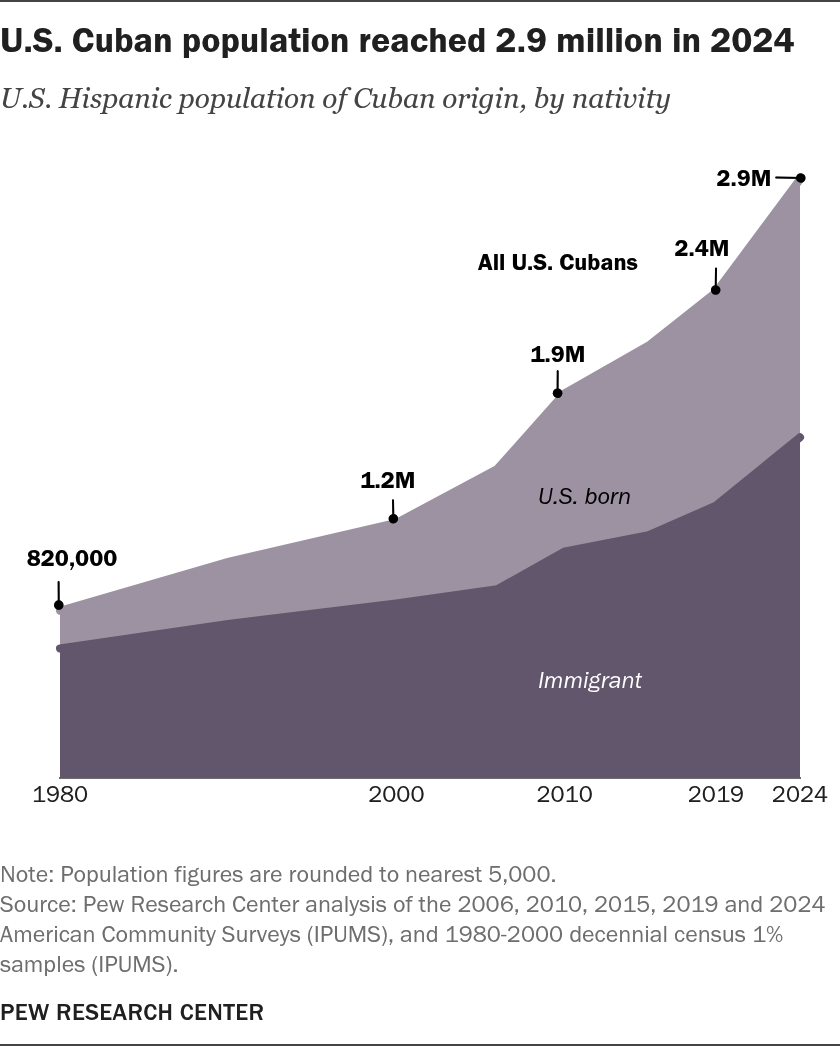
As of 2024, the Cuban-origin population in the United States stands at an impressive 2.9 million individuals, marking a substantial 23% increase since 2019. This growth rate outpaces that of other major Hispanic origin groups like Mexicans and Puerto Ricans, who saw a 5% increase during the same period. However, it trails behind the rapid expansion seen in other Latin American communities, such as Venezuelans (119%), Colombians (43%), and Hondurans (37%).
A significant characteristic of the Cuban American community is the substantial presence of immigrants. Over half of Cubans residing in the U.S. (57%, or approximately 1.7 million people) are foreign-born. This figure underscores the continuous influx of individuals from Cuba over many decades, with a notable surge in recent years.
A History of Immigration Waves: From Revolution to Modern Policy Shifts
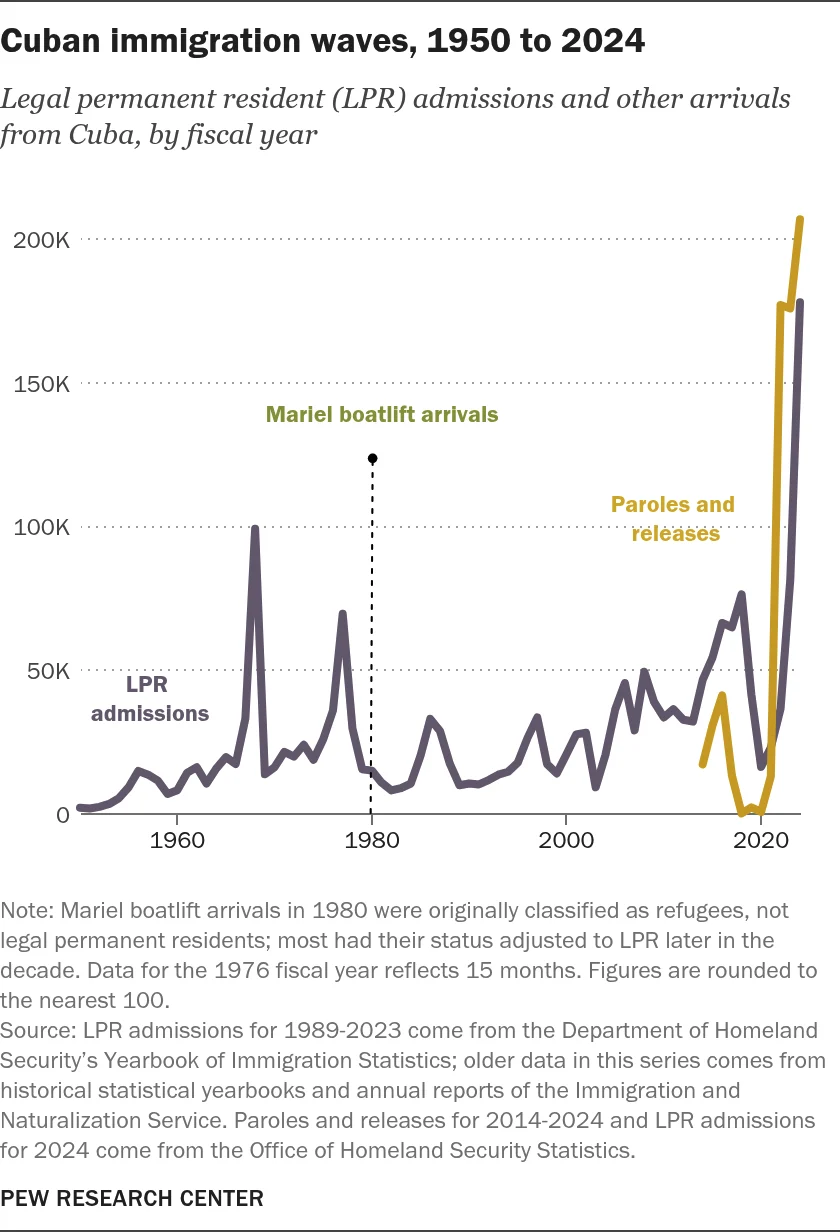
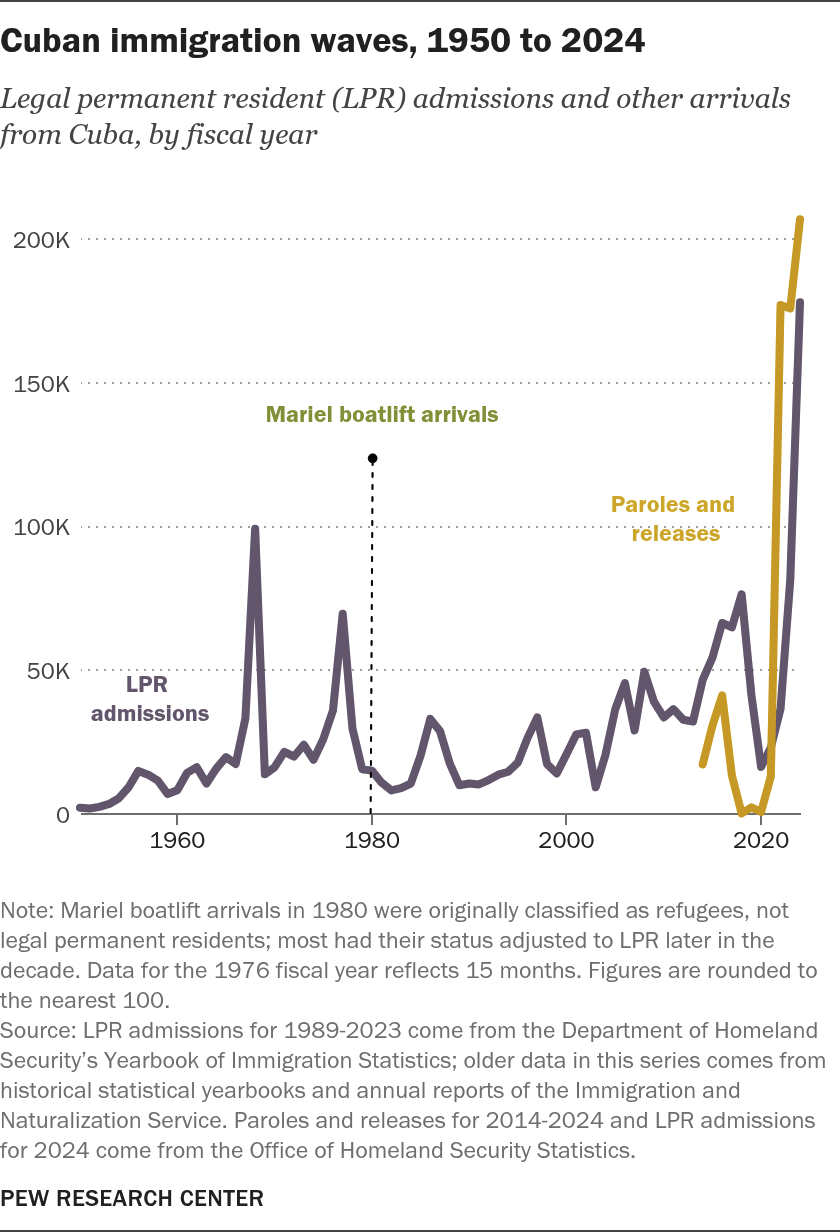
Cuban immigration to the United States has not been a uniform flow but rather a series of distinct waves, each shaped by specific historical, political, and economic circumstances. The immediate aftermath of the Cuban Revolution in 1959 saw a quarter-million Cubans arrive in the U.S. during the 1960s, many seeking refuge from the new political order. Another substantial wave of approximately 250,000 Cubans arrived in the 1970s, continuing the trend of seeking new opportunities and freedom.

The 1980s were marked by the unprecedented Mariel boatlift, a massive exodus that brought an estimated 125,000 Cubans to American shores within a few months. This event, triggered by political unrest and economic hardship on the island, represented a significant moment in U.S.-Cuba relations and reshaped the Cuban American community.
Following the Mariel boatlift, immigration from Cuba continued, with notable increases observed in the mid-2000s. These inflows remained robust until the onset of the COVID-19 pandemic. A dramatic resurgence in immigration began in 2022, coinciding with significant policy shifts implemented by the Biden administration that altered the landscape for Cuban immigrants.
Shifting U.S. Immigration Policies and Their Impact
The immigration policies governing Cubans entering the United States have undergone considerable evolution over the past seven decades. Beginning in the 1960s, a large majority of Cubans arrived legally, often admitted as refugees. This era was characterized by a welcoming stance, reflecting the geopolitical climate of the Cold War.
Later, the "wet foot, dry foot" policy, enacted in 1995 and rescinded in 2017, provided a unique pathway for Cubans. Under this policy, Cubans who reached U.S. soil without visas were generally permitted to stay and pursue legal residency. This policy was a cornerstone of U.S. efforts to establish diplomatic relations with Cuba, as initiated by President Barack Obama in January 2017. The termination of the "wet foot, dry foot" policy marked a significant turning point, aligning Cuban immigrants more closely with the immigration regulations applied to other nationalities.
The consequences of these policy changes have been profound, leading to a sharp increase in the number of unauthorized immigrants from Cuba. Prior to 2017, the number of unauthorized Cuban immigrants was virtually non-existent due to the prevailing legal entry pathways. However, by July 2023, estimates indicated that approximately 475,000 unauthorized Cuban immigrants resided in the U.S. This figure has continued to grow, with an additional 250,000 estimated to have entered the country between then and the end of 2024.
Under the Biden administration, many unauthorized Cuban immigrants have been granted temporary protection from deportation through programs like the CHNV (Cuba, Haiti, Nicaragua, Venezuela) parole program, which allows individuals from these countries to live and work in the U.S. Additional protections have been offered through special parole and release initiatives at the U.S.-Mexico border. However, in 2025, the Trump administration announced the termination of the CHNV program and sought to end other temporary protection measures, signaling a potential shift in the legal status and future of these individuals.
Political Leanings and Community Concentration
Historically, Cuban Americans have demonstrated a stronger inclination towards the Republican Party compared to the broader Hispanic population. This alignment was particularly pronounced in earlier decades. However, recent trends suggest a potential softening of this GOP allegiance, with some segments of the community showing increased receptiveness to the Democratic Party.
A Pew Research Center survey conducted in October 2025 revealed nuanced views among Cuban Americans regarding immigration policies. While 40% of Cuban Americans approved of the Trump administration’s approach to immigration, a figure notably higher than the 21% among Hispanics overall, they expressed similar levels of concern about potential deportation for themselves or loved ones (47% compared to 52% for all Hispanics). This suggests a complex interplay of cultural affinity, economic concerns, and personal anxieties within the community.
Geographically, Florida remains the undisputed hub for the Cuban American population. Approximately six in ten Cubans in the U.S. (61%, or 1.8 million individuals) reside in Florida, a concentration unmatched by any other Hispanic origin group in a single state. This profound connection to Florida reflects historical migration patterns and the establishment of strong community networks.
Texas follows as the second-largest state for Cubans, home to 8% of the population (225,000 individuals). California, New Jersey, and New York each host around 3% of the total Cuban population, with approximately 99,000, 98,000, and 85,000 residents, respectively. A significant majority of U.S. Cubans—94%—reside in metropolitan areas, a considerably higher proportion than the general American population (79%), highlighting their urban integration and the importance of established urban centers for community life and economic opportunity.
The Miami metropolitan area stands out with an exceptionally large Cuban population, encompassing 42% of all Cubans in the U.S. (1.2 million individuals). The Tampa metropolitan area also hosts a substantial Cuban community of 177,000 residents. Outside of Florida, the New York City (153,000) and Houston (107,000) metropolitan areas are home to the next largest Cuban populations.
Age Demographics and Educational Attainment
Cuban Americans represent the oldest Hispanic origin group in the United States, with a median age of 38.2 years. This median age is identical to that of the overall U.S. population but significantly higher than the median age for all Hispanics, which stands at 30.2 years. This demographic characteristic is attributed to the arrival of older immigrants from Cuba and a relatively lower fertility rate among Cuban Americans in general.
When examining educational attainment, a distinction emerges between U.S.-born and foreign-born Cubans. While foreign-born Cubans are less likely than the overall U.S. population to hold a bachelor’s degree or higher, U.S.-born Cubans exhibit a reverse trend, demonstrating a higher propensity for advanced education. Specifically, 45.4% of U.S.-born Cubans aged 25 and older have obtained at least a bachelor’s degree, compared to 27.2% of immigrant Cubans. This contrasts with the overall U.S. population, where 36.9% of adults have at least a bachelor’s degree, and for all Hispanics, where the figure is 21.6%. The data suggests that while educational opportunities and outcomes may differ based on nativity, the Cuban American community as a whole demonstrates a strong commitment to educational advancement, with U.S.-born individuals often achieving higher levels of academic success.
The rich history and ongoing evolution of the Cuban American community present a compelling narrative of resilience, adaptation, and significant contribution to the diverse tapestry of the United States. Understanding these demographic shifts, immigration patterns, and political dynamics is crucial for comprehending the present and future of this influential population.