On January 13, 2026, the Public Policy Exchange hosted a high-level forum to scrutinize the United Kingdom’s newly unveiled Child Poverty Strategy, titled "Tackling Child Poverty: Improving Welfare, Security and Future Prospects." The event featured a keynote analysis by Priya Sahni-Nicholas, Co-Executive Director of The Equality Trust, who provided a critical assessment of the government’s framework. While the strategy marks a significant departure from the policy directions of the previous fifteen years, the analysis presented at the forum suggests that the government’s current approach, while effective at addressing immediate income shortfalls, remains insufficient in confronting the deeper, structural drivers of wealth inequality and power imbalances that sustain poverty across generations.
The Socio-Economic Landscape: A Decade of Divergence
The release of the Child Poverty Strategy in December 2025 comes at a critical juncture for the United Kingdom. Since 2010, the UK has occupied an anomalous position among advanced economies. While many European neighbors successfully implemented policies that saw child poverty rates stabilize or decline, the UK witnessed a consistent upward trajectory. By the start of 2025, official statistics indicated that 4.5 million children—approximately one in three—were living in poverty.
The human cost of this trend is evidenced by the fact that nearly 20% of UK households struggle with food insecurity, unable to consistently provide adequate nutrition for children. This systemic failure has been framed by the current administration not merely as a social issue, but as a profound moral and economic crisis inherited from post-2010 policy choices, specifically citing the impact of austerity measures and the erosion of the social safety net. The strategy’s stated objective is the total eradication of child poverty over the long term, with a commitment to achieving measurable reductions within the current parliamentary term.
Chronology of Policy Shifts and the Reinstatement of Priority
The December 2025 strategy represents the first UK-wide Child Poverty Strategy since the expiration of the previous Labour government’s framework in the early 2010s. To understand the significance of this shift, a chronological perspective is essential:
- 1997–2010: A period characterized by aggressive redistribution through tax credits and benefits, which successfully lifted approximately 600,000 children out of relative poverty.
- 2010–2024: A shift toward "work-focused" welfare, characterized by the introduction of the two-child limit, the benefit cap, and a freeze on local housing allowances. During this period, child poverty rates climbed steadily despite high employment levels.
- Late 2025: The current government releases "Tackling Child Poverty," explicitly acknowledging poverty as a systemic public-service failure.
- January 2026: Policy experts and advocacy groups, including The Equality Trust, begin the formal process of auditing the strategy’s potential for long-term success.
Core Pillars of the Strategy: Immediate Income Interventions
The strategy’s primary strength lies in its "income domain"—the direct transfer of financial resources to struggling families. The Equality Trust analysis highlights several key "wins" that represent a return to evidence-based poverty reduction:
Abolition of the Two-Child Limit
The single most impactful fiscal measure within the strategy is the repeal of the two-child limit on Universal Credit and Child Tax Credit. Economic modeling suggests this move alone will lift 450,000 children out of relative poverty. This policy was previously criticized for disproportionately affecting larger families and ethnic minority households, thereby entrenching structural inequality.
Addressing In-Work Poverty
A notable shift in the strategy is the recognition that employment is no longer a guaranteed escape from deprivation. With a significant portion of impoverished children living in households where at least one parent works, the strategy introduces measures to bolster the "National Living Wage" and expand access to affordable childcare. By addressing the "cost of essentials"—including uniform caps and the expansion of free school breakfast clubs—the government aims to reduce the "poverty premium" paid by low-income families.

Inclusion of Lived Experience
Unlike previous top-down bureaucratic approaches, this strategy incorporates the voices of those with direct experience of the welfare system. Through partnerships with organizations like "Changing Realities," the policy diagnosis now includes the "mental load" of poverty, the stigma associated with claiming benefits, and the psychological impact of financial insecurity.
The Wealth Gap: The Strategy’s Silent Omission
Despite the welcome focus on income redistribution, The Equality Trust argues that the strategy suffers from a narrow definition of inequality. A central critique offered by Sahni-Nicholas is the total absence of "wealth" from the government’s diagnostic framework. While income refers to the flow of money into a household, wealth refers to the stock of assets—savings, property, and investments—that provide long-term security.
The briefing notes that the word "wealth" does not appear in the strategy’s metrics or solutions. This omission is significant because wealth is the primary predictor of a family’s resilience to economic shocks. Families with identical incomes can have vastly different standards of living based on their access to inherited assets or homeownership.
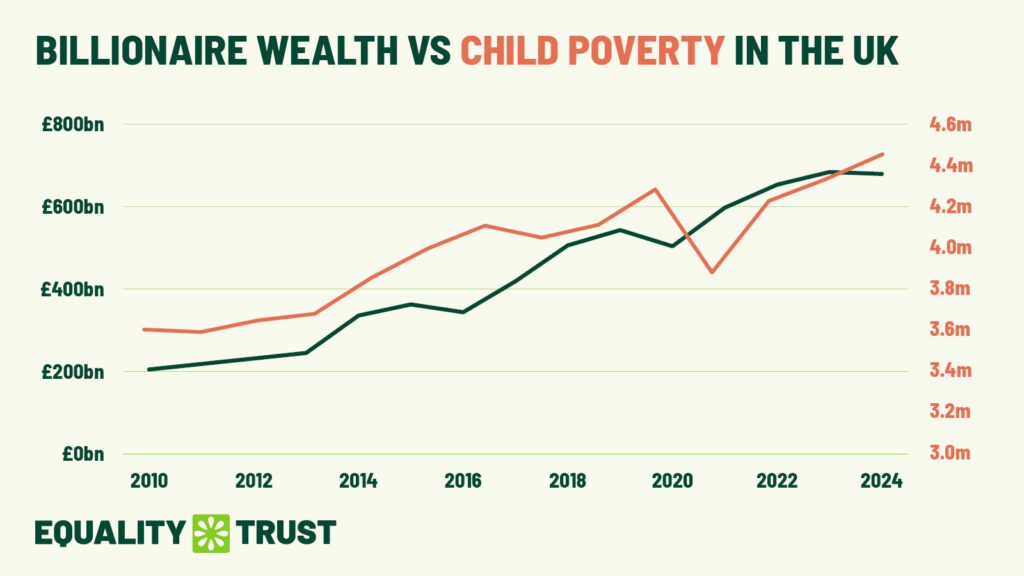
Citing the economic theories of Thomas Piketty, the analysis points to the "r > g" formula—the tendency for returns on capital (wealth) to outpace economic growth. When wealth grows faster than wages, the structural gap between the asset-owning class and the wage-dependent class widens. By focusing exclusively on wages and benefits, the government may be "trying to empty a bath while leaving the taps running."
Power Dynamics and the Economic Model
The Equality Trust posits that poverty is not an accidental byproduct of the system but a result of how power is distributed within the economy. The strategy discusses "opportunity" and "life chances," yet it remains silent on how corporate power, the deregulation of housing markets, and the preferential taxation of assets over labor shape the environment in which poverty is produced.
Historically, the most dramatic reductions in UK inequality followed World War II, driven by deliberate political choices:
- Progressive Taxation: High marginal tax rates on top earners and corporate profits.
- Strong Labor Protections: The empowerment of trade unions to ensure productivity gains were shared with workers.
- Universal Public Services: The creation of the NHS and the massive expansion of social housing, which effectively "de-commodified" essential needs.
The current strategy, by contrast, seeks to mitigate the symptoms of inequality without fundamentally reshaping the economic model that produces it.
Fiscal Reform and the "Growth" Dilemma
A recurring theme in the Public Policy Exchange discussion was the government’s reliance on economic growth to fund social investment. Currently, the majority of government revenue is derived from income tax and national insurance—taxes on work. Consequently, if wages stagnate, public service funding remains constrained.

However, policy analysts point out that while wages have remained relatively flat, returns on assets and capital have continued to grow. These returns are currently taxed at significantly lower rates than labor. The Equality Trust suggests that a truly transformative child poverty strategy must include fiscal reform that shifts the tax burden from work to wealth. Without this, the strategy remains vulnerable to economic downturns and the "austerity logic" that has dominated the last decade.
Implications and Recommendations for Future Iterations
For the Child Poverty Strategy to move from a "corrective" measure to a "transformative" one, several key adjustments are proposed by policy experts:
Integration of Wealth Metrics
Future updates to the strategy should include targets for reducing the wealth gap. This includes addressing the housing crisis—the single largest drain on low-income wealth—and creating mechanisms for intergenerational asset building.
Binding Accountability
A ten-year ambition requires more than just stated goals; it requires binding legislative targets. The analysis calls for transparent, annual reporting with clear political consequences if progress markers are missed. This accountability must include the participation of people with lived experience to ensure the "dignity" aspect of the strategy is being met in practice.

Cross-Departmental Synchronization
Ending child poverty cannot be the sole responsibility of the Department for Work and Pensions (DWP). It requires a "Health in All Policies" style approach, where the Treasury, the Department for Education, and the Ministry of Housing are held equally accountable for poverty reduction outcomes.
Conclusion: A Necessary Floor, Not a Ceiling
The consensus among analysts at the January forum was that the 2025 Child Poverty Strategy represents a vital and long-overdue shift in national priority. By reinstating child poverty as a core metric of government success and reversing punitive policies like the two-child limit, the administration has established a necessary "floor" for social protection.
However, the analysis from The Equality Trust serves as a reminder that poverty is the lower expression of a highly unequal distribution of power and resources. As the government moves from the design phase to the implementation phase, the success of the strategy will likely depend on its willingness to ask harder questions about the concentration of wealth at the top of British society. History and evidence suggest that while income top-ups can reduce immediate hardship, only structural reform can ensure that the next generation of children is truly free from the cycle of deprivation.