A comprehensive analysis of recently published government data reveals a substantial decline in the federal workforce throughout 2025. According to a Pew Research Center examination, the federal civilian workforce experienced a net reduction of nearly 238,000 employees, representing a significant decrease of 10.3% compared to the previous year. This contraction marks a notable shift in federal employment trends and raises questions about the future direction of public service.
Key Figures and Trends in Federal Employment Decline
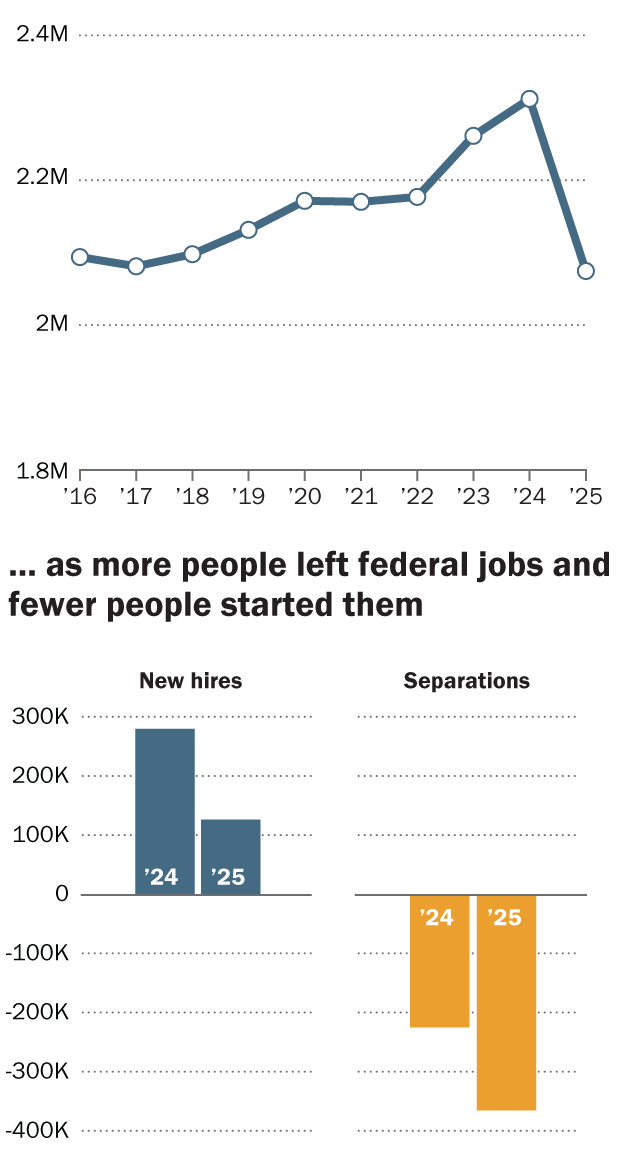
The data, meticulously compiled from the Office of Personnel Management (OPM), paints a stark picture of employment shifts. In 2025, a total of 348,219 individuals separated from federal service through various means, including retirements, resignations, and terminations. This figure represents an 80.8% surge in separations compared to 2024, indicating a significant acceleration in departures. Concurrently, the rate of new hires plummeted. Only 116,912 individuals joined the federal government in 2025, a considerable 55.6% decrease from the preceding year. This dual trend of increased departures and decreased recruitment has led to the overall shrinkage of the federal workforce.
The analysis highlights that these workforce reductions were broadly distributed across the federal government, with minimal differentiation based on educational attainment, tenure with the government, or type of appointment. This suggests a systemic approach to workforce management rather than targeted cuts in specific sectors or roles. However, the data does indicate a disproportionate impact on younger and less experienced federal employees. Those under the age of 35, who constituted 18% of the federal workforce at the close of 2024, saw their representation fall to 16.8% by the end of 2025. Furthermore, workers with less than two years of federal experience, often still within their probationary periods and without full civil service protections, saw their share of the workforce diminish from 16.2% to 10.3%. This trend could have long-term implications for institutional knowledge and the pipeline of future federal leaders.
It is important to note that the OPM has ceased publishing data regarding the gender, race, ethnicity, and disability status of federal workers. This change limits the scope of demographic analysis, preventing a comparison with previous years when such data was available, as seen in a similar Pew Research Center analysis conducted in January 2025.
Chronology of Workforce Changes
The data reflects trends dating back to 2016, providing a historical context for the recent contraction. Prior to 2024, the federal workforce experienced a period of relative stability and gradual growth. From 2016 to 2023, the total number of federal workers fluctuated but remained within a general range. However, 2024 saw a notable increase in federal employment, reaching 2,312,301 workers, with 263,433 new hires and a net separation figure of -192,562. This period likely reflected a different administrative approach to federal staffing.
The year 2025 marked a sharp reversal of this trend. The dramatic increase in separations and the significant decrease in new hires resulted in the workforce shrinking to 2,074,649 employees by December 2025. This represents the most substantial year-over-year decline in recent history, underscoring the impact of policy decisions implemented during this period.

Deep Dives into Agency and Occupational Reductions
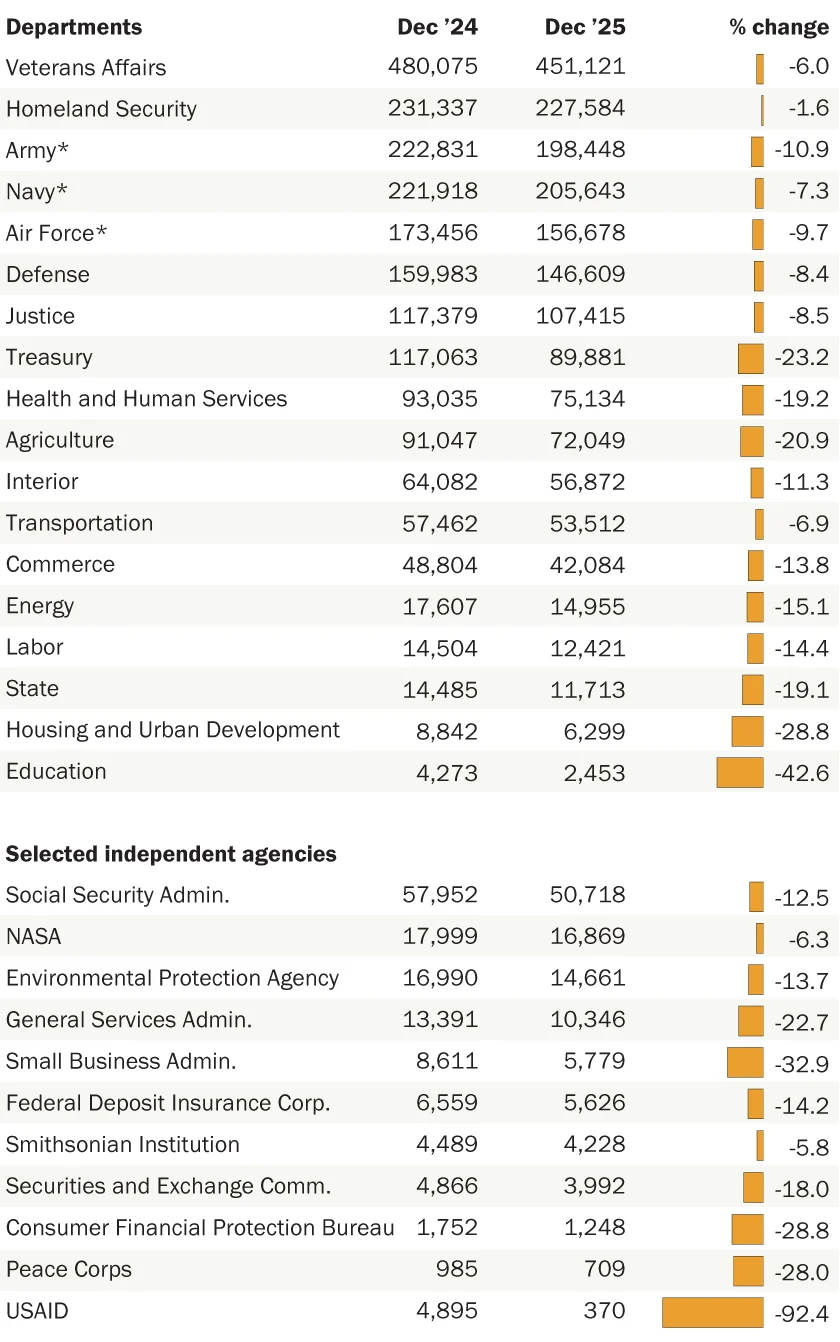
The impact of these workforce reductions varied significantly across different federal departments and agencies. Agencies that were previously vocal targets of administrative scrutiny experienced the most profound cuts. The Department of Education, for instance, saw its workforce decrease by 42.6% between December 2024 and December 2025, plummeting from approximately 4,300 employees to fewer than 2,500. Similarly, the U.S. Agency for International Development (USAID) experienced an almost complete dismantling of its operational staff, with its workforce shrinking by 92.4% from nearly 4,900 employees to a mere 370.
Other notable reductions were observed at:
- The National Endowments for the Arts and the Humanities (a combined reduction of 56.6%).
- AmeriCorps (a decrease of 43.6%).
- The Small Business Administration (a decline of 32.9%).
- The agency overseeing international broadcasters like Voice of America (a reduction of 32.7%).
- The National Science Foundation (a decrease of 30.3%).
The Department of the Treasury also experienced significant cuts, with its workforce declining by 23.2%. The Departments of Health and Human Services and Agriculture saw reductions of 19.2% and 20.9%, respectively. The Department of State also faced substantial cuts, losing 19.1% of its workforce.
Conversely, some agencies experienced growth or remained relatively stable. Within the Department of Homeland Security, while the overall headcount saw a slight decrease, its immigration enforcement components saw significant increases. Immigration and Customs Enforcement (ICE) added approximately 7,500 workers, a 36.1% increase, reaching 28,272 employees. Customs and Border Protection (CBP) also saw a modest increase of 1.5%, rising from 66,613 to 67,587 employees. However, other components within Homeland Security, such as the Transportation Security Administration (-4.3%), Citizenship and Immigration Services (-11.4%), and the Federal Emergency Management Agency (FEMA) (-14.0%), experienced job losses.
The occupational breakdown of these cuts reveals a more pronounced impact on white-collar positions. White-collar workers, who comprised 92.1% of the federal workforce at the end of 2024, saw their numbers decline by 10.6% in 2025. Blue-collar occupations experienced a smaller reduction of 6.7%.
Among the larger occupational groups, significant decreases were observed in:
- Administrative and Program Support: A reduction of 14.9%.
- Management and Program Analysis: A decline of 13.4%.
- Financial Administration and Program Management: A decrease of 12.6%.
- Information Technology: A drop of 10.9%.
- Engineering and Scientific and Technical Positions: A reduction of 10.5%.
- Legal and Related Occupations: A decrease of 9.8%.
Interestingly, the "investigation" occupational group remained relatively stable. This stability was largely attributed to increases in border patrol enforcement and customs and border protection roles, which offset declines in other areas such as compliance inspection and food safety.
Data Limitations and Analytical Scope
The Pew Research Center’s analysis, while comprehensive, is subject to certain limitations inherent in the available government data. The OPM’s Federal Workforce Data tools provide a valuable resource, but significant portions of the data, particularly for December 2025, were redacted. This redaction affects information on job locations and salary details, precluding a thorough analysis of these aspects.
Furthermore, the OPM dataset primarily covers civilian federal employees within the executive branch. It does not encompass active-duty military personnel, nor does it include all federal entities. Notably absent from the dataset are most intelligence agencies, the majority of the Executive Office of the President (with the exception of the Office of Management and Budget), the legislative branch (Congress), the judicial branch, and quasi-independent entities like the U.S. Postal Service and the Federal Reserve.
The dataset does, however, include independent agencies like the Consumer Financial Protection Bureau (CFPB), which experienced a 28.8% reduction in its workforce in 2025. The analysis also acknowledges that minor discrepancies in numbers may arise due to the exclusion of individuals who transferred between positions not publicly reported by OPM.
Broader Implications and Potential Future Impacts
The substantial contraction of the federal workforce in 2025 carries significant implications for the capacity and effectiveness of government operations. A reduced workforce can strain existing personnel, potentially impacting service delivery, regulatory oversight, and the government’s ability to respond to national challenges. The disproportionate impact on younger workers could also create a deficit in institutional knowledge and leadership for the future, potentially hindering long-term strategic planning and execution.
The focus on specific agencies, such as Education and USAID, suggests a prioritization of certain government functions over others, reflecting broader administrative and policy objectives. The contrasting trends within the Department of Homeland Security highlight the complex and sometimes divergent staffing needs within large governmental structures.
As the federal government navigates these workforce shifts, ongoing analysis of employment data will be crucial for understanding the full extent of these changes and their long-term consequences for public service and the nation’s ability to address critical issues. The Pew Research Center’s commitment to analyzing this data underscores the importance of transparency and public understanding of the federal workforce.