A comprehensive analysis by the Pew Research Center reveals a significant and striking increase in audience engagement for federal agency accounts on X, formerly Twitter, during the initial year of the second Trump administration when compared to the final year of the Biden administration. This surge in interaction, measured by likes and reposts, accompanies ongoing discussions and scrutiny surrounding the content and communication strategies employed by government entities on social media platforms. The findings highlight a stark shift in how federal agencies are utilizing X to reach and engage the public, potentially reflecting altered administrative priorities and communication styles.
Key Findings: A Steep Climb in Engagement
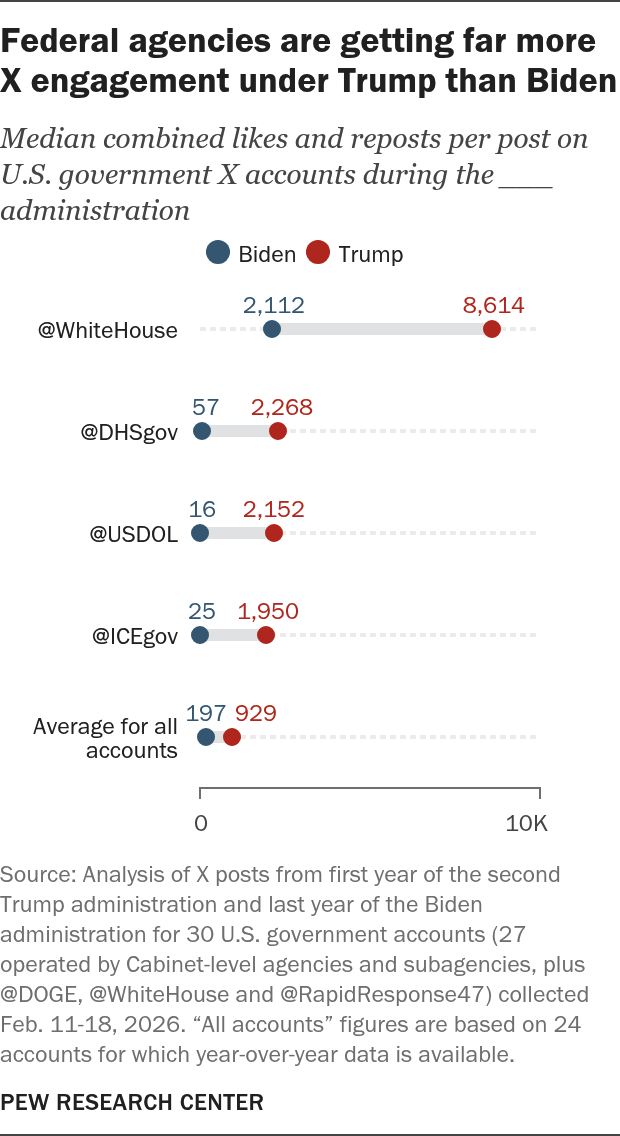
The Pew Research Center’s research indicates that virtually all federal agency X accounts analyzed experienced a substantial uplift in engagement during the first year of the second Trump administration (January 20, 2025 – January 20, 2026) compared to the last year of the Biden administration (January 20, 2024 – January 19, 2025). Out of 24 executive agency X accounts with available year-over-year data, all but two saw a notable increase in the median combined likes and reposts per post. This indicates a widespread phenomenon across various government departments and agencies.
For instance, accounts such as the Department of Homeland Security (@DHSgov) and the Department of Labor (@USDOL) transitioned from minimal X engagement under the Biden administration to routinely garnering thousands of likes and reposts per post during the Trump administration. The @DHSgov account, which averaged only 57 likes and reposts per post in the Biden era, saw this figure skyrocket to an average of 2,268 under the second Trump term. Similarly, @USDOL posts jumped from an average of 16 engagements to 2,152. The White House account (@WhiteHouse) also experienced an exponential increase, moving from a median of 2,112 engagements per post to a remarkable 8,614.
Posting Frequency and Strategic Shifts
Beyond engagement metrics, the analysis also sheds light on the posting frequency of these accounts. The study found that most agencies maintained a similar or slightly reduced posting cadence compared to the final year of the Biden administration. However, a select few, including the White House, Department of Homeland Security, and Immigration and Customs Enforcement (@ICEgov), significantly increased their output. These accounts are now posting more than twice as frequently as they did during the previous administration, suggesting a more aggressive and perhaps proactive social media strategy.

Research Methodology and Scope
The Pew Research Center’s analysis provides a granular look at the digital communication tactics of the U.S. federal government on X. The study encompassed 30 X accounts in total. This selection included 27 accounts operated by Cabinet-level agencies and their subagencies, alongside three prominent accounts: @DOGE (Department of Government Efficiency), @WhiteHouse, and @RapidResponse47 (the official White House rapid response team).
Data collection spanned from February 11-18, 2026, focusing on posts made during the last year of the Biden administration and the first year of the second Trump administration. The research team utilized a third-party web scraping service to gather post text, likes, and reposts. Direct year-over-year comparisons were possible for 24 of the 30 accounts. Certain accounts, such as @DOGE and @RapidResponse47, did not exist prior to the second Trump administration. Furthermore, Biden-era posts were unavailable for accounts associated with Customs and Border Protection, the Department of Defense/Department of War, the Justice Department, and the U.S. Trade Representative. The State Department’s data was collected just before its decision to remove posts from previous administrations.
A Shift in Messaging: Content and Language Evolution
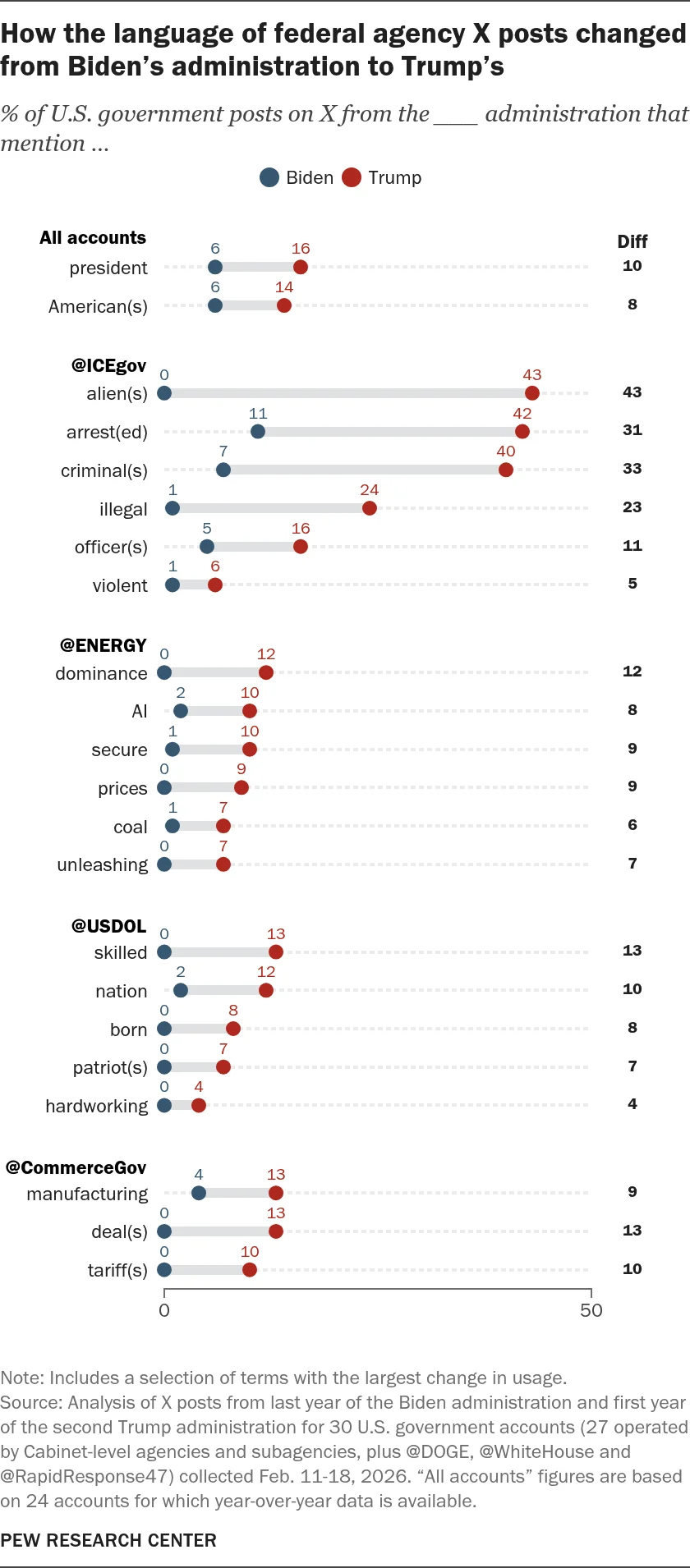
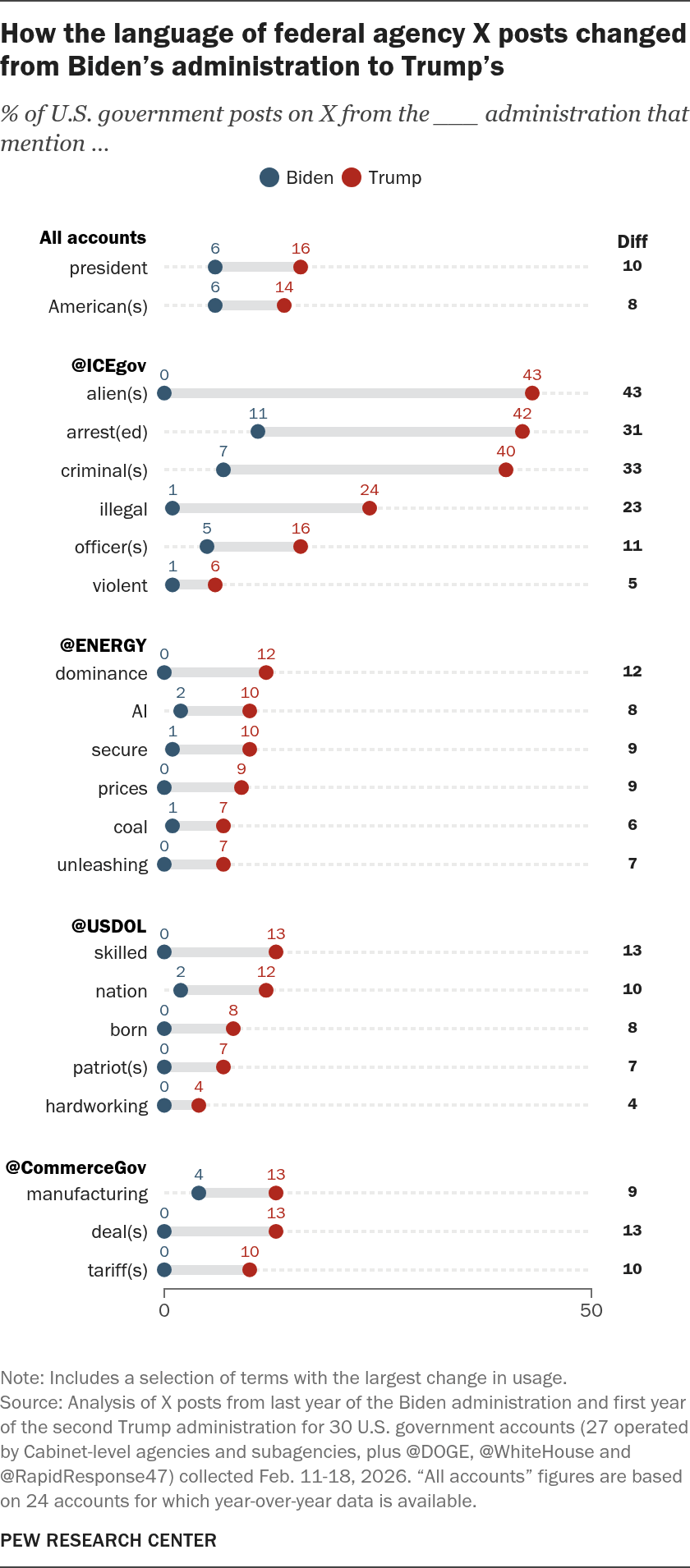
The Pew Research Center’s analysis extends beyond engagement numbers to examine the qualitative changes in federal agency communication on X. A notable shift has occurred in the language employed by these accounts, reflecting the distinct messaging priorities of the Trump administration. Across the analyzed government accounts, the frequency of terms like "American" and "president" more than doubled in posts during the second Trump administration compared to the Biden era.
This linguistic divergence is particularly pronounced at specific agencies. For instance, Immigration and Customs Enforcement (@ICEgov) saw a dramatic fivefold increase in the proportion of its posts mentioning the term "criminal." Concurrently, the use of terms like "alien(s)" surged from 0% of posts to 43%. Other agencies also exhibited significant changes in their lexicon. The Department of Energy (@ENERGY) saw an increase in mentions of terms such as "dominance," "AI," "secure," and "coal," with these terms appearing in approximately one in ten posts after being rarely, if ever, used during the Biden administration. The Department of Labor (@USDOL) also showed a shift, with increased usage of words like "skilled," "nation," "born," and "patriot(s)." The Department of Commerce (@CommerceGov) saw a rise in discussions around "manufacturing," "deals," and "tariffs."
The Impact of Content and Strategy on Engagement
The increased engagement metrics can be partially attributed to these shifts in content and language. Political messaging and the emphasis on specific policy narratives, often delivered with a more direct and assertive tone, tend to resonate strongly on social media platforms like X. The heightened focus on terms associated with national identity, executive authority, and specific policy areas like immigration and energy could be strategically designed to energize and mobilize supporters, thereby driving higher interaction rates.
The Practice of Post Deletion: Sanitizing Digital Archives
A significant development observed during this period is the practice of deleting posts from previous administrations. The State Department announced its intention to remove all X posts predating January 2025, opting to archive them internally rather than maintain them publicly. This move, occurring shortly before the Pew Research Center’s data collection, aimed to curate a more consistent digital record aligned with the current administration’s messaging.
Beyond the State Department, several other prominent federal agency X accounts have also purged content from previous administrations. These include the Department of War (@DeptofWar), which retained its original handle despite a name change, and the Justice Department (@TheJusticeDept). The U.S. Trade Representative (@USTradeRep) and Customs and Border Protection (@CBP) also appear to have removed pre-January 2025 posts. Notably, two of these accounts, @StateDept and @DeptofWar, rank among the top three most followed government accounts on X, underscoring the potential impact of such archival decisions on public access to historical government communications.
Analysis of Post Deletion Implications
The deletion of past posts by federal agencies can be interpreted in several ways. From an administrative perspective, it can be seen as an effort to present a unified and consistent brand identity, focusing on current priorities and narratives. However, it also raises concerns about the preservation of government records and the public’s right to access information from past administrations. This practice can create a selective historical record, potentially obscuring past policy decisions or public statements that might offer valuable context for understanding current events. The transparency and accountability of government communication are thus directly impacted by these archival choices.
Emerging Accounts: @DOGE and @RapidResponse47
The landscape of federal agency X accounts has also been shaped by the emergence of new, highly visible platforms. The Department of Government Efficiency, or DOGE, despite being established in early 2025, quickly became a significant presence on X. With 4.8 million followers by February 2026, it ranked as the fifth most followed government account examined in the study.
The @DOGE account distinguished itself through exceptional engagement, receiving an average of nearly 29,000 likes and reposts per post. This figure is more than triple the engagement of the second most engaged-with account, @WhiteHouse. However, the analysis notes that the @DOGE account, much like the agency it represents, has become largely inactive in recent months preceding the data collection.
Another notable new entrant is @RapidResponse47, an affiliate of the White House account launched in January 2025. This account was explicitly created to support the Trump agenda and has emerged as the most active among all examined accounts, averaging approximately 40 posts per day. Its typical post garnered around 3,400 likes and reposts, positioning it as the third most engaged-with account during the second Trump administration. The sheer volume of content from @RapidResponse47 suggests a deliberate strategy to dominate online discourse and quickly disseminate administration messaging.
Broader Context and Future Implications
The Pew Research Center’s findings provide critical data points for understanding the evolving role of social media in government communication. The dramatic increase in engagement for federal agency X accounts during the second Trump administration, coupled with shifts in content and the practice of post deletion, suggests a more assertive and potentially more politically charged approach to digital outreach.
These trends have several implications:
- Public Perception and Trust: The style and content of government communication can significantly influence public perception of agencies and their work. A more aggressive or politically aligned messaging strategy might resonate with certain segments of the population but could alienate others, potentially impacting trust in government institutions.
- Information Dissemination and Policy Understanding: The increased posting frequency and engagement could lead to broader dissemination of administration policies and initiatives. However, the nature of the content and the potential for biased language could also shape public understanding in ways that favor the administration’s narrative.
- Digital Archives and Historical Record: The practice of deleting past posts raises questions about the long-term accessibility of government information and the creation of a selective historical record. This could complicate academic research and public oversight in the future.
- Platform Dynamics: The findings also highlight the platform-specific strategies that governments employ. X, with its real-time nature and emphasis on concise messaging, appears to be a favored platform for rapid dissemination and direct engagement, particularly under administrations that prioritize a strong online presence.
As federal agencies continue to navigate the complex digital landscape, the data from this Pew Research Center analysis serves as a crucial benchmark for understanding the strategic and tactical shifts in government communication. The sustained high levels of engagement and the evolving nature of content on platforms like X will undoubtedly continue to be a subject of significant public and academic interest.