The persistent quest for genuine inclusion, diversity, and equity (IDE) within organizations, communities, and broader society frequently encounters a paradox: despite widespread awareness, dedicated resources, and sincere intentions, progress often feels like a series of hesitant steps forward, inevitably followed by frustrating retreats. Many change agents, from human resources professionals in multinational corporations to grassroots community organizers, have experienced the disheartening reality of initiatives that fail to embed lasting behavioural shifts. The aspiration to foster equitable leadership, collaborative environments, and inclusive decision-making often clashes with the entrenched default behaviours that inadvertently perpetuate exclusion. This enduring challenge has spurred the development of innovative solutions, with "Inclusion Nudges" emerging as a scientifically-backed approach designed to bridge the critical gap between intention and action, making inclusive behaviour the effortless norm.
The Unseen Barriers: Understanding the Mind’s Influence on Inclusivity
For decades, organizations and societal structures have grappled with the slow pace of change in diversity and inclusion metrics. While conscious efforts abound – from policy reforms to training programs – the tangible impact often falls short of expectations. This frustration led pioneering change-makers to explore alternative methodologies, seeking to understand why traditional approaches frequently faltered. The answer, they discovered, lies deep within the intricacies of human cognition, particularly the powerful influence of the unconscious mind.
Consider a seemingly absurd scenario: a group of highly qualified leaders evaluating candidates for a senior management role, concluding that the "tallest candidate is undoubtedly the best qualified." While consciously, no rational individual would assert that height dictates leadership prowess, extensive global research reveals a stark, irrational reality. Studies consistently demonstrate that height disproportionately influences leadership decisions, with approximately 60% of top leaders measuring 185 cm (6 ft 1 in) or taller, compared to just 14% of the general population. This "height-leadership effect" extends to greater high-status opportunities, more promotions, and higher incomes for taller individuals, establishing a normative pattern that persists across diverse cultures. This seemingly illogical preference is not a conscious choice but a potent manifestation of the unconscious mind at work.
The human mind operates through two primary, interdependent systems. The automatic system is characterized by its speed, unconsciousness, instinctiveness, effortlessness, and associative nature. It functions like an autopilot, governing an estimated 90-99% of our daily thoughts, choices, and behaviours. Conversely, the reflective system is conscious, slow, effortful, rational, logical, and self-aware, responsible for controlled, rule-following thought processes. While we aspire to operate predominantly through our reflective system, particularly in critical decisions, the automatic system wields significant influence. It employs mental shortcuts – associations and biases – to process information rapidly, conserving energy. While often efficient, these shortcuts can lead to errors in judgment, such as the unconscious association of "tall" with "strong leader," "presence," or "capability." Once this unconscious belief is activated, the reflective mind often seeks confirmatory evidence, becoming blind to contradictory facts and merits. This inherent cognitive architecture creates a significant "intention-action gap," where our stated values and rational knowledge about fairness and equality are undermined by automatic, unconscious processes.
The Genesis of Inclusion Nudges: A Scientific Approach to Systemic Change
Recognizing this profound cognitive gap, a new solution was imperative. The founders of Inclusion Nudges, drawing from their extensive experience as internal change agents in multinational corporations and observing similar challenges across their global networks, began experimenting with insights from a diverse array of scientific disciplines. This interdisciplinary approach integrated principles from behavioural economics, nudging theory, psychology, anthropology, linguistics, neuroscience, and complex system and microeconomic theory. The application of these insights proved to be a crucial differentiator, significantly enhancing the impact of inclusion initiatives.
Nudge theory, popularized by Nobel laureate Richard Thaler and Cass Sunstein, posits that by carefully designing the "choice architecture" – the environment and processes in which people make decisions – one can steer individuals towards better choices without restricting their freedom. This subtle "push" leverages the automatic system, influencing behaviour in predictable, often beneficial ways. Inclusion Nudges adapt this powerful framework specifically for diversity, equity, and inclusion challenges. The concept emerged from the understanding that traditional methods, often reliant on rational arguments or punitive measures, were insufficient to overcome the deep-seated, unconscious biases and ingrained patterns of exclusion. The timeline of this evolution saw a shift from broad awareness campaigns about bias to targeted, subtle interventions that directly addressed the cognitive drivers of behaviour.
The need for such an approach has intensified in the modern era. Far from diminishing, the influence of the unconscious mind is, in fact, increasing. The complexities of contemporary life, characterized by cognitive overload, the amplifying effects of social media echo chambers, and pervasive stress, compel individuals to rely more heavily on mental shortcuts. This reliance often inadvertently fosters greater homogeneity and exclusion, directly counteracting the collective need for diverse perspectives and inclusive environments. Thus, the imperative to proactively design for inclusion, by targeting the unconscious mind with sophisticated behavioural interventions, has become more critical than ever.
Defining Inclusion Nudges: A Framework for Behavioural Design
An Inclusion Nudge is fundamentally a behavioural design rooted in insights from the social and behavioural sciences. Its purpose is to steer the unconscious mind towards inclusive behaviours by directly targeting the underlying behavioural drivers, judgment and choice processes, and perceptions. Unlike traditional methods that demand conscious effort, rational persuasion, or enforcement, Inclusion Nudges aim to make inclusive actions effortless and normative. They subtly re-engineer environments and processes so that the path of inclusion becomes the default, bypassing the inherent resistance of the conscious mind and the limitations of willpower.

This approach acknowledges that knowing what is right or beneficial is often insufficient to trigger behavioural change. Instead, change is often initiated by what people see and feel. Inclusion Nudges provide practical, actionable strategies to close the intention-action gap by addressing implicit norms embedded within organizational cultures and systems. The methodology is designed to empower individuals and organizations to implement changes that foster an inclusive environment without constant rational debate or top-down mandates.
The Three Pillars of Inclusion Nudge Design: Practical Interventions for Lasting Change
The Inclusion Nudges change approach is structured around three distinct yet interconnected types of designed interventions, each serving a specific purpose in fostering inclusivity:
-
Show the Hidden Issue and Make People FEEL THE NEED to Engage in Change:
Human behaviour is driven more by perception and emotion than by pure logic. Simply telling people they are biased or that diversity is beneficial rarely leads to fundamental shifts. Instead, Inclusion Nudges emphasize showing the tangible implications of exclusion and bias in a way that resonates emotionally and motivates the unconscious mind. These "Feel the Need" Inclusion Nudges make invisible patterns visible, compelling individuals to recognize the status quo and feel an intrinsic desire for change.- Example Application: To address gender inequality in formal and informal networks and overcome leadership resistance to sponsorship programs, an Inclusion Nudge might graphically represent the disparity. By visually showcasing a multitude of male names in leadership networks versus a sparse few female names, leaders are confronted with an undeniable reality. This visual demonstration, without explicitly "talking about bias," triggers an emotional response that makes them feel the need for greater visibility for women and increases buy-in for initiatives like sponsorship programs. The intervention taps into the unconscious recognition of an imbalance, fostering a genuine impetus for corrective action.
-
Process Designs to Make Inclusion the Norm Without Explicitly Talking About Inclusion and Diversity:
Beyond motivating engagement, sustained inclusion often requires embedding it into daily processes and systems, making it the automatic choice. These "Process Design" Inclusion Nudges facilitate inclusive collaboration, idea generation, decision-making, and interactions by default. They reduce the negative influence of bias and ensure diverse perspectives are naturally integrated into workflows, fostering psychological safety and enabling everyone to contribute their voice.- Example Application: In group settings, individuals often conform to majority opinions or self-silence, leading to a loss of diverse perspectives crucial for innovation and robust decision-making. A "Share with a Peer" Process Design Nudge addresses this by having participants first discuss their ideas in pairs before sharing with the larger group. This simple intervention ensures that all voices are heard, mitigates the pressure to conform, allows for the capture and correction of misunderstandings, and fosters a sense of psychological safety within the group. It integrates inclusivity into the very mechanics of discussion, making diverse input an automatic outcome without needing to explicitly discuss "diversity" in the moment.
-
Frame Perceptions of Issues in Ways That Alter Understanding and Support Action:
The way information is presented, the language used, and the framing of issues profoundly influence perceptions, judgments, and subsequent behaviours. "Framing Perceptions" Inclusion Nudges leverage this power to shift unconscious associations, challenge stereotypes, and redefine narratives. By strategically altering the frame, anchoring thought processes, or priming specific associations, these designs influence what people see, how they interpret situations, and ultimately how they act.- Example Application: To highlight the invisibility of underrepresented groups and challenge perceptions of diversity as a burden, a "Show the Hidden People by Reversing the Numbers" Nudge can be highly effective. If, for instance, a company reports that 90% of its senior leadership are from a majority group, this Nudge would reframe the statistic to emphasize that only 10% are from minority groups. This reversal draws immediate attention to the "hidden" or missing populations, prompting a new perspective on the consequences of existing disparities. It flips the narrative from a focus on the majority’s presence to the minority’s absence, altering unconscious perceptions and fostering a greater understanding of the need for change.
These three types of behavioural designs are not merely theoretical concepts but proven strategies that have demonstrated their power in driving meaningful change across diverse contexts.
The Global Movement: Empowering Change Agents Through Sharing and Reciprocity
The effectiveness of applying behavioural insights and designs for inclusivity has been witnessed firsthand in countless communities, organizations, and teams worldwide. This approach simplifies the role of a change agent, making the pursuit of inclusion less burdensome and more intrinsically motivating. By co-creating changes with "the people it’s about," the resulting transformations are more impactful and sustainable. The potential for designing inclusive systems, processes, cultures, technologies, policies, environments, and even cities, based on these insights, is immense.
The Inclusion Nudges initiative extends beyond a mere change approach; it is a burgeoning global movement founded on the principles of empowerment, sharing, reciprocity, and open source. Acknowledging a common frustration within social change circles – where insights into what works are often shared, but the crucial how-to details remain elusive – the founders committed to a different path. They meticulously documented their effective change designs, providing detailed, step-by-step descriptions and explaining the underlying behavioural insights.
- Sharing: This initiative is built on collaborative sharing. Change agents are invited to contribute their own successful designs and experiences. These are then distilled, documented, and disseminated through guidebooks, action guides, and online resources, empowering a broader community of practitioners. This continuous exchange of knowledge accelerates progress and scales impact.
- Reciprocity: The movement thrives on mutual support. The exchange of examples, offering assistance to peers, and spreading awareness about these valuable resources are vital to sustaining momentum and collectively driving social change.
- Open Source: Embodying a commitment to universal access, the Inclusion Nudges concept and approach are shared under a Creative Commons License. This ensures that knowledge is not hoarded or restricted by proprietary rights but is freely accessible to all who seek to learn, apply, or simply explore ideas for creating a more inclusive world. This open-access philosophy is fundamental to achieving widespread social transformation.
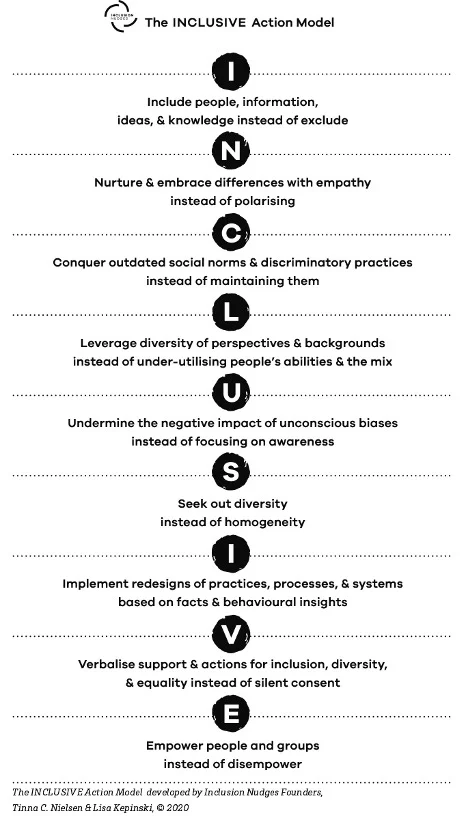
The mission of the Inclusion Nudges global initiative is clear: to empower individuals to apply these designs and engage everyone in making systems, cultures, and behaviours inclusive as the norm – everywhere, for everyone. By integrating these behavioural designs into daily actions, individuals can foster everyday experimentation, transforming the pursuit of inclusion from a daunting task into a natural, integrated part of work and life. The Inclusion Nudges INCLUSIVE Action Model, detailed in The Inclusion Nudges Guidebook and Action Guides, provides a comprehensive framework based on decades of experience in leading and facilitating inclusive change.
The need for fundamentally rethinking how we achieve inclusive outcomes has never been greater. Inclusion Nudges offers a powerful, scientifically-informed pathway to overcome the inherent challenges of human cognition and societal inertia, enabling a collective leap towards a truly inclusive future. By joining forces through this global movement, we can collectively unlock the potential for inclusion to become the undeniable norm.