Section 1 of the Equality Act 2010 stands as one of the most polarizing yet deferred provisions in modern British legislative history. Designed to place the reduction of socio-economic disadvantage at the core of strategic public policymaking, the Socio-Economic Duty (SED) has spent over a decade languishing in statutory dormancy in England while being successfully operationalized in Scotland and Wales. As the UK government takes concrete steps toward drafting statutory guidance and moving closer to the long-anticipated commencement of the duty, a deeply fragmented public discourse has emerged.
To make sense of these competing narratives, researchers from The Equality Trust and the University of York Law School have launched a comprehensive collaborative study. Utilizing Critical Discourse Analysis (CDA) informed by Fairclough’s three-dimensional model and Interpretive Policy Analysis (IPA), the research examines how the SED is framed across parliamentary debates, mainstream news media, academic literature, civil service practice, and advocacy groups. The findings expose stark ideological divides, misrepresentations in billionaire-backed media, and a concerning absence of the voices of those most affected by structural inequality.
Chronology and Background of the Socio-Economic Duty
The legislative journey of the SED began during the final years of the Labour administration under Prime Minister Gordon Brown. Championed fiercely by Equalities Minister Harriet Harman, Section 1 of the Equality Act 2010 received Royal Assent, establishing that public authorities must—when making strategic decisions—have "due regard to the desirability of exercising them in a way that is designed to reduce the inequalities of outcome which result from socio-economic disadvantage."
However, the political landscape shifted dramatically with the 2010 general election. The incoming Conservative-Liberal Democrat coalition government quickly announced that it would not commence Section 1, arguing that it represented unnecessary bureaucracy and state overreach. Although left uncommenced and dormant on the statute books in Westminster, the clause was never formally repealed through a democratic parliamentary vote.
Sensing an opportunity for devolved progressive policy, the Scottish Parliament chose to activate the duty in 2018, followed by the Senedd in Wales in 2021. Meanwhile, a growing coalition of local authorities across England began voluntarily adopting the principles of the SED as a benchmark for good governance. The election of a Labour government in 2024 brought a renewed manifesto commitment to finally trigger the duty in England, prompting a fresh wave of public consultations, stakeholder resistance, and intense media scrutiny throughout 2025 and 2026.
Dissecting the Sites of Discourse
The ongoing research categorizes the debate surrounding the SED into six distinct discursive sites, revealing how language is deployed to either reinforce or challenge existing power structures.
Parliamentary Debates and Political Polarization
An analysis of Hansard records reveals that parliamentary engagement with the SED peaked during its legislative introduction in 2009–2010 and subsequently plummeted until Labour’s return to power in 2024. During its initial introduction, opposition from the Conservative front bench was characterized by hostile and contradictory framing. Critics simultaneously dismissed the duty as too weak and vague to achieve tangible results, while condemning it as excessive social engineering, "left-wing tosh," and a direct assault on middle-class interests.
Conversely, advocates within Parliament—including cross-party figures such as former Conservative MP John Bercow, alongside representatives from the Liberal Democrats, Green Party, and SNP—argued that market forces alone cannot resolve systemic stagnation in social mobility. Proponents have repeatedly linked the necessity of the SED to contemporary crises, including soaring child poverty, widening regional disparities, post-pandemic health inequalities, and recommendations from the landmark COVID-19 Inquiry and Baroness Doreen Lawrence’s review.
News Media and the Right-Wing Press
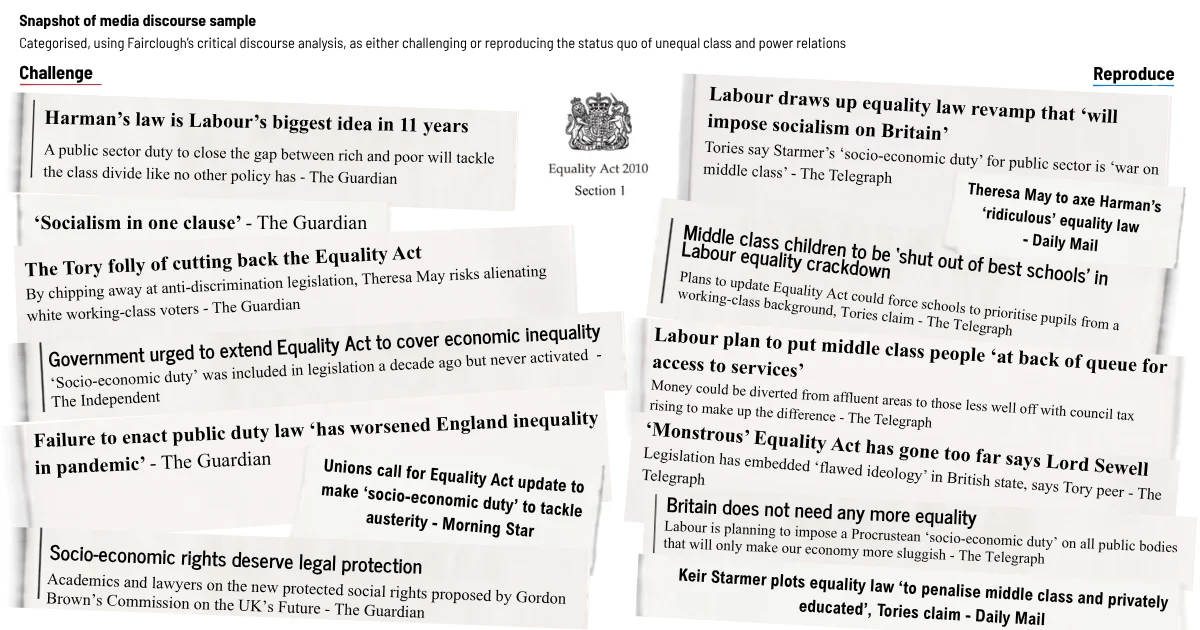
Media coverage of the SED has been heavily dominated by right-wing outlets, particularly The Telegraph, the Daily Mail, and the Express. Out of a multimodal sample of 27 articles reviewed in the study, 17 reflected negative, hostile framings. These publications frequently utilize emotive language, framing the duty as a form of "class warfare," a "war on the middle class," and an ideological mechanism designed to "inflict socialism on Britain."
Commentators and political figures, including current Conservative leader Kemi Badenoch, have categorized the duty as "ideological dross" that will paralyze public administration and disadvantage hard-working families in favor of the socio-economically disadvantaged. These zero-sum narratives suggest that public services, school places, and NHS resources will be forcibly diverted away from affluent taxpayers.
In stark contrast, center and left-leaning outlets such as The Guardian and The Independent have historically published supportive op-eds and polling data. Notably, research conducted by Opinium and cited by The Independent revealed that 57% of voters support the activation of the SED, with only 6% opposed, indicating a significant disconnect between hostile newspaper headlines and broader public sentiment.
Academic Scholarship and Legal Perspectives
Despite the political storm surrounding the SED, academic engagement has remained relatively sparse and largely confined to legal scholarship. Seminal works by legal experts such as Professor Sandra Fredman have robustly defended the proactive nature of the duty, arguing that critics have vastly overstated concerns regarding its enforceability.
Other academics, including Dr. Fernando Casla and Dr. Jed Meers, have suggested that the active implementation of the SED could have helped mitigate the harshest impacts of post-2010 austerity measures, the housing shortage, and educational inequalities. Scholars have also linked the absence of socio-economic duty enforcement to institutional failures observed during the Grenfell Tower tragedy, where intersecting vulnerabilities of class, race, and deprivation were routinely overlooked by policymakers. However, because academic discourse remains largely siloed within peer-reviewed journals, it has failed to penetrate mainstream public consciousness.
Practitioners and Civil Service Reality
Public sector workers tasked with implementing the SED represent another critical yet frequently sidelined voice. Feedback collected from civil servants and local government officers in England reveals a workforce that is broadly supportive in principle but deeply skeptical about logistical delivery and resourcing.
While a small minority of practitioners echoed the hostile media rhetoric by dismissing the duty as "woke nonsense," the majority expressed practical concerns. Many warned that without adequate funding, training, and clear statutory guidance, the SED risked deteriorating into a hollow "tick-box exercise." Local government officers noted that they are routinely asked to "do more with less," questioning where the institutional capacity for rigorous socio-economic impact assessments will originate.
Despite these internal anxieties, ground-level data shows encouraging signs of proactive adoption. Organizations like Resolve Poverty have mapped that approximately 10% of English councils have formally adopted the duty, while 51% operate within its spirit. Practical case studies—such as the Merseyside Fire & Rescue Service removing driving licence requirements to broaden recruitment access for disadvantaged candidates—demonstrate that the SED can successfully unlock untapped labor potential when applied correctly.
Civil Society and the Lived Experience Gap
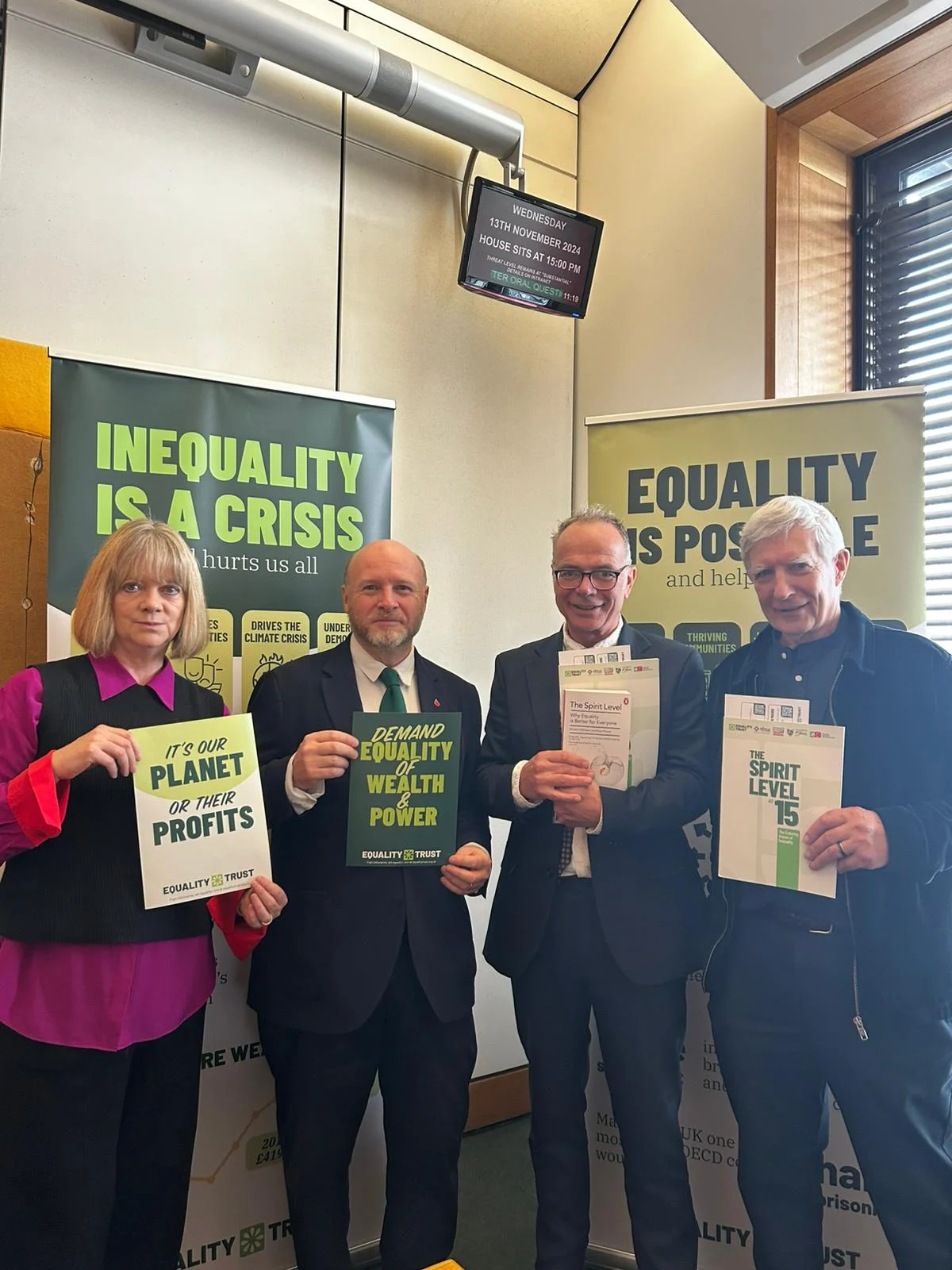
Civil society organizations have formed the backbone of support for Section 1. Co-chaired by Just Fair and The Equality Trust, the 1 for Equality coalition—alongside prominent bodies like the Trades Union Congress (TUC), the Royal College of Physicians, and the Institute for Health Equity—has consistently lobbied for prompt implementation. International bodies, including the United Nations, have repeatedly criticized successive UK governments for leaving the duty uncommenced amid rising levels of destitution.
Crucially, civil society groups have prioritized intersectional advocacy, linking socio-economic disadvantage to race, gender, and disability. Organizations such as Thrive Teesside, Poverty2Solutions, and the APLE Collective have worked tirelessly to amplify the voices of individuals with direct, lived experience of poverty. Through community peer research and local dialogues, these grassroots initiatives ensure that policymakers hear directly from those affected by strategic public decisions. Yet, these vital perspectives remain largely excluded from mainstream parliamentary and media debates.
Implications for Future Policymaking
The interim findings of the Equality Trust and University of York Law School study highlight a profound systemic failure in how public policy is communicated and debated in the United Kingdom. While right-wing media outlets and political opponents have successfully weaponized the Socio-Economic Duty as an emblem of cultural division, the reality on the ground—supported by voluntary local authority adoption, academic analysis, and civil society expertise—presents a far more pragmatic and morally compelling picture.
As the UK government moves closer to finalizing statutory guidance and formally commencing Section 1 of the Equality Act 2010, the success of the duty will depend heavily on robust administrative support, adequate resourcing, and transparent communication. Bridging the gap between high-level political rhetoric and the lived realities of disadvantaged communities will be essential to ensuring that the Socio-Economic Duty fulfills its legislative promise: transforming public decision-making to actively reduce inequality and build a fairer society.