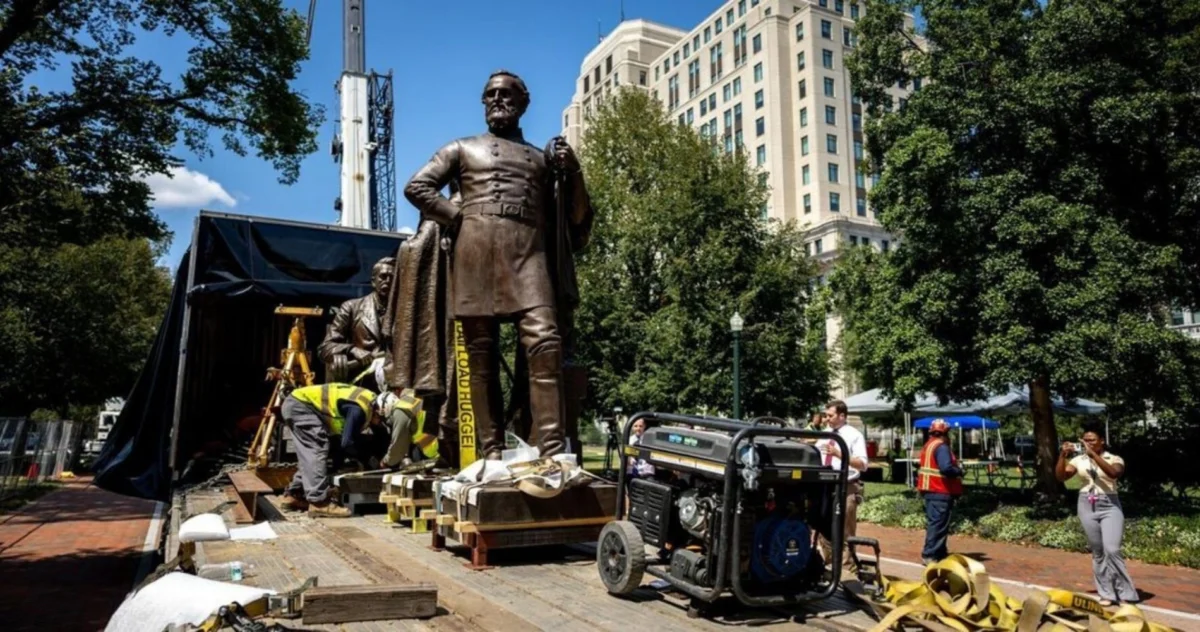
In a definitive conclusion to a decades-long push for civic reform, the Commonwealth of Virginia finalized the removal of the last three Confederate monuments situated on Capitol Square in Richmond this past Friday. The action, mandated by legislation passed earlier this year, signifies that the state no longer hosts any public displays of the Confederate States of America on government-owned grounds. The removal of these statues—including a prominent likeness of Stonewall Jackson—represents the culmination of a protracted effort to decouple the state’s public identity from the symbols of the Confederacy, a legacy that has defined the political and social landscape of Richmond for over a century.
The removal process was conducted quietly but decisively, closing a chapter that has seen intense local and national debate regarding the purpose and placement of historical iconography. By clearing Capitol Square of these figures, state officials have effectively scrubbed the last remnants of state-sponsored Confederate commemoration from the heart of the capital city.
A Chronology of Monument Removal in Virginia
The movement to dismantle Confederate iconography in Virginia did not begin in a vacuum; it was the product of years of localized activism that eventually transitioned into state-level policy.
In the early 20th century, the proliferation of Confederate monuments was largely a reactive measure intended to solidify a post-Reconstruction racial hierarchy. However, the modern impetus for removal gained significant momentum in 2017. Following the "Unite the Right" rally in Charlottesville, where white supremacists gathered to protest the planned removal of a Robert E. Lee statue, the conversation shifted from local governance to a national reckoning. The violent death of a peaceful counterprotester during that rally served as a grim catalyst, forcing lawmakers to evaluate the public safety and moral implications of maintaining monuments to figures who fought to preserve slavery.
The pace of change accelerated dramatically in June 2020, following widespread civil unrest sparked by the death of George Floyd. In Richmond, protesters took direct action, toppling a statue of Confederate President Jefferson Davis. This act of public defiance provided the political cover for municipal leaders to begin systematically dismantling city-owned monuments. By December 2022, the City of Richmond had successfully removed its final city-owned Confederate statue, that of A.P. Hill.
Parallel to city actions, the state legislature moved to address the presence of symbols on state property. In July 2020, then-House Speaker Eileen Filler-Corn ordered the removal of a life-sized statue of Robert E. Lee and the busts of seven other Confederate figures from the Virginia Capitol. This week’s removal of the final three monuments from Capitol Square serves as the legal and physical completion of that 2020 legislative initiative.
The Strategic Placement of History
Historical records maintained by the Equal Justice Initiative (EJI) indicate that Virginia has historically held more Confederate monuments than any other state in the nation. This is not coincidental; Richmond served as the capital of the Confederacy, and the state’s cultural narrative was long dominated by the "Lost Cause" ideology.
The installation of these monuments occurred in two distinct waves. The first, beginning around the turn of the 20th century, sought to romanticize the secessionist cause as a defense of "states’ rights" rather than the preservation of the institution of chattel slavery. These statues were intended to serve as permanent, physical anchors for white supremacy during an era of Jim Crow segregation and systemic disenfranchisement of Black citizens.
The second wave of installations occurred during the 1950s and 1960s, coinciding with the rise of the Civil Rights Movement. Sociologists and historians note that these monuments were frequently erected in direct opposition to federal integration mandates. By branding the Confederacy as a noble tradition, segregationists utilized these statues to reinforce a cultural identity that resisted the expansion of racial equality. The persistence of these symbols throughout the 21st century became a flashpoint, as many Virginians argued that the statues functioned as instruments of intimidation rather than historical markers.
Legislative and Fiscal Reform
Beyond the physical removal of bronze and granite, the Commonwealth has recently taken steps to curtail the institutional support that maintained these symbols for decades. Earlier this year, Governor Abigail Spanberger signed legislation reversing a long-standing carve-out in the state’s tax code. This specific provision had provided tax benefits to organizations such as the United Daughters of the Confederacy, which played a pivotal role in funding and installing hundreds of memorials across the state during the mid-20th century.
The repeal of this tax exemption represents a significant policy shift. By removing the financial incentives that once supported the maintenance and proliferation of pro-Confederate groups, the state has signaled a move toward a more neutral fiscal policy that does not prioritize the legacy of the Confederacy. This legislative move, combined with the clearing of Capitol Square, suggests that Virginia is attempting to reorient its public resources toward a more inclusive historical narrative.
Official Responses and Public Sentiment
The political climate surrounding these removals has been marked by a clear divide. Proponents of the removals, including former Mayor Levar Stoney, have consistently emphasized that the process was not merely about aesthetic changes to public spaces, but about the "difficult work" of reconciliation. "We’ve done something that a lot of communities have struggled with," Stoney noted during the 2022 removals, expressing a sentiment that many residents were eager to "turn the page" on a chapter of history that had long marginalized the contributions of Black Virginians.
Conversely, some critics have argued that the removal of monuments constitutes an erasure of history. However, state officials, including those who supported the legislative mandates, have consistently countered that the removal of a statue from a place of honor does not equate to the deletion of historical facts. Instead, they argue, it allows for a more comprehensive telling of Virginia’s history—one that acknowledges the complexities of the Civil War without glorifying the motivations of those who fought to maintain slavery.
Broader Implications: A State at Odds with Federal Trends
Virginia’s current trajectory stands in stark contrast to recent developments at the federal level. While the state has moved to excise Confederate symbols, the federal government has seen recent attempts to reverse similar trends. Reports indicate federal efforts to reinstall Confederate monuments and restore names to military bases that had previously been scrubbed of their Confederate associations.
This divergence creates a unique tension in American political life. As Virginia moves to reconcile its state-level public iconography with modern standards of racial equity, it faces an increasingly polarized national environment. Analysts suggest that Virginia’s actions may serve as a blueprint for other Southern states, or conversely, as a point of friction for future federal-state relations.
Looking Toward the Future
The removal of the monuments from Capitol Square is a symbolic punctuation mark for the state of Virginia. As the pedestals are dismantled and the grounds are repurposed, the Commonwealth faces the task of determining what, if anything, should replace these figures. Many historians and urban planners advocate for a more holistic approach to public commemoration, suggesting that the focus should shift toward figures who contributed to the advancement of civil rights, education, and the democratic process.
The "difficult work" referenced by local leaders is far from finished. While the physical monuments are gone, the broader societal discussions regarding race, historical memory, and the definition of a "patriot" continue. By choosing to remove these symbols from the seat of its government, Virginia has transitioned from a passive observer of its own history to an active participant in re-evaluating which values it chooses to celebrate in its most prominent public spaces.
The outcome of this process remains to be seen in the coming years, but for now, the visual landscape of Richmond has been fundamentally altered. The empty plinths on Capitol Square serve as a reminder of the shifting priorities of a state that is actively attempting to confront its past in order to navigate its future. As the Commonwealth looks forward, the focus remains on whether these removals will translate into more substantive institutional changes that address the lasting impacts of the racial hierarchy these statues were originally intended to uphold.