A comprehensive new study by the Pew Research Center, conducted as part of the Pew-Knight Initiative, has shed light on the diverse ways Americans engage with public life. The research, which examined political activity, civic involvement, religious participation, and news consumption, reveals that the American public can be broadly categorized into four distinct "engagement groups." This nuanced understanding moves beyond simplistic notions of engagement and disengagement, offering a more granular view of how citizens participate in their communities and the nation.
The Pew-Knight Initiative, a collaborative effort between Pew Research Center and the Knight Foundation, is dedicated to exploring how individuals acquire civic information, shape their beliefs and identities, and actively participate in their communities. This latest report builds upon years of research into the dynamics of civic engagement, a topic that has gained renewed urgency amid significant societal shifts, including the lingering effects of the global pandemic and the rapid evolution of digital technologies like smartphones, social media, and artificial intelligence.

Unpacking the Four Engagement Groups
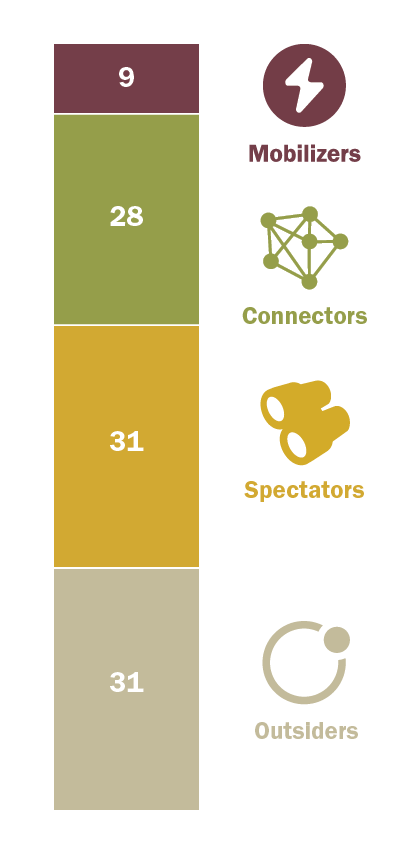
The study, which surveyed a nationally representative sample of U.S. adults between July 9 and December 5, 2025, identified four key groups based on a cluster analysis of 19 distinct measures of participation. These groups are:
- Mobilizers (9% of U.S. adults): This group represents the most actively engaged segment of the population, demonstrating high levels of participation across political, civic, and religious spheres, as well as consistent attention to the news.
- Connectors (28% of U.S. adults): While also highly engaged, Connectors distinguish themselves by a stronger emphasis on community and non-political activities, with significant participation in volunteering and donations, alongside consistent news consumption and religious attendance.
- Spectators (31% of U.S. adults): This group is characterized by a high level of news consumption and online engagement with news content, but a lower propensity for direct civic or political action. They are generally younger and more digitally oriented.
- Outsiders (31% of U.S. adults): Representing the least engaged segment, Outsiders exhibit low levels of participation across all measured activities, including political involvement, civic engagement, and even news consumption.
The report underscores that these groups are not static and that patterns of engagement can shift over time, particularly around major political cycles such as the 2024 presidential election, which was a significant period for many respondents.
A Deeper Dive into the Engagement Landscape
The study’s methodology involved robust data collection, utilizing the Cross-Sectional Engagement Survey (5,393 U.S. adults) and the American Trends Panel (ATP) survey (5,195 U.S. adults). The cluster analysis, a statistical technique used to group individuals based on their similarities, was applied to the Cross-Sectional Engagement Survey data. Respondents in the ATP survey were then assigned to these identified engagement groups to allow for further analysis of their demographics, attitudes, and civic knowledge.

The rationale behind this research is to provide a more integrated understanding of how Americans participate in public life. Previous studies often examined these behaviors in isolation, making it challenging to grasp how they coalesce or diverge in individuals’ daily lives. By identifying distinct engagement patterns, the Pew Research Center aims to offer a more comprehensive picture of civic life in the United States.
The Mobilizers: The Vanguard of Civic Action
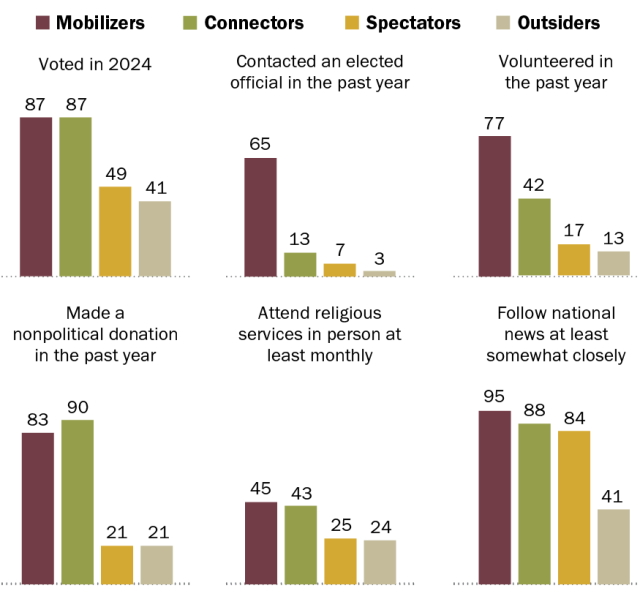
The Mobilizers, comprising 9% of the adult population, are the most consistently active participants in public life. Their engagement is broad and deep, encompassing high rates of volunteering (77%), membership in groups or organizations (73%), and voting in the 2024 election (87%).
What particularly sets Mobilizers apart is their elevated level of political activity. A striking 74% have displayed signs, bumper stickers, or clothing supporting a political cause or candidate. A significant 65% have contacted an elected official in the past year, and 21% have volunteered for a political campaign. These figures far exceed those of the general U.S. adult population.
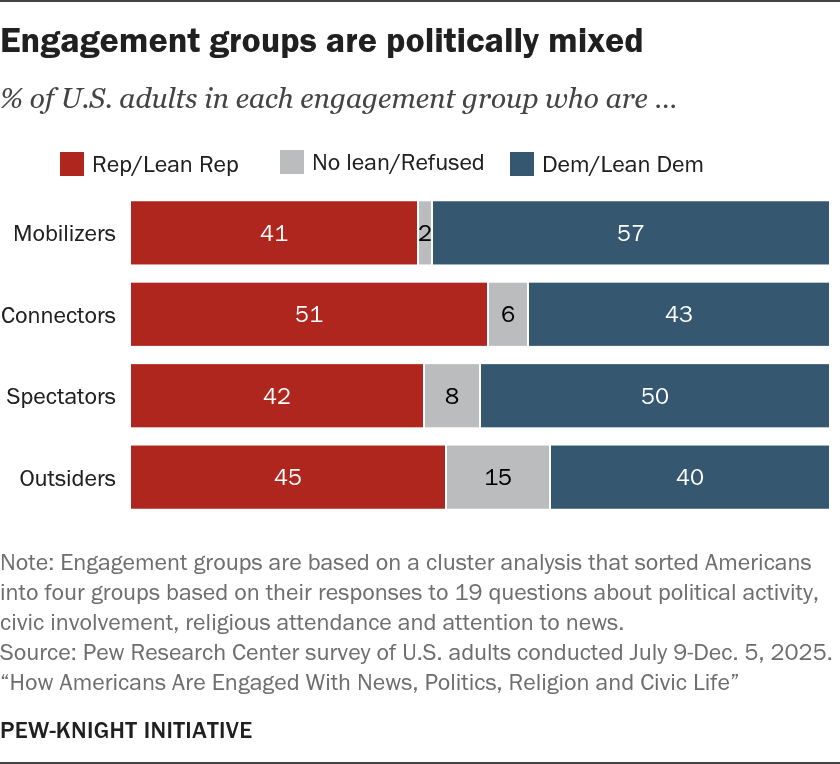
Demographically, Mobilizers are more likely than the average American to possess higher levels of education and income. Notably, this group exhibits a more pronounced ideological intensity, with Republicans tending to identify as very conservative and Democrats as very liberal. While the overall political landscape is polarized, Mobilizers represent a segment where both ends of the political spectrum are highly motivated and engaged.
The Connectors: Anchors of Community Life
Making up 28% of the U.S. adult population, Connectors represent a substantial segment of actively engaged individuals, though their focus leans more towards community and non-political endeavors. They exhibit high rates of participation in activities such as making nonpolitical donations (90%) and being part of groups or organizations (65%). Their voting rates are also comparable to Mobilizers (87%).
While Connectors are actively involved in civic life, their political engagement is notably less pronounced than that of Mobilizers. They are less likely to contact elected officials or display public support for political causes. Their engagement is characterized by a strong commitment to social well-being and community support, rather than direct political advocacy. Religious participation is also a significant component for this group, with 43% attending religious services at least monthly, a figure close to that of Mobilizers.
In terms of demographics, Connectors share similarities with Mobilizers in their higher educational attainment and income levels. They are also an older demographic, with a greater proportion being White compared to the general population. Politically, they are slightly more inclined towards the Republican Party than the Democratic Party.
The Spectators: Informed but on the Sidelines
The Spectator group, comprising 31% of U.S. adults, is characterized by a high level of news consumption and online interaction with news content, but a comparatively lower engagement in direct civic or political actions. A substantial 84% of Spectators follow national news closely, and 75% have engaged with news content online by liking or saving posts in the past week.
However, their participation in activities such as voting (49%), volunteering (17%), or joining groups (10%) is significantly lower than that of Mobilizers and Connectors. While they consume news avidly, they tend to be less interested in politics itself. Their online news engagement often involves passive consumption or private sharing rather than public discourse.
Demographically, Spectators are the youngest of the four groups, with a significant portion under 30. They are heavy internet users, with 56% reporting near-constant internet access. They are also more likely to be Hispanic and tend to identify as politically moderate. This group’s engagement is largely information-based, with a lower propensity for direct action.
The Outsiders: The Least Engaged Segment
The Outsiders, also representing 31% of the U.S. adult population, exhibit the lowest levels of engagement across all measured activities. Their participation in volunteering, voting, civic group membership, and even following the news falls below the general U.S. average. Religious attendance rates are also lower for this group, though their belief in God is not significantly different from other groups.
While some Outsiders do vote (41%) and attend religious services (24%), their overall engagement with public life is minimal. They are particularly disengaged from political activities. Their interaction with news is also considerably lower than that of Spectators, with only 41% following national news closely and a mere 7% engaging with news content online.

Outsiders are demographically similar to the general U.S. population in terms of age and gender. They are politically moderate and tend to have lower levels of education and income compared to the other engagement groups. Approximately half have a high school education or less, and a significant portion fall into lower-income brackets.
Broader Implications and Context
The emergence of these distinct engagement groups provides crucial insights into the complex tapestry of American civic life. The study highlights that while political polarization remains a significant feature of the American landscape, engagement itself is not solely defined by partisan affiliation. None of the identified groups are dominated by a single political party, indicating that motivations for engagement, or disengagement, are multifaceted.
The research also provides context for ongoing debates about the state of democracy and civic participation in the United States. Concerns about declining civic participation have been voiced for decades, fueled by trends in religious attendance, group membership, and news consumption. The COVID-19 pandemic and the pervasive influence of digital technologies have further complicated these discussions. This study’s methodology, which includes multiple modes of survey administration and outreach, was specifically designed to capture a more inclusive representation of the population, including those less likely to participate in traditional surveys.

The findings suggest that interventions aimed at increasing civic engagement would need to be tailored to the specific characteristics and motivations of each group. For instance, strategies targeting Mobilizers might focus on amplifying their existing activism, while efforts to reach Spectators could leverage their strong connection to news and digital platforms. Understanding the unique drivers and barriers for each group is essential for fostering a more informed and participatory citizenry.
The Pew Research Center and the Knight Foundation’s ongoing commitment through the Pew-Knight Initiative to research in this area is vital for providing the data and analysis needed to navigate the evolving landscape of public engagement in the 21st century. As technology continues to reshape how Americans interact with information and each other, understanding these nuanced patterns of engagement will be critical for the health of democratic societies.