
India has achieved monumental strides in expanding its public health infrastructure over the past decade, dramatically cutting down the total burden of vaccine-preventable diseases. Yet, as national immunization coverage scales upward, health authorities confront the most stubborn frontier of public health delivery: the remaining pocket of zero-dose children. These are infants and toddlers who have failed to receive even the first routine dose of the diphtheria, tetanus, and pertussis (DTP1) vaccine. To close this final immunity gap, public health strategists are discovering that broad, top-down immunization campaigns must give way to hyper-localized, context-sensitive interventions. Nowhere is this more critical than in the densely populated urban slums and peri-urban neighborhoods of India’s most populous states, Bihar and Uttar Pradesh.
Recent public health initiatives in these two northern states have leveraged a novel paradigm known as the "Learning by Doing" approach. By melding human-centred design (HCD) with rigorous, iterative program delivery, health practitioners, frontline workers, and local caregivers are rewriting the playbook on vaccine access. Rather than treating immunization hesitancy or logistical failure as a uniform problem, this methodology treats every community as a distinct ecosystem with unique barriers, operationalizing solutions from the ground up.
The Complex Landscape of Zero-Dose Children in Northern India
To understand the urgency of grassroots interventions in Bihar and Uttar Pradesh, one must examine the broader epidemiological and demographic landscape of India. According to national health surveys, India has successfully slashed its overall proportion of unvaccinated children over the last fifteen years, driven largely by intensive missions such as Mission Indradhanush. However, state-level disparities remain stark. Uttar Pradesh and Bihar, home to hundreds of millions of residents, house a disproportionate share of India’s remaining zero-dose population.
Urban and peri-urban settings present a paradox for public health delivery. While clinics and hospitals are physically closer than in remote rural areas, urban poverty creates invisible walls. Migrant construction workers, daily wage earners, and residents of informal settlements often slip through the cracks of municipal health tracking systems. For these families, missing a vaccination is rarely a matter of ideological opposition; rather, it is the result of compounding socioeconomic stressors. Daily survival leaves little room for waiting in public clinic queues, while misinformation, fear of lost wages due to post-vaccination fever, and rapidly shifting residential addresses create formidable barriers to completion.
Recognizing that conventional awareness campaigns—such as generic posters, television announcements, and broad-brush loudspeaker broadcasts—were falling short, public health implementers pivoted toward a participatory problem-solving framework.
The 3D Framework: Define, Design, and Deliver
At the core of the Bihar and Uttar Pradesh initiative is the structured "3D" framework: Define, Design, and Deliver. This methodology rejects the traditional bureaucratic cycle of planning policies in state capitals and blindly executing them at the district level. Instead, it embeds continuous learning into every stage of the immunization lifecycle.
Phase 1: Define
The first phase involves intensive qualitative and quantitative mapping at the community level. Rather than relying solely on aggregate administrative data, public health teams engage directly with mothers, fathers, local elders, and frontline health workers—including Accredited Social Health Activists (ASHAs) and Auxiliary Nurse Midwives (ANMs). Through ethnographic interviews, focus group discussions, and journey mapping, researchers uncover the exact friction points preventing a child from receiving a vaccine.
In some neighborhoods, the barrier is a mismatch between clinic timings and the working hours of informal laborers. In others, it stems from deep-seated rumors regarding vaccine side effects or mistrust of municipal health workers. By accurately defining the localized barriers, stakeholders can avoid applying one-size-fits-all remedies.
Phase 2: Design
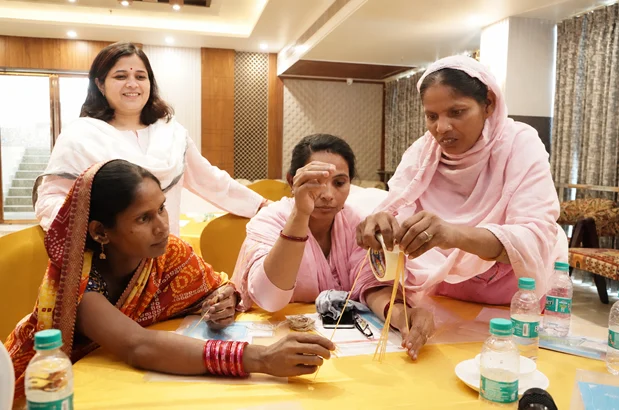
Once the specific bottlenecks are identified, the initiative moves to co-creation workshops. Government stakeholders, frontline workers, and community caregivers sit at the same table to brainstorm and prototype potential solutions. This collaborative design phase ensures that proposed interventions are culturally appropriate, economically viable, and operationally feasible for the frontline staff tasked with executing them.
For instance, rather than imposing rigid immunization schedules, the co-created designs often feature flexible, community-tailored micro-planning. These include evening vaccination camps timed to coincide with the return of daily wage earners, localized peer-support networks among mothers, and simplified digital tracking tools designed specifically for grassroots use.
Phase 3: Deliver and Adapt
The final phase is characterized by rapid testing, continuous feedback loops, and iterative refinement. Interventions are rolled out on a pilot basis in select urban wards of Bihar and Uttar Pradesh. Implementation is closely monitored not just through vaccination tallies, but through qualitative feedback from frontline workers who report daily operational friction. If a specific strategy—such as a weekend clinic—fails to draw the expected turnout, the model is quickly adjusted in real time based on community input.
Voices from the Ground: Frontline Realities and Stakeholder Perspectives
The success of the Learning by Doing approach hinges on the dedication and empowerment of frontline health workers. For decades, ASHAs and ANMs have served as the invisible backbone of India’s rural and urban health architecture, often working under immense pressure with limited resources.
Public health officials involved in the Bihar and Uttar Pradesh programs emphasize that listening to frontline workers is just as important as listening to caregivers. "Frontline workers are not merely delivery agents; they are local intelligence gatherers," notes a senior public health consultant associated with the initiative. "When we give them the agency to participate in the design of immunization drives, they feel valued, and the quality of outreach improves dramatically."
Caregivers in urban informal settlements have similarly reported a shift in their relationship with the public health system. Historically, interactions with health officials were often perceived as transactional or top-down directives. By involving parents in co-creating solutions—such as determining the most convenient locations for mobile immunization booths—distrust has steadily eroded, replaced by a sense of shared ownership over community health outcomes.
Independent epidemiologists and health economists observing the project have lauded the initiative for bridging the gap between high-level policy goals and ground-level realities. While quantitative metrics such as coverage percentages remain the ultimate benchmark of success, analysts point out that qualitative resilience—building enduring trust and institutional flexibility—is what will sustain high immunization rates over the long term.
Chronology of Urban Immunization Reform in Northern India
To appreciate the trajectory of these targeted urban interventions, it is helpful to trace the evolution of India’s immunization strategy over the past decade:
- 2014–2015: Launch of Mission Indradhanush, marking a strategic pivot toward intensive, multi-phase catch-up vaccination campaigns targeting districts with low immunization coverage.
- 2017–2019: Expansion of targeted strategies under Gram Swaraj Abhiyan and Intensified Mission Indradhanush (IMI), with an increasing focus on hard-to-reach urban pockets and migrant settlements.
- 2020–2021: Disruptions caused by the COVID-19 pandemic severely impact routine immunization schedules globally and nationally, creating a renewed urgency to track and recover zero-dose children.
- 2022–2023: Pilot deployment of human-centred design methodologies and the 3D (Define, Design, Deliver) framework in select urban districts of Bihar and Uttar Pradesh.
- 2024 and Beyond: Scaling up continuous-learning models, integrating localized feedback loops into municipal health planning, and documenting best practices for national replication.
Broader Implications and Path Forward
The lessons emerging from the urban streets of Bihar and Uttar Pradesh carry profound implications for the broader future of public health delivery in developing nations. As countries approach the final, most difficult percentages of immunization coverage, traditional administrative capacity hits diminishing returns. Reaching the remaining zero-dose children requires an evolution from bureaucratic administration to adaptive management.
The integration of human-centred design demonstrates that public health interventions can be both scientifically rigorous and deeply empathetic to human behavior. By acknowledging that structural poverty, social marginalization, and psychological barriers are legitimate components of epidemiological data, health systems can design interventions that respect the dignity and constraints of the communities they serve.
Furthermore, the institutionalization of continuous learning models creates a resilient public health apparatus capable of withstanding future shocks, whether from localized disease outbreaks, economic disruptions, or infrastructural strains. As Bihar and Uttar Pradesh continue to refine and expand these community-driven problem-solving processes, they offer a compelling blueprint for other regions striving to ensure that no child is left behind in the global march toward universal vaccine access.




