
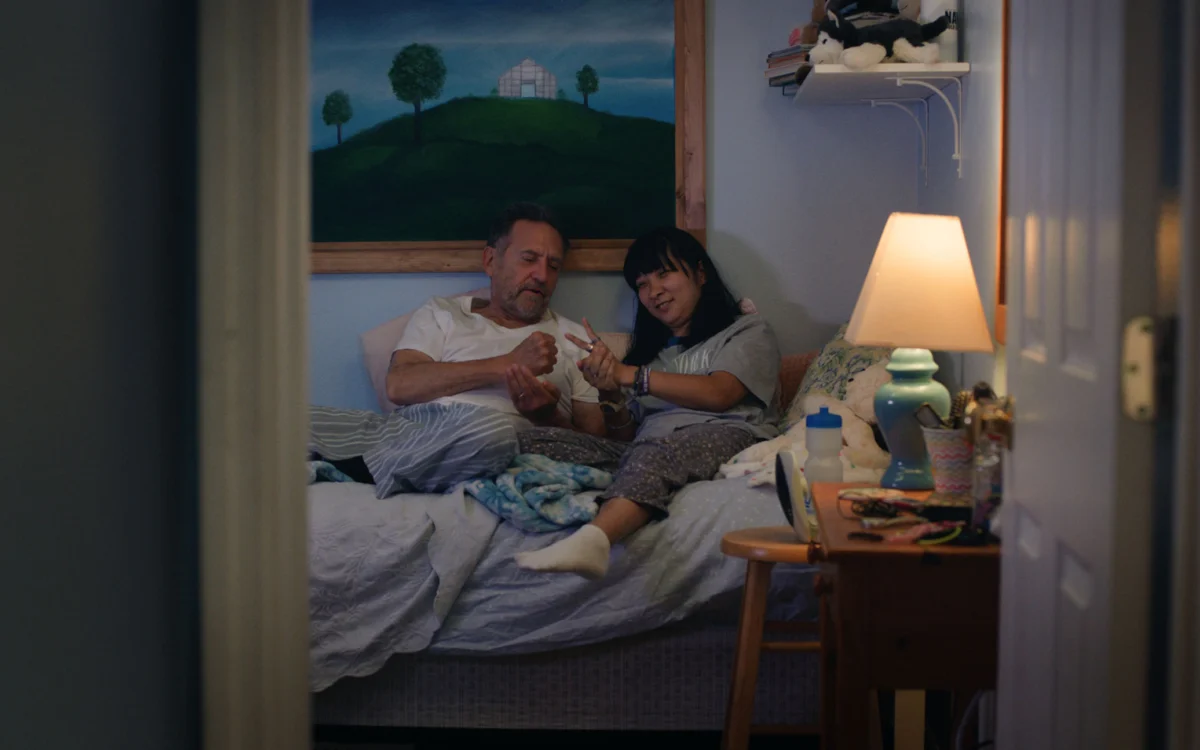
The intersection of personal narrative and cinematic art often yields powerful storytelling, but few contemporary feature films achieve the level of intimate, lived authenticity found in Liz Sargent’s narrative debut, Take Me Home. Set against the humid, sun-drenched backdrop of suburban East Orlando, Florida, the 90-minute feature explores the intricate and often overwhelming landscape of family caregiving, developmental disabilities, aging parents, and the bureaucratic hurdles of the American medical system. What makes the project unique is its foundation in reality: the movie was filmed in the Sargent family’s actual home and stars the filmmaker’s 37-year-old sister, Anna Sargent, who lives with cognitive disabilities.
While professional actors—including Victor Slezak as father Bob, Marceline Hugot as mother Joan, and Ali Ahn as sister Emily—round out the fictionalized family dynamic, the emotional core of Take Me Home remains anchored in the shared history of the Sargent sisters. The film captures a vulnerable transitional period in a family’s life, reflecting broader societal challenges concerning long-term care and disability advocacy in the United States.
A Personal Genesis Born from Anxiety and Bureaucracy
The conceptual roots of Take Me Home extend back to a period of intense personal pressure for writer and director Liz Sargent. In her twenties, she experienced mounting anxiety regarding the long-term future of her family. As one of seven children adopted by her parents alongside four biological siblings, she found herself deeply entangled in the logistical and emotional labor of supporting her youngest sister, Anna.
Navigating the complexities of the healthcare apparatus proved to be a grueling experience. Sargent faced steep hurdles while fighting for appropriate medical care for her sister, securing legal guardianship, and confronting the reality of her aging parents eventually aging out of their lifelong caregiving roles. These systemic challenges sparked the initial creative impulse to document that specific emotional landscape.
"There was a time in my 20s where I just felt this extreme anxiety about what the future held for my family, for my parents, and for my youngest sister—but also where I belonged with my own hopes and dreams and goals," Liz Sargent reflected. "I was drowning in the medical system trying to fight for my sister who has mental illness and getting her health care, and finding guardianship for Anna, and thinking about my parents aging out of their role as caregivers… It became this film of capturing that moment and talking about how we make those decisions and what’s available in this country."
Choosing Florida as the primary setting was a deliberate creative decision. The state’s unique climate and suburban sprawl served as a character in its own right, mirroring the family’s environment. August in Florida provided a harsh, atmospheric backdrop that Sargent utilized to symbolize both the beauty and the difficulty of the American dream.
"We shot in August. It’s the worst. It’s the hottest. But the downpours are sort of magical in a way," Sargent noted. "Suddenly it disappears, and there’s this beautiful light that shines through, and everything’s glowing around it from the water. I feel like there’s something about that Florida that I wanted to capture, like this is the American dream. There’s also the harshness of the environment and these people trying to survive within it."
The Chronological Evolution: From Sundance Short to International Feature
The journey of Take Me Home from a modest concept to an internationally recognized feature film spans several years of critical momentum and strategic grant acquisition.
The project originated as a 16-minute short film. This foundational short earned critical acclaim, leading to its premiere at the prestigious Sundance Film Festival in 2023. Following its initial debut, the short screened at numerous film festivals across the United States, including the regional Florida Film Festival, building substantial industry buzz.
This momentum culminated in a major career milestone for Sargent when she was awarded a $1 million production grant through the Tribeca Film Festival and AT&T Untold Stories initiative. The funding provided the necessary resources to expand the short film into a full-length feature within a remarkably swift one-year window.
The newly minted 90-minute feature film made its grand return to the Sundance Film Festival in January, where it earned Sargent a prestigious screenwriting award. Following its Sundance success, the film embarked on an international tour, securing an international premiere at the Berlin Film Festival and its official New York premiere at Tribeca. The theatrical rollout includes a New York City opening followed by a Los Angeles release, bringing the intimate Florida-set story to major commercial markets.
Within the narrative arc of the feature film, the plot centers on Anna, who must learn to navigate an unfamiliar world, her shifting relationship with her sister, and her father’s progressive memory loss, all precipitated by the grief of losing her mother.
Pioneering Inclusive Production Practices On Set
A defining element of Take Me Home is its commitment to authentic representation not only on screen, but also behind the camera. To ensure that Anna Sargent could safely and successfully deliver an award-winning performance, the production team instituted a specialized, supportive environment. This methodology was heavily supported by Caring Cross Generations, a national advocacy organization dedicated to reforming caregiving public policy and shifting cultural narratives to make support systems more accessible.
The production integrated several distinct roles and methodologies on set, including a dedicated disability producer, a specialized acting coach, and an improvisational directing approach tailored to Anna’s needs.
"We were able to provide some grant funding to the film in order to make sure she had a caregiver, an accessibility producer that trained everybody else to work with Anna in the way that she needed to be worked with, and also an acting coach to really work in a personalized way to help Anna prepare for all of her scenes," explained Lydia Storie, an executive producer on the film and the director of culture change for Caring Across Generations. "Having that in place allowed for her to deliver an award-winning performance."
This structured yet flexible production model offers a potential blueprint for future inclusive filmmaking, demonstrating that accommodations for actors with cognitive disabilities can elevate artistic output while maintaining an ethical, supportive workplace.
Broader Socioeconomic Implications and the Caregiving Crisis
While Take Me Home is deeply rooted in the specific experiences of one suburban Florida family, its thematic resonance extends to millions of individuals facing similar circumstances. According to recent data from caregiving advocacy groups, an estimated 130 million people in the United States currently find themselves in informal or formal caregiving roles, navigating aging, chronic illness, or developmental disabilities within their families.
The wider societal relevance of the film became vividly apparent during a special screening held at Bonnet Springs Park in Lakeland—geographically tied to the setting of the film’s final acts. The screening marked the first time Liz Sargent’s parents viewed the completed feature.
"I think it was very moving for them to get to be in an audience with people and understand that their personal struggles, like the intimate details that I’m sharing about our lives, are normalized. There’s a vulnerability that we all have," Sargent said. "It was beautiful to see people come up to them afterward and talk to them about their own care stories."
The narrative structure of Take Me Home deliberately avoids sugarcoating the difficulties associated with long-term care. The middle portion of the film confronts the stark tensions bred by financial instability, systemic failures, and deep uncertainty regarding the future. However, the final act pivots toward cautious optimism, painting a picture of what supportive communities can achieve for individuals requiring lifelong care.
Industry analysts and advocates suggest that cultural artifacts like Take Me Home play a crucial role in shifting public policy. By humanizing the statistics surrounding disability and elder care, creative works can foster greater political will and civic engagement.
"It is possible to create a world where we can all thrive and have our needs met. What I want is for people to identify and fall in love with Anna. I think that kind of love and protection is what’s going to change the way we vote and interact in this world," Liz Sargent emphasized.
Echoing this sentiment, executive producer Lydia Storie noted the transformative potential of inclusive storytelling on public consciousness. "When I watch this film through to the end, I see this vision of what can be when we recognize that all of us deserve better. A more supportive and inclusive future will be better for all of us."
As Take Me Home continues its theatrical expansion into major metropolitan areas, its dual legacy as a triumph of independent filmmaking and a catalyst for disability advocacy remains firmly established. By turning a personal family chapter into a universal cinematic experience, Sargent has opened a wider national dialogue on the fundamental human need for community, support, and a place to call home.




