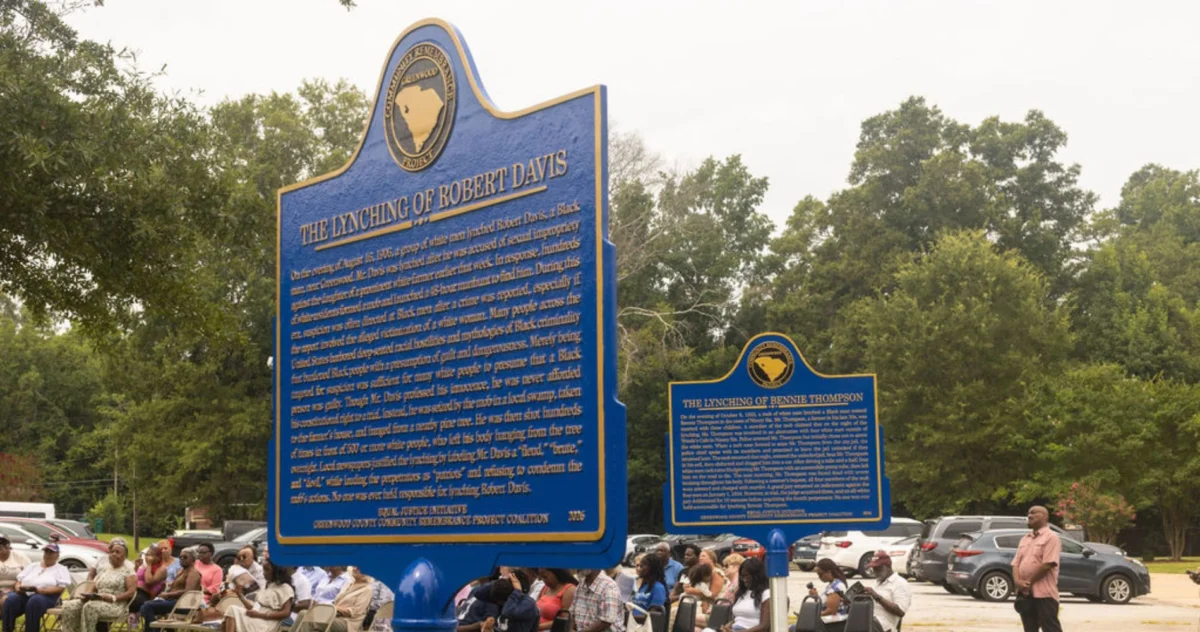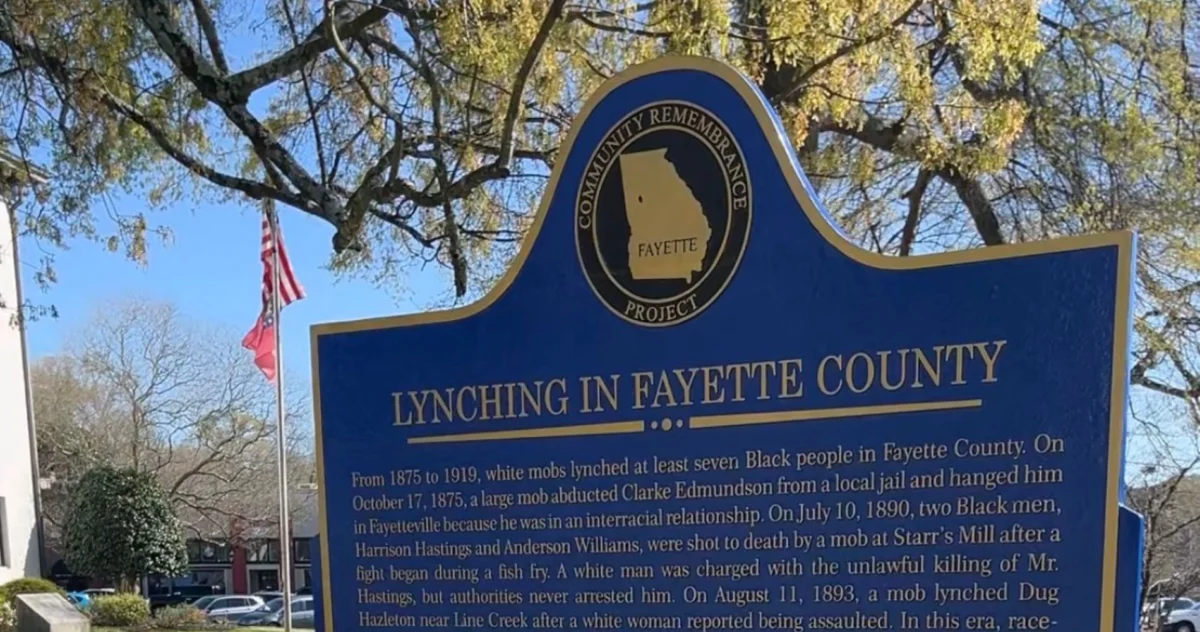
On March 12, dozens of community members and local officials gathered outside the historic courthouse in the heart of Fayetteville, Georgia, for a poignant dedication ceremony. The event marked the unveiling of a historical marker explicitly recognizing the victims of racial terror lynching in Fayette County, a solemn acknowledgment of a painful chapter in the region’s past. Located centrally in Fayetteville, approximately 20 miles south of Atlanta, the marker stands as a tangible result of years of dedicated work by the Fayette County Community Remembrance Project (FCCRP) in collaboration with the Equal Justice Initiative (EJI). Since its inception in 2021, the FCCRP has actively engaged the community in confronting its history of racial terror through various initiatives, including emotionally resonant community soil collections from lynching sites.
The dedication ceremony commenced with powerful opening remarks from coalition co-chairs Janice Bryant and Tamika Smith. They underscored the profound importance of recognizing this dark history as a critical step toward genuine community healing and accountability. The FCCRP’s efforts, they explained, are part of a broader national network of remembrance initiatives championed and supported by EJI, highlighting a collective commitment across the country to confront historical injustices.
"Today, we gather not only to unveil a marker, but to remember lives that were taken, acknowledge a painful chapter in our past, and confirm a commitment to truth, justice, and healing," Ms. Bryant articulated, her words resonating with the gathered crowd. Her statement encapsulated the dual purpose of the event: memorialization and a forward-looking pledge to a more just future.
The Rev. Edward Johnson, who holds the distinction of being Fayetteville’s first Black mayor, offered an opening prayer on behalf of the city. His prayer expressed profound gratitude for the opportunity to reflect on the past while simultaneously striving for a more just and unified future. Mayor Johnson emphasized the indispensable roles of fellowship, compassion, and collective responsibility in fostering stronger, more resilient communities. His presence and words underscored the city’s official recognition and support for this crucial act of remembrance.
County Commissioner Charles Rousseau further elaborated on the profound power embedded in publicly memorializing racial terror lynchings. These acts, he noted, were historically intended to intimidate and silence entire Black communities, maintaining a brutal system of white supremacy. Breaking that ingrained silence, Commissioner Rousseau asserted, is an essential step toward restoring dignity to the victims and their surviving families, many of whom have carried the trauma of these events for generations.
"[R]emembering is not about dwelling in the past. It is about telling the truth about the past, so that our future can be different," Mr. Rousseau declared, encapsulating the transformative potential of historical truth-telling. He lamented that for too long, countless stories like those commemorated by the marker were deliberately ignored, minimized, or left unspoken, perpetuating a harmful narrative of omission.
Jennifer Harris, Senior Project Manager for the Equal Justice Initiative, underscored the vital role of EJI’s work in connecting with local community coalitions nationwide. This collaborative effort, she explained, aims to meticulously document histories of racial terror and facilitate the installation of historical markers, thereby encouraging education, remembrance, and reconciliation. As a testament to the Fayette County Community Remembrance Project’s exemplary dedication and the national significance of their work, Ms. Harris announced a significant honor: "To honor [FCCRC], a duplicate marker will be placed at the National Memorial for Peace and Justice in Montgomery." This announcement means that Fayette County’s commitment to truth and justice will be recognized on a national and international stage, ensuring that "People around the world will know that people here in Fayette County have taken a stance to advance truth and justice."
The Journey to Remembrance: Fayette County Community Remembrance Project
The Fayette County Community Remembrance Project (FCCRP) was founded in 2021 with a clear and urgent mission: to confront and acknowledge the history of racial terror lynching within Fayette County. Their work is part of a broader national movement initiated by the Equal Justice Initiative, which seeks to create a more honest reckoning with America’s history of racial injustice.
The FCCRP’s approach has been deeply rooted in community engagement. One of its most impactful initiatives has been the community soil collection process. This involves gathering soil from the sites where lynchings occurred, often with community members participating in a solemn ceremony. Each jar of soil represents a life lost and a story that must not be forgotten. These jars are then often displayed locally and a duplicate is sent to the Legacy Museum in Montgomery, Alabama, a powerful symbolic act that connects local trauma to a national narrative of remembrance. This process not only preserves the memory of the victims but also creates a tangible, visceral connection for current generations to the violent history that shaped their communities.
The years of work leading up to the marker’s dedication involved extensive historical research to identify victims, outreach to local families, public educational forums, and sustained collaboration with local government and EJI. This diligent effort ensured that the marker is not merely a piece of stone but a symbol imbued with collective memory and a commitment to historical accuracy. The project has fostered dialogue, challenged long-held silences, and brought together diverse segments of the community in a shared pursuit of truth and healing.
A Painful Past Unearthed: Lynching in Fayette County (1875-1919)
Fayette County, like many Southern counties, bears the scars of racial terror lynchings. From 1875 to 1919, at least seven Black individuals were brutally murdered by white mobs within its borders. These acts of violence were not random but calculated instruments of social control, designed to enforce racial hierarchy and instill fear.
The earliest documented lynching occurred on October 17, 1875. Clarke Edmundson, a Black man, was abducted from a local jail in Fayetteville and hanged. His alleged crime: being in an interracial relationship. This case tragically illustrates how perceived violations of racial norms, particularly those involving intimacy between Black men and white women, were often met with swift, extrajudicial violence, reflecting the deep-seated anxieties and racist ideologies of the post-Reconstruction South.
Fifteen years later, on July 10, 1890, Harrison Hastings and Anderson Williams, two Black men, were shot to death by a mob near Starr’s Mill. The violence erupted after a fight during a fish fry, an ostensibly minor dispute that escalated into fatal racial terror. Though a white man was charged with the unlawful killing of Mr. Hastings, he was never arrested, exemplifying the systemic failure of the justice system to protect Black lives and hold white perpetrators accountable.
On August 11, 1893, Dug Hazleton was lynched near Line Creek following an allegation of assault by a white woman. In this era, race-based suspicion was almost invariably directed at Black men whenever a crime was reported, particularly those involving white women. Indeed, historical research indicates that approximately 25% of all lynchings were fueled by often unsubstantiated allegations of sexual impropriety, a powerful and frequently fabricated pretext for racial violence.
The turn of the century brought no reprieve. On May 20, 1899, masked "whitecaps" — a term often used to describe vigilante white supremacist groups similar to the Ku Klux Klan — broke into the home of Thomas Linton and shot him to death. These nocturnal raids, carried out by disguised assailants, were common tactics used to terrorize Black communities and maintain racial control through anonymity and fear.
The violence continued into the 20th century. Bud Crosby, a Black man, was lynched by a mob on the night of February 17, 1918, near present-day Peachtree City. He was accused of attempted robbery and kidnapping, charges that were often used as pretexts to justify racial violence, regardless of evidentiary basis.
Perhaps one of the most poignant cases occurred on July 31, 1919, when Charles Kelly, a 26-year-old Black World War I veteran, was lynched by a white family in Woolsey. This heinous act took place just days after Kelly had returned home from serving his country. His "offense" was allegedly not turning out of the road soon enough in his car to let a white boy pass—a perceived violation of prevailing social norms that dictated Black subservience. This incident is particularly chilling as it occurred during the "Red Summer" of 1919, a period marked by widespread racial violence and lynchings across the United States, often targeting Black veterans who, having fought for democracy abroad, dared to assert their dignity and rights at home.
In every single one of these documented cases in Fayette County, no one was ever held accountable for these brutal lynchings. This stark reality underscores the pervasive impunity with which racial terror was carried out, a clear indication of a justice system that was either complicit or utterly ineffective in protecting Black citizens.
The Shadow of Racial Terror: Lynching in America and Georgia
The lynchings in Fayette County are not isolated incidents but represent a localized manifestation of a much broader national epidemic of racial terror. Between 1865 and 1950, more than 6,500 Black people were killed in racial terror lynchings across the United States. This era, following the Civil War and the end of Reconstruction, saw the emergence of a virulent white backlash against the newfound freedoms and rights of Black Americans. Lynching became the most public and notorious form of racial terrorism, a tool to re-establish white supremacy and maintain a brutal social order.
During this period, deep racial hostility permeated Southern society, burdening Black people with an inherent presumption of guilt. This presumption often served to focus suspicion on Black communities whenever a crime was discovered, regardless of whether any evidence supported such suspicion. Race, rather than the alleged offense, almost invariably played a pivotal role in the lynching of Black individuals.
Public spectacle lynchings were deliberately orchestrated events, designed to achieve specific goals: to maintain white supremacy and to instill pervasive fear within the Black community. Lynch mobs would target and attack Black people, often in public spaces or even in their homes. Victims were frequently displayed for hours, their bodies serving as gruesome warnings. Families were often prevented from claiming their loved ones, further compounding the trauma and ensuring that the threat of violence to the rest of the Black community remained palpable and immediate.
The institutional failure to prevent these atrocities was widespread and systemic. In most cases, local law enforcement was either indifferent or actively complicit, proving ineffective in protecting Black residents from these brutal attacks. This widespread inaction effectively granted white mobs license to employ violence and murder without any fear of legal repercussions, creating a culture of impunity that fueled the terror.
While many racial terror lynchings were never officially documented and thus remain unknown to history, the seven victims killed by white mobs in Fayette County are part of a larger, tragic statistic: more than 715 Black victims killed in Georgia alone. This places Georgia among the states with the highest numbers of lynchings, underscoring the severity and widespread nature of this violence in the state.
Implications for Healing, Education, and Reconciliation
The unveiling of the historical marker in Fayetteville is more than a symbolic gesture; it is a profound act with far-reaching implications for healing, education, and reconciliation. For generations, the trauma of these lynchings was buried under a blanket of silence, leaving deep wounds within the Black community and an incomplete, often sanitized, historical narrative for all.
By publicly acknowledging these horrific acts, the Fayette County Community Remembrance Project and EJI are actively challenging this historical amnesia. The marker serves as a permanent educational tool, prompting current and future generations to confront the truth of racial violence and its enduring legacy. It forces a reckoning with how systemic racism and white supremacy were enforced through terror, shaping the social, economic, and political landscape of Fayette County and the nation.
Community healing, as emphasized by the project leaders, begins with truth. The process of researching, documenting, and memorializing these lynchings allows for a collective grieving process and a validation of the experiences of victims and their descendants. It signals a shift from denial to acknowledgment, a necessary step for communities to move forward in a healthier, more equitable way.
Furthermore, this initiative connects Fayette County to a broader national conversation about historical injustice and racial justice. The duplicate marker at the National Memorial for Peace and Justice in Montgomery elevates Fayette County’s story to a national platform, ensuring that local efforts contribute to a larger understanding of American history. This is not about dwelling in the past but about learning from it to build a different future—a future where truth is embraced, justice is pursued, and all lives are valued equally.
The Fayette County marker stands as a testament to the power of community advocacy and the enduring quest for truth. It is a stark reminder of a painful past, but also a beacon of hope, signifying a commitment to remembering, learning, and striving for a more just society where such terror can never again take root.