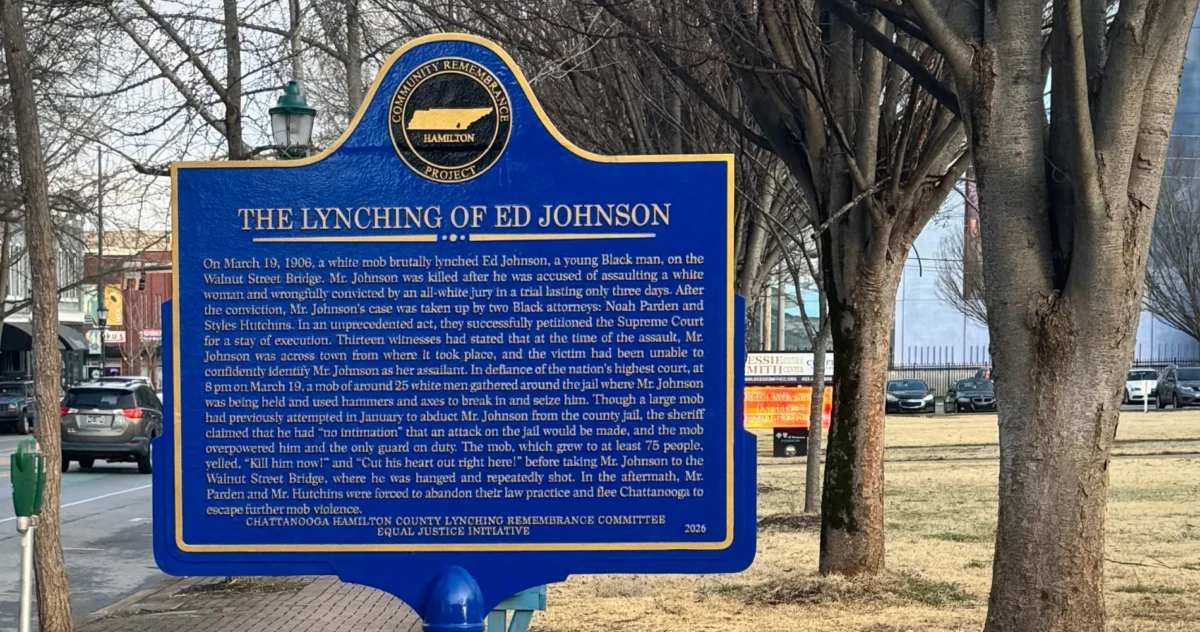
The solemn dedication ceremony, held on February 26 in downtown Chattanooga, Tennessee, marked a pivotal moment in the community’s ongoing commitment to confronting its difficult past and promoting racial healing. Hosted by the Bessie Smith Cultural Center, under the leadership of its president, Paula Wilkes, and in partnership with Eric Atkins from the Unity Group, the event brought together civic leaders, historians, and community members. The Bessie Smith Cultural Center, established in 1983, has long served as a vital institution in Chattanooga, renowned for its dedication to preserving and celebrating African American history and culture through a rich array of art, educational programs, research initiatives, and entertainment. Eric Atkins, a prominent figure in the community, has been a tireless advocate for historical preservation, particularly in fostering education within marginalized communities. His prior collaboration with EJI included a significant soil collection ceremony in 2017, honoring Ed Johnson and other victims of lynching in Chattanooga, laying the groundwork for this latest remembrance project.
A Ceremony of Remembrance and Resolve
The dedication ceremony itself was imbued with a spirit of somber reflection and forward-looking resolve. The Reverend Ernest Reid of the Second Missionary Baptist Church led attendees in a heartfelt prayer, invoking remembrance for the past and hope for a unified future. His words underscored the spiritual dimension of confronting historical injustice, seeking solace and strength in collective faith. Paula Wilkes, addressing the gathering, articulated the profound significance of the marker: “By naming what happened here, we honor Ed Johnson’s humanity and affirm that remembrance is a necessary step toward justice and healing.” She emphasized the dual responsibility the community now carries: “May this marker remind us not only of the past we must confront, but of the responsibility we carry forward.” Her statement resonated deeply, highlighting that the marker is not merely a historical artifact but a living testament to ongoing efforts for equity and understanding.
Brandon McRae, a Community Remembrance Project Team Member, offered remarks on behalf of EJI, expressing gratitude for the local community’s dedicated work on the project and their collective participation. His appreciation acknowledged the arduous efforts involved in bringing such a project to fruition, often requiring difficult conversations and sustained commitment. Further reinforcing the community’s engagement, Alexa LeBoefu, Hamilton County’s economic and community development director, and Carmen Elliot, representing Chattanooga Mayor Tim Kelly, both spoke passionately about the transformative power of openly sharing history. They articulated a shared desire to continue and expand educational initiatives, recognizing that a clear understanding of the past is fundamental to building a more just and equitable future. Eric Atkins, reflecting on the project’s evolution, remarked on its profound growth since its initial conception five and a half years prior. His powerful summation underscored the essence of communal strength: “We have to love together, we have to pray together, we have to stand together. Together is the only way we are at our best as a community.” His words served as a rallying cry for continued unity and collaborative action in addressing historical wounds and contemporary challenges.
The Tragic Injustice of Ed Johnson’s Lynching
The historical marker stands as a stark reminder of the brutal injustice inflicted upon Ed Johnson on March 19, 1906. Johnson, a young Black man, was savagely lynched by a white mob on the Walnut Street Bridge in downtown Chattanooga. His tragic fate unfolded after he was accused of assaulting an unnamed white woman, an accusation that quickly led to a wrongful conviction by an all-white jury in a trial that lasted a mere three days, characterized by a complete disregard for due process and evidence.
In an extraordinary and courageous act, two Black attorneys, Noah Parden and Styles Hutchins, took up Johnson’s case. Their relentless advocacy led them to successfully petition the U.S. Supreme Court for a stay of execution, an unprecedented legal victory for Black lawyers in the Jim Crow South. Their appeal was bolstered by compelling evidence: thirteen witnesses had testified that Johnson was across town from the crime scene at the time of the alleged assault, and the victim herself had been unable to confidently identify Johnson as her assailant. This Supreme Court intervention, an extremely rare instance of federal judicial oversight in a state-level lynching case, briefly offered a glimmer of hope for justice.
However, this glimmer was brutally extinguished by the defiance of local authorities and the unchecked fury of racial terror. At 8:00 PM on March 19, in flagrant contempt of the nation’s highest court, a mob of approximately 25 white men converged on the jail where Johnson was held. Using hammers and axes, they violently broke into the facility, overpowering the sheriff and the single guard on duty. Despite a previous attempt by a large mob in January to abduct Johnson from the county jail, the sheriff later claimed to have had “no intimation” that another attack would occur, a statement that has long been viewed with skepticism and as indicative of official complicity or negligence. As the mob grew to at least 75 individuals, their violent intent was chillingly clear, with shouts of “Kill him now!” and “Cut his heart out right here!” The mob dragged Johnson to the Walnut Street Bridge, where he was brutally hanged and repeatedly shot, his life extinguished in a horrifying public spectacle of racial violence. In the harrowing aftermath, attorneys Parden and Hutchins were themselves forced to abandon their law practice and flee Chattanooga to escape further mob violence, a testament to the pervasive and dangerous climate of racial terror that permeated the region.
Lynching in America: A National Scourge
Ed Johnson’s lynching was not an isolated incident but a grim manifestation of a widespread campaign of racial terror that gripped the United States, particularly the South, between the end of the Civil War in 1865 and 1950. During this dark period, more than 6,500 Black people were victims of mob violence and lynching across the country. These acts were not merely random violence; they were a systematic tool of racial control, designed to enforce white supremacy and suppress Black economic, social, and political advancement following the abolition of slavery.
A disturbing pattern within these atrocities was the frequent allegation of "assault" or inappropriate behavior between Black men and white women, which fueled nearly 25% of all lynchings. The mere accusation of sexual impropriety, often baseless or fabricated, was enough to ignite violent mobs. This preoccupation and fear among white communities regarding perceived sexual contact between Black men and white women were deeply rooted in the pervasive and false presumption that Black men were inherently violent, sexually aggressive, and a threat to white womanhood. This racist trope served as a powerful justification for terror, dehumanizing Black men and legitimizing their brutal murder.
Such accusations extended far beyond genuine physical harm, encompassing any action that could be interpreted as a Black man seeking contact with a white woman. This included actions as innocuous as looking at, accidentally bumping into, smiling, winking, or even simply getting too close to a white woman, or expressing disagreement. The ambiguity and subjective nature of these accusations made virtually any Black man vulnerable. Moreover, law enforcement and judicial systems often played a complicit role. It was distressingly common for lynch mobs to seize their victims directly from jails, prisons, courtrooms, or out of police custody. Police forces almost invariably failed to use force to resist these white lynch mobs, and in some documented cases, police officials were found to be active participants in or collaborators with the lynchings themselves. This systemic failure of justice and official complicity further cemented the terror and impunity enjoyed by these mobs. Ed Johnson was one of at least five documented victims of racial terror lynching killed in Hamilton County between 1865 and 1950, and his case represents one of more than 375 such victims in the state of Tennessee, underscoring the deeply entrenched nature of this violence within the region.
The EJI Community Remembrance Project: Reckoning with Truth
The historical marker dedicated to Ed Johnson is a tangible outcome of the Equal Justice Initiative’s broader Community Remembrance Project. This ambitious national campaign aims to recognize and memorialize the victims of lynching through several interconnected initiatives: collecting soil from lynching sites, erecting historical markers like the one in Chattanooga, and developing the Legacy Sites in Montgomery, Alabama, including the National Memorial for Peace and Justice and the Legacy Museum.
EJI’s foundational belief is that confronting the truth of racial violence is an essential prerequisite for communities to begin a necessary conversation that can advance genuine healing and reconciliation. By making these historical injustices visible, EJI seeks to challenge the narratives of silence and denial that have long obscured the scale and brutality of racial terror. The project provides a framework for communities to engage with their local histories of lynching, acknowledging the victims and the profound, lingering impact of these events on contemporary society. The 2017 soil collection ceremony for Ed Johnson, which preceded the marker dedication, exemplifies this process, symbolically reclaiming the earth that witnessed such violence and transforming it into a testament of remembrance and commitment to justice.
Broader Impact and Implications
The dedication of the Ed Johnson historical marker carries significant implications, extending far beyond the immediate community of Chattanooga. It represents a vital step in the national effort to acknowledge and reconcile with America’s history of racial terror. By publicly commemorating victims like Ed Johnson, communities are not only honoring the humanity of those who were brutally murdered but also actively challenging historical narratives that often minimized or ignored these atrocities. Such markers serve as powerful educational tools, ensuring that future generations understand the systemic nature of racial injustice and the long struggle for civil rights.
The initiative fosters a critical dialogue about the enduring legacy of lynching, which continues to manifest in various forms of systemic racism and inequality today. By grappling with this painful past, communities can better understand contemporary issues related to criminal justice, racial bias, and social inequity. The collective efforts of organizations like the Bessie Smith Cultural Center, the Unity Group, and the EJI demonstrate the power of collaboration in driving social change and fostering a more inclusive historical memory. This process of truth-telling is not merely about looking backward; it is about building a more just future by understanding the foundations of present-day challenges. The marker for Ed Johnson stands as a beacon, illuminating a dark chapter of American history and inspiring ongoing commitment to justice, unity, and the tireless pursuit of a society where such injustices are never again allowed to occur.