Recent developments in artificial intelligence are presenting both unprecedented opportunities and significant challenges to the field of public opinion polling. While some companies are exploring the use of AI to model public sentiment, others are employing it for more nefarious purposes, such as fabricating survey responses at scale. Compounding these issues are persistent data quality problems within traditional online polling methods, often stemming from "bogus respondents" who do not engage with surveys in good faith. These intertwined challenges have led to a climate of uncertainty, making it difficult for the public to discern which polls are reliable and which are not. To address these pressing concerns, Courtney Kennedy, Vice President of Methods and Innovation at Pew Research Center, offers expert insights into the evolving landscape of polling in the United States.
The Rise of "Silicon Sampling" and Its Critiques
One of the most prominent new trends involves companies utilizing artificial intelligence to simulate public opinion, a practice sometimes referred to as "silicon sampling." Instead of directly surveying individuals, these firms are prompting AI models with questions to predict what people would think. This approach has raised significant ethical and scientific questions within the research community.
Pew Research Center, a non-partisan organization dedicated to public opinion research, has explicitly stated that it does not engage in silicon sampling. "No. We only interview real people. We don’t use AI to tell us what the public thinks," Kennedy affirmed. "There are ethical and scientific concerns with using AI to replace humans in public opinion surveys."
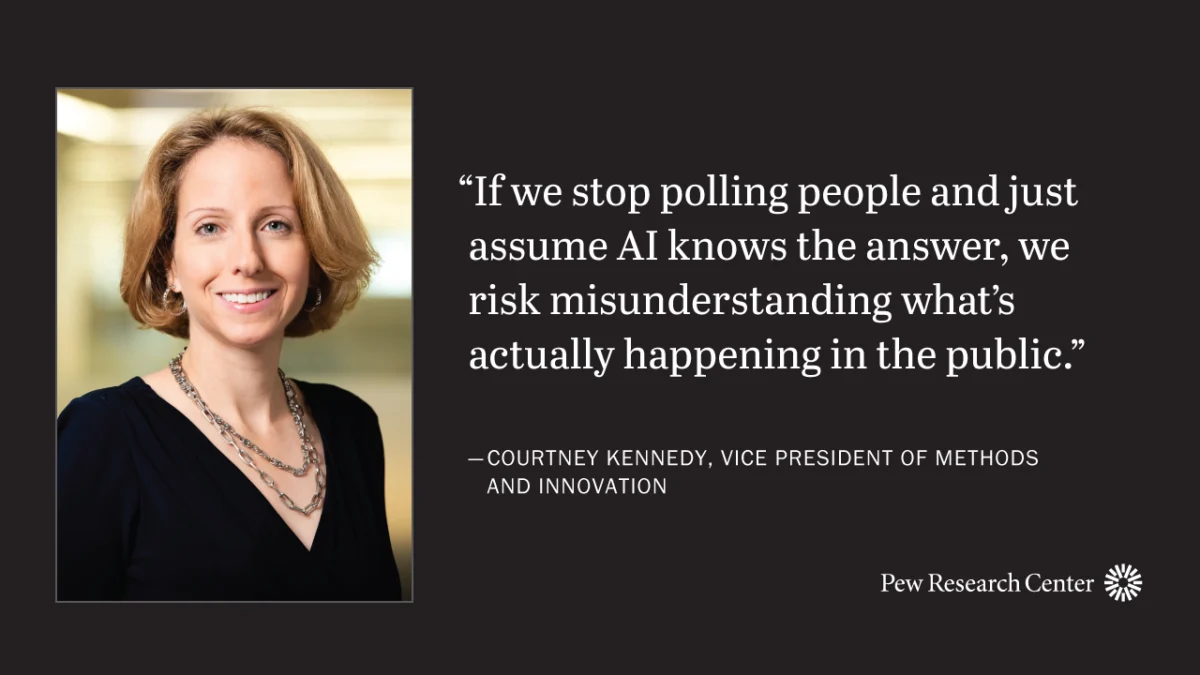
The core of polling, Kennedy explained, lies in understanding the authentic thoughts and experiences of individuals. "Polling is fundamentally about humans – what they’re thinking and experiencing," she stated. "Polls give the public a voice in politics, business and other areas. In the political realm, they let leaders know what hardships people are experiencing and what they’d like the government to do differently. If we stop polling people and just assume AI knows the answer, we risk misunderstanding what’s actually happening in the public."
Scientific critiques of silicon sampling are also emerging. Experimental research, including internal studies conducted by Pew Research Center for learning purposes, has highlighted potential limitations. These studies suggest that AI-generated estimates can lead to generalizations about demographic groups, may exhibit a bias in representing political viewpoints (often underrepresenting Republican perspectives compared to Democratic ones), and can fail to capture the nuanced spectrum of disagreement present in genuine public opinion. While AI technology is continuously evolving and may eventually become more adept at mimicking human responses, the fundamental ethos of polling, according to Kennedy, is rooted in direct engagement with human participants.
AI-Powered Fraud: The Threat to "Opt-In" Surveys
Beyond silicon sampling, a more malicious application of AI involves its use by bad actors to generate fraudulent survey responses at an unprecedented scale. This threat primarily targets "opt-in" surveys, a common format where individuals voluntarily sign up to participate, often incentivized by monetary rewards.
"No. That threat applies to ‘opt-in’ surveys," Kennedy clarified when asked about the impact of AI-generated fake responses on Pew Research Center. "Those are polls that people can proactively sign up to take – for example, by responding to social media ads offering a reward for taking a survey. Since it’s easy to adopt a fake identity online, opt-in polling opens the door to AI and bad actors seeking to commit fraud."
The ease with which fake identities can be created online, coupled with the financial incentives offered by many opt-in survey platforms, creates a fertile ground for manipulation. Reports from law enforcement agencies, such as indictments for large-scale fraud schemes, underscore the real-world consequences of these fraudulent activities. For instance, individuals can allegedly create multiple fake accounts and complete hundreds of surveys daily, potentially amassing significant sums of money. One hypothetical scenario described by Kennedy suggests that an individual using AI bots could earn upwards of $30,000 per month through fraudulent participation in opt-in surveys.
Pew Research Center employs a fundamentally different methodology: probability-based sampling. This method involves the random selection of individuals from a comprehensive list of U.S. home addresses. Initial contact is made via postal mail, and a carefully curated sample of the public is invited to participate each year. The probability of any single individual being selected is exceptionally low, and self-enrollment or nomination is not possible. This rigorous recruitment process inherently prevents bad actors from self-selecting into their research panels and gaming the system.
The financial disincentive for fraud within probability-based panels is stark. In contrast to the potential for substantial earnings through opt-in fraud, participants in Pew’s probability panel have a single account, take a limited number of surveys per month, and receive a modest compensation per survey. This structure makes large-scale cheating financially unviable, as the hypothetical earnings from AI-assisted fraud would be a mere fraction of what is possible through opt-in schemes.

The Persistent Problem of "Bogus Respondents"
The issue of fraudulent survey responses is closely linked to the phenomenon of "bogus respondents." These are individuals who participate in surveys without any genuine intention of providing truthful answers. Their primary motivation is to complete surveys as rapidly as possible to maximize monetary rewards. A common characteristic of bogus respondents is a tendency to provide uniformly positive answers, such as "yes" or "approve," regardless of the actual question.
This behavior has demonstrably led to flawed conclusions and necessitated the retraction of news stories based on unreliable data from opt-in polls. For example, studies have shown that opt-in polls can produce misleading results regarding the prevalence of certain beliefs or behaviors, particularly among specific demographic groups. The existence of bogus respondents is largely attributed to the open enrollment nature of opt-in surveys, which, by design, encourage broad participation without stringent researcher-led recruitment.
Are All Opt-In Surveys Inherently Flawed?
While opt-in surveys are susceptible to fraud and data quality issues, they are not universally problematic. In certain contexts, they can yield results comparable to those from probability-based polls. For instance, when the objective is to gauge the general opinion of all adults on a broad topic, such as presidential approval ratings, the outcomes from opt-in and probability-based surveys may align.
However, significant discrepancies emerge when attempting to measure more specific or less common phenomena. Research has indicated that opt-in polls can generate erroneous data when assessing the opinions of younger adults and when estimating the prevalence of relatively rare behaviors. These rare behaviors can include holding fringe beliefs, identifying with specific religious affiliations, having military service experience, or supporting political violence. In these instances, the unrepresentative nature of opt-in samples, often skewed by self-selection and potential fraudulent participation, leads to inaccurate estimations.
The Trustworthiness of Probability-Based Polls
While probability-based polls, like those conducted by Pew Research Center, are considered the gold standard for ensuring representative samples, they are not inherently infallible. Kennedy emphasized that while respondent recruitment is a critical starting point, it is not the sole determinant of a poll’s trustworthiness.
"It’s important to assess how respondents were recruited, but it’s not all that matters," she stated. "For example, in recent elections, there have been examples of probability-based polls that were not weighted properly and, as a result, were way off."
Proper weighting, a statistical technique used to adjust sample data to reflect the known characteristics of the population, is crucial for ensuring accuracy. Inadequate weighting can lead to significant deviations from actual public opinion, even when a probability-based sample is employed. Therefore, a trustworthy poll requires a comprehensive approach, encompassing a robust sampling methodology from inception to completion, alongside meticulous data analysis and weighting.
The Cost of Rigor: Why Probability Polls Are More Expensive
The adherence to rigorous methodologies, such as probability-based sampling, inevitably incurs higher costs compared to opt-in surveys. Pew Research Center’s commitment to these standards translates into a more resource-intensive process.
"Our surveys are more expensive because getting participation from a randomly selected sample of Americans is time- and labor-intensive," Kennedy explained. "We recruit people offline, in real life, via letters mailed to home addresses. We use random sampling so that nearly all U.S. adults have a chance of being selected for our surveys. And we allow people to answer our questions by web or phone (because research shows that some groups of Americans are reluctant to take surveys online)."
The process involves extensive outreach, multiple contact attempts, and accommodating various response preferences, all of which contribute to the overall expense. This investment in methodological integrity, however, is seen as essential for producing reliable and credible data that can inform public discourse and policy decisions.
Looking Ahead: The Future of Public Opinion Research
The advent of AI presents a dual-edged sword for the polling industry. While the potential for misuse is significant, leading to the erosion of public trust, the ethical and scientifically sound application of AI could also offer new avenues for research and analysis. For organizations like Pew Research Center, the unwavering commitment to direct engagement with real people, coupled with the continuous refinement of rigorous methodologies, remains paramount. The challenge for the industry, and for the public consuming poll data, will be to navigate this evolving technological landscape with a critical eye, prioritizing transparency, scientific validity, and the fundamental principle of hearing directly from the populace. The integrity of public opinion research hinges on this delicate balance between innovation and the enduring value of human voices.