A comprehensive new report from the Pew Research Center illuminates the intricate and often imbalanced realities faced by working parents in the United States, particularly concerning the division of household chores and childcare responsibilities. The study, based on extensive surveys and data analysis, underscores a persistent disparity where mothers disproportionately shoulder the burden of domestic labor, even when both parents work full-time. This research, conducted in March 2026 with 2,242 U.S. working parents, aims to provide critical insights into how Americans navigate the complex interplay between their professional and family lives, informing the public, media, and policymakers.
The Enduring Load: Mothers Carry More of the Domestic Weight
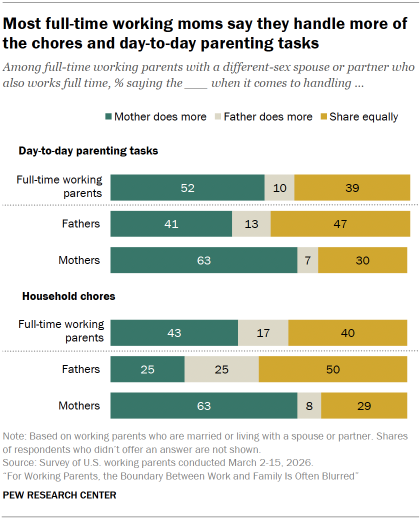
The findings reveal a stark difference in perception and reality regarding who manages the daily demands of home and family. Among married or cohabiting parents in different-sex couples where both partners are employed full-time, a significant majority of mothers report undertaking more parenting and household tasks than their male counterparts. Specifically, 63% of mothers state they handle more day-to-day parenting responsibilities, and an equal percentage say the same about household chores.
In contrast, fathers in these dual-income households are considerably more inclined to perceive these responsibilities as being divided more equitably. This divergence in perception highlights a fundamental disconnect in how domestic labor is experienced and acknowledged within many heterosexual partnerships.
Even in households where the mother dedicates more hours to paid employment than the father, this does not translate into a more balanced distribution of domestic duties. The data indicates that when mothers work longer hours, parents are still more likely to report that the mother handles more of the parenting and household tasks than to suggest the father does. This suggests that factors beyond hours worked in the paid labor force are at play in shaping the division of domestic responsibilities.

Paid Work vs. Unpaid Labor: A Complex Equation
The study also delved into the division of paid work. Among couples where both parents work full-time, 41% of parents reported that the father spends more time on paid work on a typical day. Conversely, 21% indicated that the mother spends more time working, and 39% stated that both parents dedicate roughly the same amount of time to their professional roles. Interestingly, these figures did not exhibit significant variations based on gender, suggesting a more nuanced distribution of paid work hours compared to the more pronounced gendered patterns observed in unpaid domestic labor.
The research methodology involved a survey of 2,242 U.S. working parents, all members of the Pew Research Center’s American Trends Panel. The survey was conducted from March 2 to March 15, 2026. The report also incorporates an analysis of parents in the labor force using data from the U.S. Census Bureau’s Current Population Survey, providing a broader demographic and economic context. This comprehensive approach allows for a robust understanding of the multifaceted challenges and dynamics facing working families.
Satisfaction Levels: A Tale of Two Perceptions
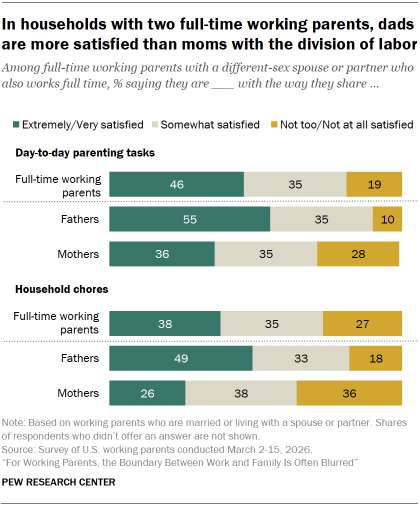
The research also explored parental satisfaction with the division of labor at home, revealing another layer of disparity. In dual-income households, fathers generally express higher levels of satisfaction with the distribution of domestic and parenting tasks compared to mothers. This difference in contentment is particularly pronounced when examining satisfaction with the division of parenting tasks and household chores.
For instance, among fathers in full-time working couples, 74% reported being extremely or very satisfied with how parenting tasks are divided, compared to 57% of mothers. Similarly, 72% of fathers expressed high satisfaction with the division of household chores, whereas only 57% of mothers shared this sentiment. This indicates that while mothers may be shouldering more of the load, fathers are more likely to feel content with the existing arrangement, even if it’s not perceived as equal by their partners.
The Impact of Perceived Equity on Satisfaction
The study further highlights a crucial correlation between the perceived equitability of task distribution and overall satisfaction. In families where both parents work full-time, those who report sharing parenting tasks "about equally" are significantly more likely to express satisfaction with the arrangement than those who believe the mother performs more of these duties. This finding was consistent for both mothers and fathers, underscoring the universal desire for fairness in domestic responsibilities.
For parenting tasks, 70% of parents who feel they share duties equally report being satisfied, compared to 51% of parents who believe the mom does more. A similar pattern emerged for household chores: 67% of parents who perceive an equal division of chores are satisfied, in contrast to 44% of those who believe the mother handles more.
Mothers, in particular, demonstrate a strong preference for equitable distribution. When mothers and their partners share household chores equally, 54% report being satisfied, a stark contrast to the 11% satisfaction rate when mothers perform more of these tasks. This suggests that mothers’ satisfaction is closely tied to a perceived balance, whereas fathers’ contentment may be less sensitive to the precise division of labor, as long as it doesn’t feel overly burdensome to them.
Navigating the Unexpected: Childcare Emergencies and Work Flexibility
Beyond the daily grind of parenting and household management, working parents frequently face unexpected challenges, particularly concerning childcare. The Pew Research Center’s findings indicate a prevailing belief that mothers are more likely to take time off from work to attend to sick children or other unforeseen childcare needs.
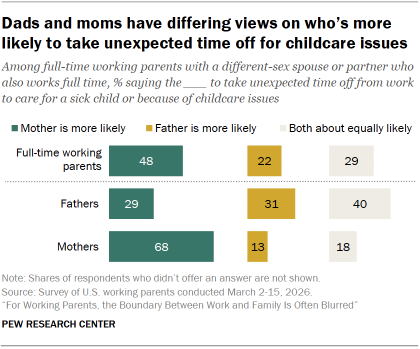
In different-sex couples where both parents work full-time, 48% of respondents believe the mother would be more likely to take unexpected time off. While 29% suggested both parents would be equally likely to do so, and 22% thought the father would be more likely. This perception reinforces the traditional gender roles, suggesting an expectation that mothers will be the primary responders to childcare emergencies.
However, similar to the division of household labor, there are differing perspectives between mothers and fathers on this issue. While 50% of mothers believe they would be more likely to take time off for childcare emergencies, only 42% of fathers hold this view. Conversely, fathers are more likely than mothers to believe that both parents would be equally likely to take time off (36% of fathers vs. 23% of mothers). This discrepancy underscores a potential lack of shared understanding and expectation regarding who is the primary caregiver in times of crisis.
The Crucial Role of Workplace Flexibility
When it comes to deciding which parent will take time off for unexpected childcare situations, workplace flexibility emerges as the paramount factor. A significant majority of parents, 70%, identified "who has more flexibility at work" as a major determinant in this decision. This suggests that the ability of a parent to adapt their work schedule without penalty is a critical consideration for families trying to balance work and immediate family needs.
Other factors, while less influential than workplace flexibility, also play a role. These include the parent whose job is less demanding (49%), the parent with more paid time off available (45%), and the parent whose employer is more understanding of family needs (41%). The relative importance of these factors indicates that practical considerations related to employment are key drivers in these difficult family decisions.
The research also noted that there were insufficient numbers of same-sex couples in the sample to conduct a separate analysis, a limitation acknowledged by the researchers. Previous Pew Research Center studies have explored the experiences of same-sex parents, providing a broader context for family dynamics.
Broader Implications and Future Considerations
The findings of this Pew Research Center report carry significant implications for understanding the modern American family. The persistent gendered division of labor, where mothers disproportionately manage household and childcare responsibilities, contributes to what is often termed the "second shift" for working mothers. This imbalance can lead to increased stress, burnout, and potential career limitations for women, even in households where both partners are committed to their professional lives.
The divergence in satisfaction levels between mothers and fathers also points to a need for greater open communication and negotiation within couples. The data suggests that a more equitable division of labor, or at least a shared perception of equity, is strongly linked to higher levels of satisfaction for both partners.
Furthermore, the emphasis on workplace flexibility as a key factor in managing childcare emergencies highlights the critical role employers and policymakers can play. Policies that support paid family leave, flexible work arrangements, and a culture that values work-life integration are essential for alleviating the burden on working parents, particularly mothers.
This research serves as a vital reminder that while societal norms around gender roles are evolving, the practical realities of domestic labor distribution remain a significant challenge for many working families. The Pew Research Center’s ongoing commitment to studying these complex issues provides invaluable data for fostering a more equitable and supportive environment for all parents striving to balance their professional aspirations with their family obligations. The report’s detailed methodology, survey questions, and topline responses are publicly available, inviting further examination and discussion among academics, policymakers, and the general public.