
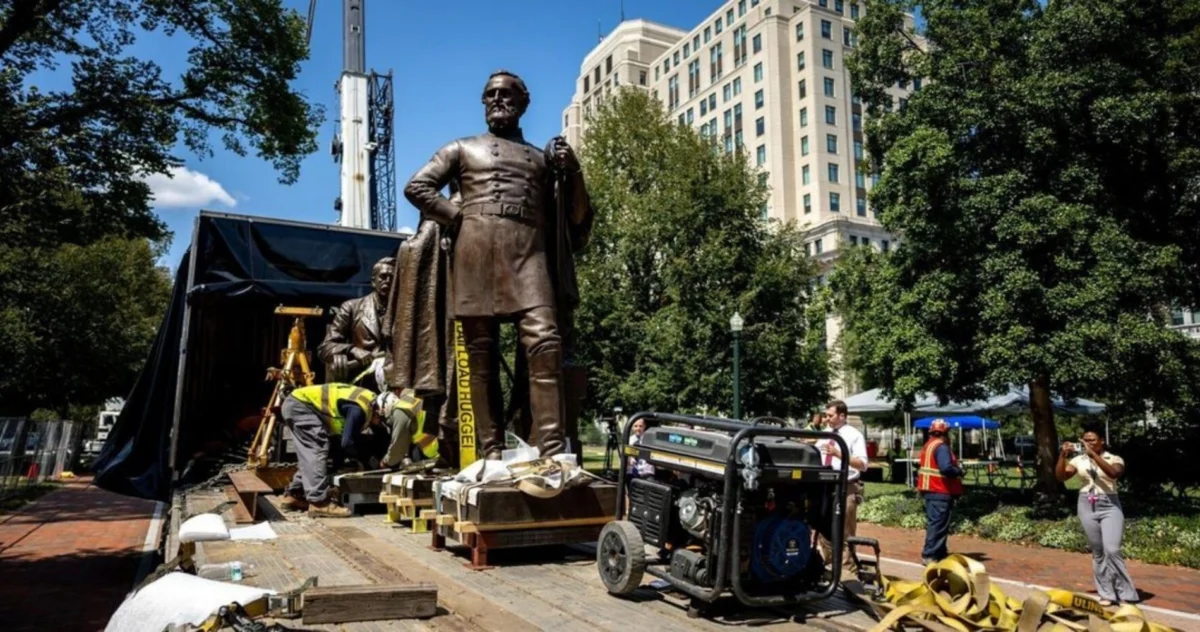
In a move that signals a profound shift in how the Commonwealth of Virginia reconciles with its turbulent past, state officials removed the final three Confederate monuments from Capitol Square in Richmond this past Friday. This decisive action, carried out in accordance with legislation enacted earlier this year, ensures that no statues or symbols dedicated to the Confederate States of America remain on public state property. The removal of these figures, including a prominent likeness of Stonewall Jackson, serves as the concluding chapter in a protracted, state-wide effort to dismantle the physical vestiges of an era defined by racial terror, segregation, and the defense of chattel slavery.
The Historical Genesis of Confederate Iconography
To understand the significance of these removals, one must analyze the timeline of when these monuments were erected. Contrary to the popular belief that these statues were immediate post-Civil War tributes, the vast majority were installed during two distinct periods of heightened racial tension: the turn of the 20th century and the height of the mid-century Civil Rights Movement.
During the late 1800s and early 1900s, white Southern legislatures and private organizations, most notably the United Daughters of the Confederacy, launched a coordinated campaign to rebrand the Confederate cause. By erecting monuments in prominent public squares, these groups sought to rewrite the narrative of the Civil War, framing the secession of the South not as a war to preserve the institution of slavery, but as a heroic defense of "states’ rights" and "local autonomy."
This period coincided with the implementation of Jim Crow laws, a regime of disenfranchisement and racial violence designed to restore the racial hierarchy that had been disrupted by the abolition of slavery. The monuments served as permanent, imposing sentinels of this hierarchy, reinforcing white supremacy in the public consciousness.
Decades later, in the 1950s and 1960s, a second wave of monument installation occurred. As the federal government began to enforce desegregation and the Civil Rights Movement gained momentum, these statues were deployed as political weapons. By venerating the Confederacy, segregationist leaders aligned themselves with the "lost cause" ideology, signaling their resistance to federal mandates and their commitment to maintaining a segregated society.
A Chronology of Removal and Public Reckoning
The path to the events of this past Friday has been paved by years of grassroots advocacy, legal battles, and a growing public demand for institutional honesty. The following timeline outlines the key milestones in this transition:
- 2017: The white supremacist "Unite the Right" rally in Charlottesville, sparked by the planned removal of a Robert E. Lee statue, brought national scrutiny to Virginia’s Confederate symbols. The violent death of a peaceful counterprotester catalyzed a movement that forced local and state governments to confront the public safety and moral implications of these statues.
- 2020: In the wake of the global protests against police brutality following the death of George Floyd, activists in Richmond toppled the statue of Confederate President Jefferson Davis. This act of civil disobedience accelerated official government efforts. In July 2020, House Speaker Eileen Filler-Corn ordered the removal of a statue of Robert E. Lee and seven other Confederate busts from the Virginia Capitol interior.
- 2021: The City of Charlottesville successfully removed its central Confederate monuments, including the Lee statue that had become a flashpoint for national tension.
- 2022: The City of Richmond completed the removal of all its city-owned Confederate monuments, including the statue of A.P. Hill, signaling that the capital of the former Confederacy had officially turned the page on its commemorative landscape.
- 2025–2026: Governor Abigail Spanberger signed legislation reversing tax code carve-outs that had historically benefited organizations like the United Daughters of the Confederacy, effectively ending the state’s financial subsidization of groups committed to the promotion of Confederate ideology.
Data and Scope: The Magnitude of the Task
The Equal Justice Initiative (EJI) has documented that Virginia holds the distinction of having more Confederate monuments than any other state in the nation. This high density reflects the state’s unique position as the headquarters of the Confederacy. For decades, Richmond’s "Monument Avenue" functioned as a grand, outdoor gallery of the Lost Cause, featuring five massive statues dedicated to Confederate generals and leaders.
The scale of the removal effort has been substantial. According to records maintained by the Washington Post and various civil rights monitoring groups, more than a dozen significant Confederate memorials were removed from state-controlled sites in Richmond alone between 2020 and 2026. The removal of the final three monuments from Capitol Square is the culmination of a decade of legislative and executive work, reflecting a broad, bipartisan consensus that these symbols no longer represent the values of the modern Commonwealth.
Official Perspectives and Political Implications
The removal process has been met with both widespread support from proponents of historical accuracy and vocal opposition from those who view the statues as essential parts of Southern heritage.
Reflecting on the progress made during his tenure, former Richmond Mayor Levar Stoney noted the difficulty of the process, stating, "Richmond had more Confederate monuments than any other city in the United States, and we were the former capital of the Confederacy. This wasn’t just two years of work; this was a hundred years of difficult work." His remarks highlight the emotional and political exhaustion associated with challenging deeply entrenched cultural symbols.
From the legislative perspective, the focus has shifted from mere removal to the necessity of providing context. As Speaker Filler-Corn emphasized during the initial 2020 removals, "Virginia has a story to tell that extends far beyond glorifying the Confederacy." The current state administration has echoed this sentiment, arguing that removing the statues does not "erase history," but rather clears the way for a more inclusive and complete historical narrative that acknowledges the lived experiences of all Virginians, particularly those who were enslaved and marginalized.
Broader Impact: A National Contrast
The Commonwealth’s recent actions occur within a complex national climate. While Virginia has moved toward the systematic removal of Confederate iconography, other jurisdictions and federal entities have moved in the opposite direction. There have been ongoing efforts at the federal level to re-establish Confederate names on military bases and to reinstate monuments that were previously removed.
This creates a stark contrast between Virginia’s approach and the current federal trend. By codifying the removal of these statues, Virginia has effectively distanced itself from the revisionist history that persists in other parts of the country. Political analysts suggest that this shift could have lasting implications for Virginia’s political culture, making it a case study for other states currently grappling with their own commemorative landscapes.
The Future of Capitol Square
With the pedestals now empty, the conversation in Richmond has turned to the future of Capitol Square. The removal of these statues is widely viewed by historians as an opportunity to curate a public space that reflects the diversity and democratic aspirations of the 21st century. Proposals for new memorials have already begun to surface, with many advocates pushing for monuments that honor the civil rights struggle, the contributions of African American leaders, and the democratic achievements of the Commonwealth.
As the state moves forward, the silence left behind by the removal of the statues is intended to be filled with a more comprehensive historical dialogue. By treating these monuments as artifacts of a specific political era—rather than as static, venerated history—Virginia is attempting to reconcile its past while establishing a more equitable foundation for its future. The physical landscape of the state capital has changed, but the work of contextualizing the legacy of slavery and the Civil War remains an ongoing, vital part of the state’s civic life.




