
The American financial landscape has undergone a seismic shift over the last decade, fundamentally altering how households interact with the economy. Since 2015, the share of Americans who rely on cash for all or nearly all of their weekly purchases has plummeted by half, dropping from 24% to just 12%. Simultaneously, the proportion of consumers who report using no cash at all during a typical week has surged from 24% to 42%, according to recent findings from a 2026 Pew Research Center survey. This transition toward a digital-first economy represents a profound change in consumer habits, accelerated by technological advancements, the ubiquity of mobile banking, and a gradual departure from traditional physical transaction methods.
A Chronology of Payment Evolution
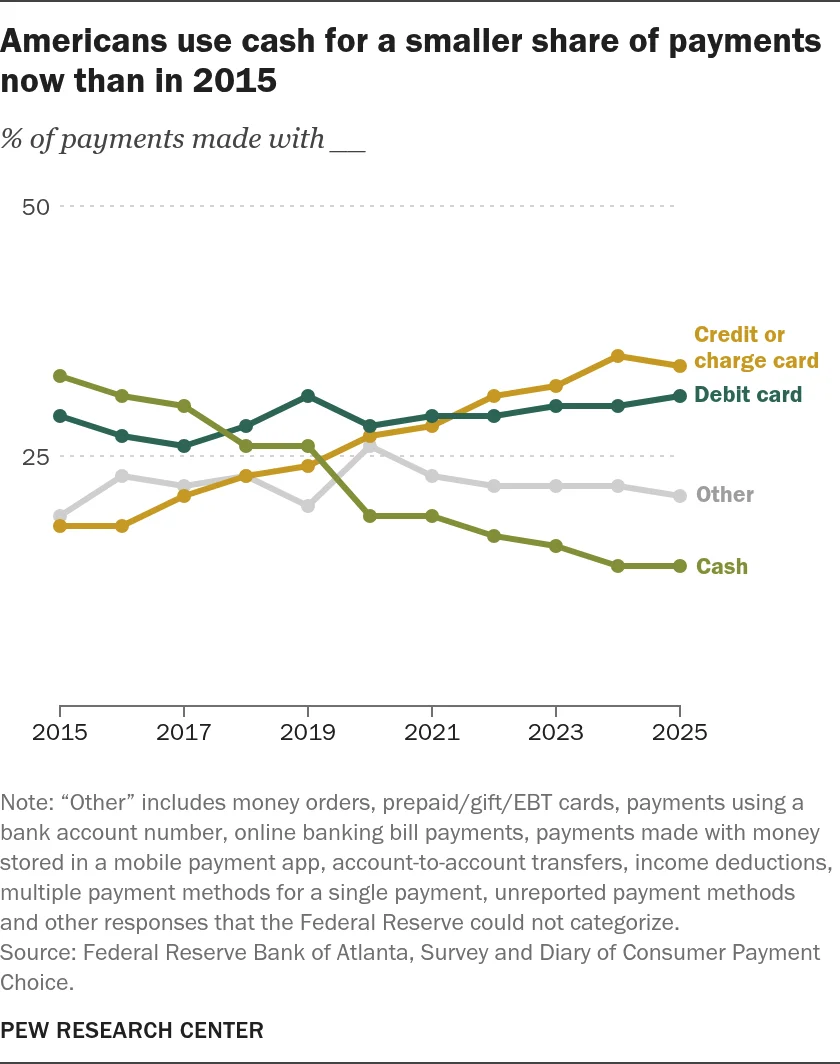
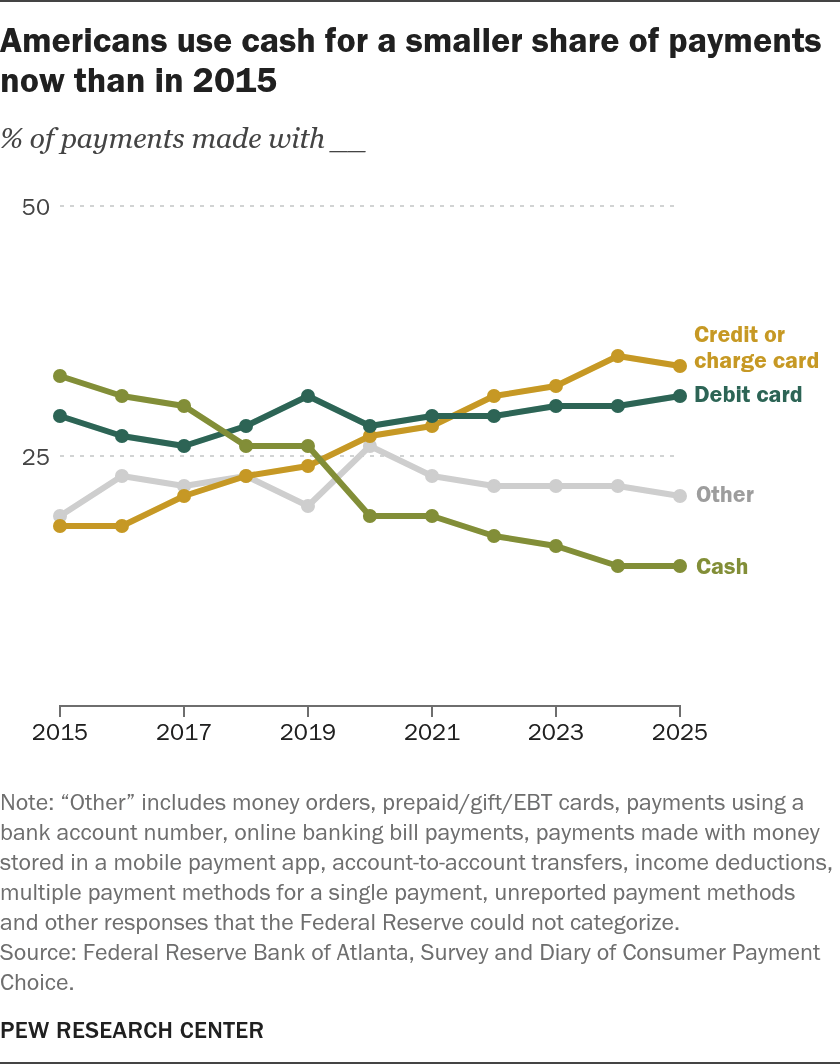
To understand the trajectory of this shift, one must look back at the state of personal finance in 2015. At that time, cash reigned supreme as the most utilized payment instrument in the United States. Data from the Federal Reserve Bank of Atlanta’s Survey and Diary of Consumer Payment Choice indicates that 33% of all transactions in 2015 were settled with physical currency. In contrast, debit cards accounted for 29%, and credit cards trailed at 18%.
The turning point arrived in 2018, a year that marked a historic pivot in consumer preference. For the first time since the Federal Reserve began tracking these metrics, the volume of debit card transactions surpassed those made with cash. This shift signaled that the convenience and security of card-based payments had begun to outweigh the anonymity and tangibility of physical notes.
The trend gained further momentum during the global disruptions of 2020. As social distancing measures and hygiene concerns discouraged the handling of physical currency, the transition to electronic payments accelerated. By 2022, a new hierarchy had emerged: credit cards overtook debit cards as the most frequently used payment method. By 2025, credit cards commanded a 34% share of all payments, while debit cards held 31%. Consequently, the share of cash transactions withered to a mere 14%.
Understanding the Shift in Transaction Dynamics
The decline of cash is not merely a matter of convenience; it is a reflection of how the average transaction value dictates payment choices. Federal Reserve data from 2025 illustrates a clear correlation between the cost of a purchase and the chosen payment instrument.
Cash remains most viable for smaller, day-to-day expenditures. In 2025, the average cash transaction hovered around $58. This stands in contrast to the average debit card transaction of $74 and the average credit card transaction of $80. The data suggests that as the value of a transaction increases, consumers are increasingly inclined to utilize credit cards, likely driven by rewards programs, consumer protections, and the ease of tracking larger expenses.
Conversely, specialized payment instruments serve specific niches. Prepaid, gift, and EBT cards are typically utilized for lower-value transactions, averaging $35. At the other end of the spectrum, transactions involving checks, direct account transfers, and online banking systems are reserved for high-value payments, often ranging between $400 and $700. These high-value transactions remain firmly anchored in the banking infrastructure, as they provide an audit trail and security features that cash cannot replicate.
Consumer Preferences and the Digital Divide
While the actual usage of payment methods tells one part of the story, consumer preference provides a window into the future of the economy. When surveyed on their ideal payment methods, the vast majority of Americans express a clear bias toward electronic systems.
For in-person transactions, 78% of consumers prefer to use either a credit or debit card, compared to only 16% who still favor cash. This gap has widened significantly since 2015, when 73% preferred cards and 23% opted for cash. The data suggests that the "cashless" trend is largely consumer-driven, rather than solely a result of merchants refusing cash.
Online purchases have reached near-total saturation by electronic methods, with 92% of consumers preferring cards for e-commerce. However, the realm of bill payments reveals a more nuanced landscape. While 47% of consumers prefer using a credit or debit card for recurring bills, 40% favor online banking or direct account transfers. This split suggests that for institutional payments—such as utilities or mortgages—consumers are increasingly comfortable with direct bank-to-bank connections, effectively bypassing the credit card network entirely.
Implications for the Financial Ecosystem
The transition away from cash has profound implications for financial inclusivity and systemic stability. Economists and policymakers have noted that while the digital transition offers efficiency and reduced transaction costs for merchants, it also risks alienating populations that are "unbanked" or "underbanked."
Furthermore, the reliance on credit cards for the majority of transactions introduces a new dimension of consumer debt management. As credit cards become the primary vehicle for daily consumption, the potential for revolving debt increases. Financial institutions have responded by integrating more robust digital tools to help consumers manage their spending in real-time, yet the systemic reliance on these proprietary networks continues to grow.
The Federal Reserve’s ongoing monitoring of these trends highlights that 70% of current cash transactions are made by individuals who would actually prefer to use another method, primarily credit or debit cards. This suggests that the decline of cash is not a result of a lack of desire for digital options, but rather the gradual removal of friction in the digital payment process. As more merchants implement tap-to-pay, mobile wallets, and seamless point-of-sale systems, the remaining 14% of cash usage is likely to face continued downward pressure.
Official Responses and Future Outlook
While no formal government mandate has been issued to move toward a cashless society, the decline of physical currency has prompted discussions within the central banking community regarding the necessity of Central Bank Digital Currencies (CBDCs). Proponents argue that as physical cash usage wanes, the central bank must provide a digital equivalent that remains a public good, ensuring that the convenience of digital payments does not come at the expense of public access to money.
Critics, however, raise concerns regarding privacy and government surveillance. The anonymity of cash is a feature that many citizens value, and the transition to a purely digital economy leaves a permanent, traceable record of every transaction. These ethical and practical considerations continue to be the subject of rigorous debate in legislative and academic circles.
As the decade progresses, the trajectory appears clear: the American consumer is signaling a definitive preference for the speed, security, and integration of digital payment systems. Whether this trend eventually eliminates cash as a viable payment option entirely remains to be seen, but the current data indicates that the "cashless" future is no longer a distant possibility—it is the present reality. The integration of mobile apps, digital wallets, and biometric authentication will likely be the next frontier in this evolution, further distancing the average American from the traditional wallet filled with paper currency. For businesses, financial institutions, and policy makers, the challenge will be to ensure that this transition remains inclusive, secure, and resilient in the face of an ever-changing global financial environment.




