
As the United Kingdom edges closer to the formal commencement of Section 1 of the Equality Act 2010, public discourse surrounding the socio-economic duty (SED) has intensified into a major political and ideological battleground. Described variously as a transformative tool for social mobility or an unwelcome bureaucratic burden, the clause requires certain public authorities to actively consider how strategic policy, budgetary, and commissioning decisions can reduce inequalities stemming from socio-economic disadvantage.
Nearly sixteen years after the Equality Act received Royal Assent, the impending implementation of Section 1 in England has prompted a critical re-examination of how the law is understood, debated, and framed across different segments of society. A recent collaborative study by The Equality Trust and the University of York Law School utilizes Critical Discourse Analysis (CDA) to map the starkly contrasting narratives advanced by politicians, the mainstream media, academics, public sector practitioners, civil society organizations, and the communities most affected by poverty.
Background and Legislative Origins
The legislative roots of the socio-economic duty trace back to the Labour government of the late 2000s. Championed prominently by then-Minister for Women and Equality Harriet Harman, the Equality Bill was designed to streamline and strengthen anti-discrimination legislation across Great Britain. Within this sweeping framework, Section 1 was formulated to address a persistent blind spot in traditional equality law: the failure of public bodies to systematically account for class-based and economic inequalities.
Under the statutory provision, specified public authorities—primarily local authorities and major government departments—are legally obligated to have "due regard" to the desirability of reducing inequalities of outcome resulting from socio-economic disadvantage when making strategic decisions. Unlike day-to-day operational choices, these strategic decisions involve long-term priority setting, overarching policy positions, and major resource allocations.
However, the political trajectory of the clause shifted dramatically following the 2010 general election. The incoming Conservative-Liberal Democrat coalition government quickly announced that it would not commence Section 1, leaving it dormant on the statute book in Westminster. Despite lacking a formal parliamentary repeal, the clause remained inactive in England for over a decade. Conversely, the devolved administrations in Scotland and Wales took independent legislative steps, activating the duty in 2018 and 2021, respectively.
The political landscape shifted again with the election of the Labour government in 2024, which featured a manifesto commitment to finally revive the duty in England. With the government currently drafting statutory guidance following a nationwide public consultation, stakeholders across the political spectrum are fiercely contesting the scope, intent, and potential consequences of the long-delayed legal requirement.
Chronology of a Divisive Policy
The lifecycle of the socio-economic duty has been marked by distinct phases of parliamentary attention, legislative dormancy, and renewed public friction:
2009–2010: Introduction and Dormancy. Parliamentary debate over the duty peaks during the passage of the Equality Bill. Following the 2010 election, the coalition government halts the implementation of Section 1, arguing it is unnecessary and overly bureaucratic.
2018–2021: Devolved Implementation. The Scottish Government implements the socio-economic duty in 2018, followed by the Welsh Government in 2021, providing empirical case studies for researchers and policymakers assessing its practical impact.
2024: Policy Revival. The Labour Party returns to power with a manifesto pledge to activate the dormant clause in England, prompting renewed scrutiny from think tanks, local authorities, and the national press.
2025–2026: Consultation and Backlash. The government initiates a formal public consultation and begins drafting statutory guidance. Right-wing media outlets and opposition politicians ramp up criticism, framing the duty as a threat to the middle class, while civil society groups mobilize extensive support.
Media Framing and Political Polarization
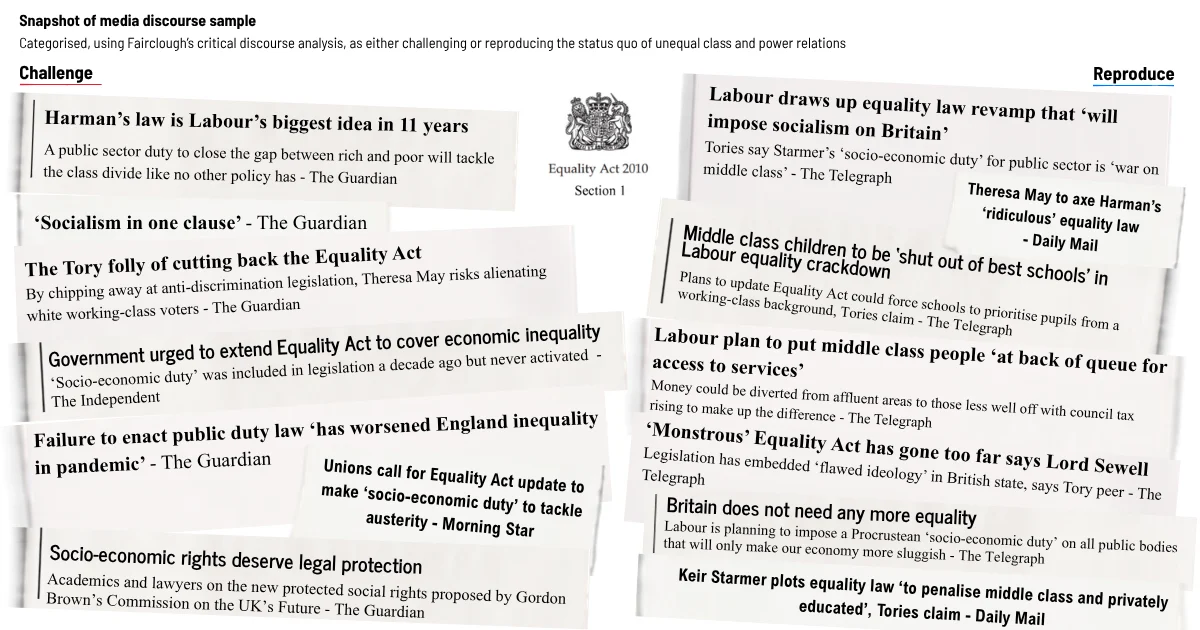
An analysis of national news coverage reveals a profound ideological divide. Right-leaning publications, including The Telegraph, the Daily Mail, and the Daily Express, have consistently dominated the narrative with skeptical or openly hostile framings. Out of a sample of 27 key articles reviewed by researchers, 17 reflected a distinctly negative perspective, often utilizing emotive terminology such as "class warfare," "socialism in one clause," and a "war on the middle class."
Conservative political figures have frequently driven this media narrative. Current Conservative leadership figures have characterized the duty as "ideological dross" and a potential source of bureaucratic paralysis that could disadvantage families outside targeted socio-economic groups. Critics in this camp argue that the duty introduces a zero-sum dynamic, suggesting that resources and public services will be unfairly diverted away from affluent or middle-class communities to subsidize deprived areas.
Conversely, centrist and left-leaning publications, such as The Guardian and The Independent, have framed the duty as a necessary moral and structural remedy for deep-seated British inequality. Supporters point to extensive public polling—such as an Opinium survey commissioned during earlier legislative debates showing 57% voter support for the clause compared to just 6% opposition—to argue that the public appetite for meaningful anti-poverty measures is high. Proponents consistently emphasize the empirical link between wealth disparities and critical social outcomes, including plunging life expectancies, widening regional divides, and escalating child poverty rates.
Perspectives from Academia and Practitioners
Academic engagement with the socio-economic duty has been relatively sparse outside specialized legal scholarship, yet prominent legal and policy experts have offered rigorous assessments of its potential. Leading scholars have argued that while the duty is not a standalone panacea for systemic poverty, robust judicial interpretation and clear statutory guidance could significantly enhance transparency in public sector decision-making. Researchers studying the practical application of the duty in Scotland and Wales note that when supported by adequate training, data utilization, and leadership buy-in, the duty successfully prompts officials to consider intersectional disadvantages—how economic hardship compounds racial, gender, and disability-based inequalities.
Public sector practitioners charged with eventually implementing the duty exhibit a mixture of professional pragmatism and skepticism. Surveys of civil servants and local government workers in England reveal broad agreement with the principle of reducing inequality, but acute anxiety regarding institutional capacity. Many respondents voiced concerns that the duty could devolve into a superficial "tick-box exercise" if introduced without commensurate financial resources and staffing support. Others noted that many progressive authorities already incorporate socio-economic factors informally into equality impact assessments, raising questions about administrative redundancy.
Civil Society and the Lived Experience Gap
In stark contrast to political skepticism, civil society organizations have mobilized powerfully in favor of Section 1. Coalitions such as the 1 for Equality campaign—co-chaired by Just Fair and The Equality Trust, and backed by major institutions including the Trades Union Congress (TUC), the Royal College of Physicians, and Amnesty International UK—have provided extensive evidence to government consultations. Furthermore, practical mapping by organizations like Resolve Poverty demonstrates that approximately 10% of English local authorities have already voluntarily adopted the socio-economic duty, with over half operating in its spirit by embedding economic disadvantage into local policy evaluations.
Despite this robust organizational backing, researchers highlight a glaring omission in mainstream discourse: the voices of the individuals whose lives the duty is intended to improve. Grassroots community groups and anti-poverty networks, such as the APLE Collective and Thrive Teesside, have attempted to bridge this gap through community reporting and peer-led research. However, the lived experiences of those navigating severe socio-economic deprivation remain largely sidelined in parliamentary debates and national media coverage.
Implications for Policymakers
As the UK government moves toward finalizing statutory guidance and determining a commencement date for Section 1 of the Equality Act 2010, the findings of this discourse analysis carry significant implications. The success of the socio-economic duty will depend heavily on the clarity of the forthcoming guidance, the provision of adequate institutional resources, and the ability of policymakers to counter misleading rhetorical framing.
If implemented effectively, the duty offers a structural mechanism to embed economic fairness into the DNA of public administration. However, realizing this potential requires moving beyond polarized political rhetoric to ensure that practitioners are practically equipped, local authorities are adequately supported, and the voices of disadvantaged communities remain central to the policymaking process.




