
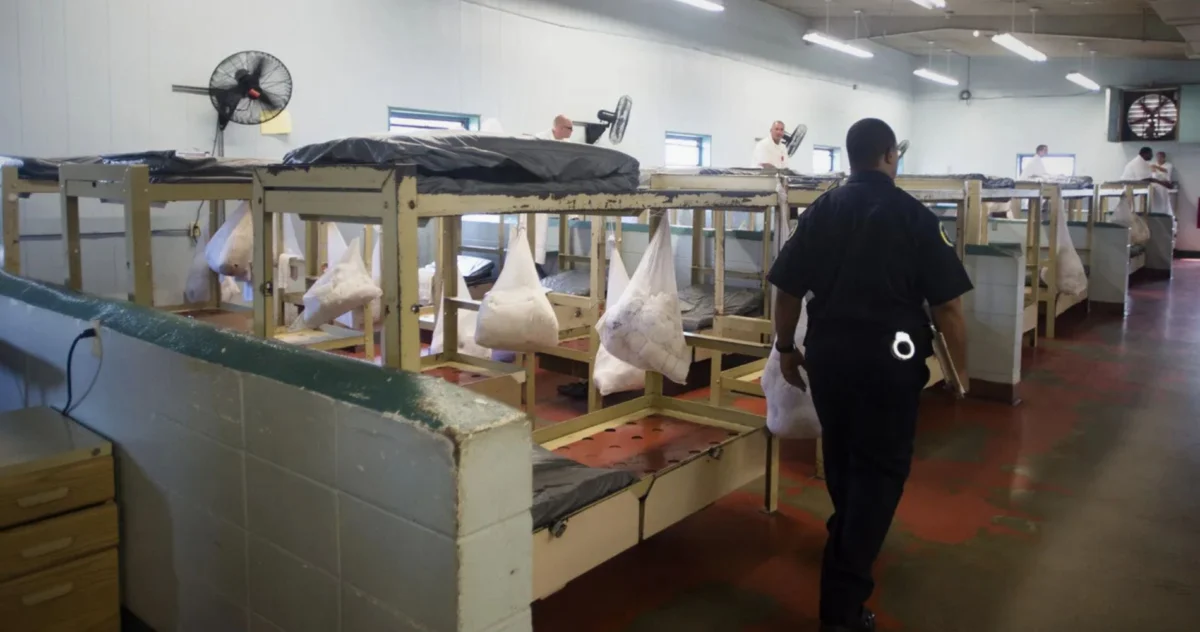
The indictment, returned on December 5, 2025, represents a significant development in the ongoing scrutiny of the Alabama Department of Corrections (ADOC). Melvin Ledarrius Thomas, 35, faces a two-count indictment charging him with reckless manslaughter and failing to perform a legal duty regarding a person in his custody. These charges stem from the death of 45-year-old Antwion Webb, who was fatally stabbed while incarcerated at the Donaldson Correctional Facility in Bessemer, Alabama.
The case has drawn sharp attention from legal experts and advocates who have long argued that the systemic failure of the Alabama prison system is not merely a matter of understaffing, but one of administrative negligence and, in some instances, active malfeasance by correctional staff.
The Events of September 12, 2025
The circumstances surrounding Antwion Webb’s death paint a grim picture of the conditions within Donaldson Correctional Facility. According to court filings and reports from the Jefferson County Coroner, the incident occurred late on the night of Friday, September 12, 2025.
Webb was subjected to a violent assault by another incarcerated individual, resulting in a severe sharp-force injury to his chest. Despite the gravity of the wound, the indictment alleges that Thomas, who was on duty at the time, failed to act in accordance with his professional and legal obligations. Specifically, prosecutors contend that Thomas recklessly returned Webb to the general prison population after becoming aware of the stab wound. Furthermore, the indictment asserts that Thomas failed to secure necessary medical care for the victim, an omission that effectively sealed Webb’s fate.
The progression of the medical emergency was rapid. Following the assault, Webb remained in a critical state until the early hours of the following morning. He was officially pronounced dead at 4:36 a.m. on September 13, 2025.
Legal Proceedings and Employment History
The accountability process for Melvin Ledarrius Thomas has been deliberate. Following the death of Webb, Thomas remained in the employ of the ADOC for one additional week, with his tenure officially ending on September 20, 2025.
The criminal investigation culminated in his booking at the Jefferson County Jail on August 26, 2026. Following his booking, Thomas was released on a $20,000 bond. The legal process is now moving toward a formal arraignment, which is currently scheduled for October 26, 2026. This hearing will serve as the initial opportunity for the defense to respond to the charges, which carry significant implications for the defendant’s future.
Systemic Context: A Crisis of Violence
The death of Antwion Webb is not an isolated event but rather a data point in a long-standing pattern of violence that has plagued the Alabama prison system for years. The U.S. Department of Justice (DOJ) has been actively investigating the ADOC since 2019, when federal officials formally notified the state that its prisons were unconstitutionally violent.
The findings of the DOJ and various advocacy organizations, such as the Equal Justice Initiative (EJI), have highlighted a consistent trend of preventable deaths. Data indicates that more than 100 individuals have lost their lives in Alabama state prisons due to violence since the DOJ’s initial warning. This statistic reflects one of the highest prison homicide rates in the United States, placing the ADOC under intense federal oversight and public pressure.
Critics of the current administration argue that the frequency of these homicides is directly tied to the culture within the facilities. Allegations of "staff complicity" have become a central component of the discourse surrounding Alabama’s prison reform. Advocates suggest that in some instances, correctional officers have not only been negligent but have occasionally facilitated violence by ignoring disputes or, in extreme cases, actively conspiring with incarcerated individuals to settle scores.
Institutional Negligence and Legal Duty
The charges brought against Thomas highlight the specific legal doctrine of "failing to perform a legal duty." In a correctional setting, officers are considered the primary providers of safety for those in their custody. Because incarcerated individuals lack the autonomy to seek medical help or protect themselves from immediate physical harm, the state assumes a fiduciary-like responsibility for their well-being.
When an officer knowingly places a vulnerable individual back into a dangerous environment—as is alleged in the case of Mr. Webb—or denies them access to life-saving medical treatment, they are effectively breaching the "duty of care" owed to the prisoner. Legal scholars suggest that the decision to pursue manslaughter charges against a guard indicates that the prosecution intends to prove that Thomas’s actions were not merely a lapse in judgment, but a reckless disregard for human life that directly resulted in a homicide.
Broader Implications for the Alabama Department of Corrections
The case against Melvin Ledarrius Thomas serves as a litmus test for how the state of Alabama handles internal accountability. For years, the ADOC has faced criticism for a lack of transparency regarding officer conduct. By bringing criminal charges against a former employee, the state is signaling a potential shift in how it addresses staff-involved incidents.
However, many observers remain skeptical. The recurring nature of prison violence suggests that individual prosecutions may be insufficient to address the underlying structural issues. These include severe overcrowding, chronic understaffing, and a lack of adequate rehabilitation programs, all of which contribute to a volatile environment.
The implications for the ADOC are twofold. First, there is the immediate legal and financial liability associated with wrongful death lawsuits that often follow such criminal indictments. Families of victims, like those of Antwion Webb, frequently pursue civil litigation to seek damages and demand systemic changes. Second, there is the political pressure. With federal oversight in place, the state is under constant scrutiny to demonstrate that it is capable of managing its facilities without violating the constitutional rights of the incarcerated.
Looking Toward the Future
As the arraignment of Melvin Ledarrius Thomas approaches, the case will likely serve as a focal point for legislative debates in Montgomery. State lawmakers are currently grappling with the financial costs of prison construction and the human costs of current conditions.
Advocates for reform are expected to use the Webb case as evidence that current oversight mechanisms are failing. They argue that until there is a fundamental transformation in how correctional officers are trained, vetted, and held accountable, the cycle of violence will continue. The demand for transparency—such as the release of internal reports and clearer communication with the families of those incarcerated—remains a top priority for reform-minded groups.
Ultimately, the death of Antwion Webb and the subsequent criminal charges against his guard represent a tragic failure of the state’s duty to protect. As the court prepares to hear the evidence, the public will be watching to see whether the judicial system can provide a measure of justice that has thus far remained elusive for the victims of Alabama’s prison violence. The case will be a significant indicator of whether the state is truly committed to reforming a system that has long been defined by its lethal instability.




