
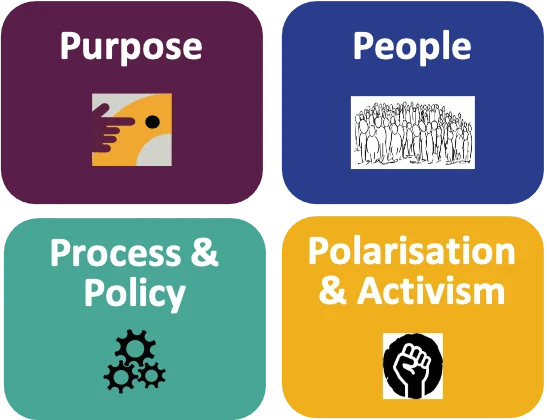
The global labor landscape has undergone a seismic shift since early 2020, as the COVID-19 pandemic acted as an unprecedented catalyst for the transformation of work models, employee expectations, and the role of corporate purpose. What began as a crisis-management response to lockdowns has evolved into a fundamental questioning of the "social contract" between employer and employee. This transition is defined by four intersecting pillars: the search for individual purpose, the changing nature of the workforce, the modernization of process and policy, and the rise of polarization and corporate activism.
The Chronology of a Workplace Revolution
In early 2020, the onset of the pandemic triggered an immediate, forced transition to remote work for millions, exposing the fragile nature of traditional office-based models. By mid-2020, the structural inequities of these models became apparent, particularly for working parents and caregivers, who faced the dual burden of professional responsibilities and domestic management.
By 2021, the trend colloquially dubbed "The Great Resignation" emerged, as employees began re-evaluating their professional trajectories. This was characterized by a sharp rise in voluntary turnover, with U.S. labor data from August 2021 revealing 4.3 million people quitting their jobs—a historic high. Simultaneously, the global landscape saw a decline in labor participation, with the International Labour Organization (ILO) noting that 2021 saw 125 million fewer full-time jobs compared to pre-pandemic levels. This period marked a transition from a reactive state to a proactive demand for better working conditions, higher flexibility, and, crucially, a stronger alignment between personal values and organizational output.
The Pursuit of Purpose: A New Professional Anchor
The pandemic-era experience has fundamentally altered how individuals weigh the value of their labor. Research from McKinsey & Company indicates that nearly two-thirds of U.S. employees have used the pandemic as a period of reflection to reassess the role of work in their lives. This shift is not merely superficial; it represents a core move away from the traditional model of personal sacrifice for career advancement.
Data from the Edelman Trust Barometer (2021) underscores this, finding that approximately 60% of employees have left or are actively considering leaving their jobs to find roles that better align with their personal values. This motivation now frequently supersedes traditional drivers such as incremental salary increases or standard promotional paths. This trend is generational and cross-cultural, with Millennials showing a heightened propensity to re-evaluate their professional purpose and older demographics—particularly those over 50 in the U.K.—exiting the workforce at double the pre-pandemic rate.
The implication for leadership is clear: organizational purpose can no longer be a marketing slogan. Business leaders, 79% of whom acknowledged the importance of purpose in pre-pandemic studies, must now bridge the gap between acknowledging that importance and integrating it into operational decision-making, where only 34% currently succeed.
The Talent Paradigm and the Great Resignation
As the global economy attempts to stabilize, the power dynamic between employer and employee has undergone a durable shift. The "war for talent" is no longer just about compensation; it is about the "employee experience." With job openings in the U.S. exceeding 10 million in late 2021 and similar record highs in the U.K., the leverage has shifted toward workers.
This shift has exposed deep-seated issues in organizational culture. Analysis shows that mid-career professionals in high-demand sectors like technology and healthcare are leading the turnover, often triggered by burnout. Furthermore, the public’s heightened awareness of working conditions in the service and hospitality sectors has led to what some analysts call "rage quitting," where employees exit environments perceived as exploitative or lacking in psychological safety.
The economic recovery, however, remains uneven. While high-skill workers demand flexibility, "The Great Divergence" highlights that the most significant declines in working hours and job security have occurred in low-paid, frontline roles. An inclusive recovery requires organizations to look beyond the "resignation" narrative and address the systemic inequalities that have left millions of workers behind, particularly women and people of color, who have suffered disproportionate job losses.
Modernizing Policy: The Death of Presenteeism
The debate over remote work has moved from a temporary health measure to a central policy conflict. Prior to the pandemic, remote work was often a privilege granted to a select few—typically senior males—while others faced stigma for requesting flexibility. Today, this has been inverted.
Data from the Future Forum suggests that a significant majority of employees, particularly women and people of color, report higher satisfaction and productivity when afforded flexibility. However, a disconnect persists between management and staff; 66% of executives are drafting return-to-office or hybrid policies with little to no employee input. This "top-down" approach risks alienating a workforce that has already demonstrated its ability to operate effectively in distributed environments.
The challenge for leadership is to move away from "presenteeism"—the culture of valuing time spent in an office over actual output. Effective policies now require an agile, experimental approach that incorporates data-driven feedback from all levels of the organization to ensure that remote or hybrid models do not become new vectors for bias.
Polarization and the Rise of Activism
The social turbulence of the last two years has reached into the workplace, with 60% of people across 17 countries reporting that their societies are more divided now than before the pandemic. Issues such as vaccine mandates, health safety, and social justice movements have placed organizations in the spotlight.
The murder of George Floyd in 2020 and the subsequent rise of the Black Lives Matter movement forced a reckoning in boardrooms globally. Employees are no longer satisfied with neutral corporate stances. A 2021 Edelman report found that 76% of employees expect their leaders to take a stand on social issues, and 33% have quit when they felt their employer failed to address a pressing societal concern.
This era of the "belief-driven employee" has fundamentally changed the role of the executive. Silence is now interpreted as complicity. The standard has shifted toward "allyship by action," where organizations are judged not by their press releases regarding Diversity, Equity, and Inclusion (DEI), but by their tangible policy changes, pay equity audits, and internal advancement structures.
Implications for the Future of DEI
The convergence of these trends suggests that the future of organizational success is inextricably linked to inclusive leadership. For DEI practitioners and business leaders, the path forward involves several critical imperatives:
- Co-creation of Policy: Organizations must abandon top-down mandates for work location and benefits. Engaging employees in the design process ensures policies are equitable and actually used.
- Addressing the "Intention-Action Gap": Leadership must reconcile the stated purpose of their organization with their day-to-day decision-making. If an organization claims to value well-being, its policies regarding burnout and overwork must reflect that.
- Holistic Talent Management: An inclusive recovery necessitates a focus on those most impacted by the pandemic. This means investing in reskilling for the roles of the future and ensuring that remote work policies are applied fairly to prevent the creation of a "two-tier" workforce.
- Embracing Transparency: As trust in traditional institutions wanes, employees are looking to their employers for stability and integrity. Transparency regarding internal data—whether it be pay gaps, promotion rates, or social stances—is now a requirement for retention.
The pandemic has effectively stripped away the veneer of many outdated workplace practices. While the period has been one of significant stress and loss, it has also provided an objective, forced experiment that has proven that work can be more flexible, more purposeful, and more inclusive. The organizations that thrive in the coming years will be those that acknowledge this structural reset and move beyond the status quo to build systems that reflect the realities of the modern workforce. The era of the silent, office-bound executive is over; the era of the inclusive, purpose-driven leader has begun.




