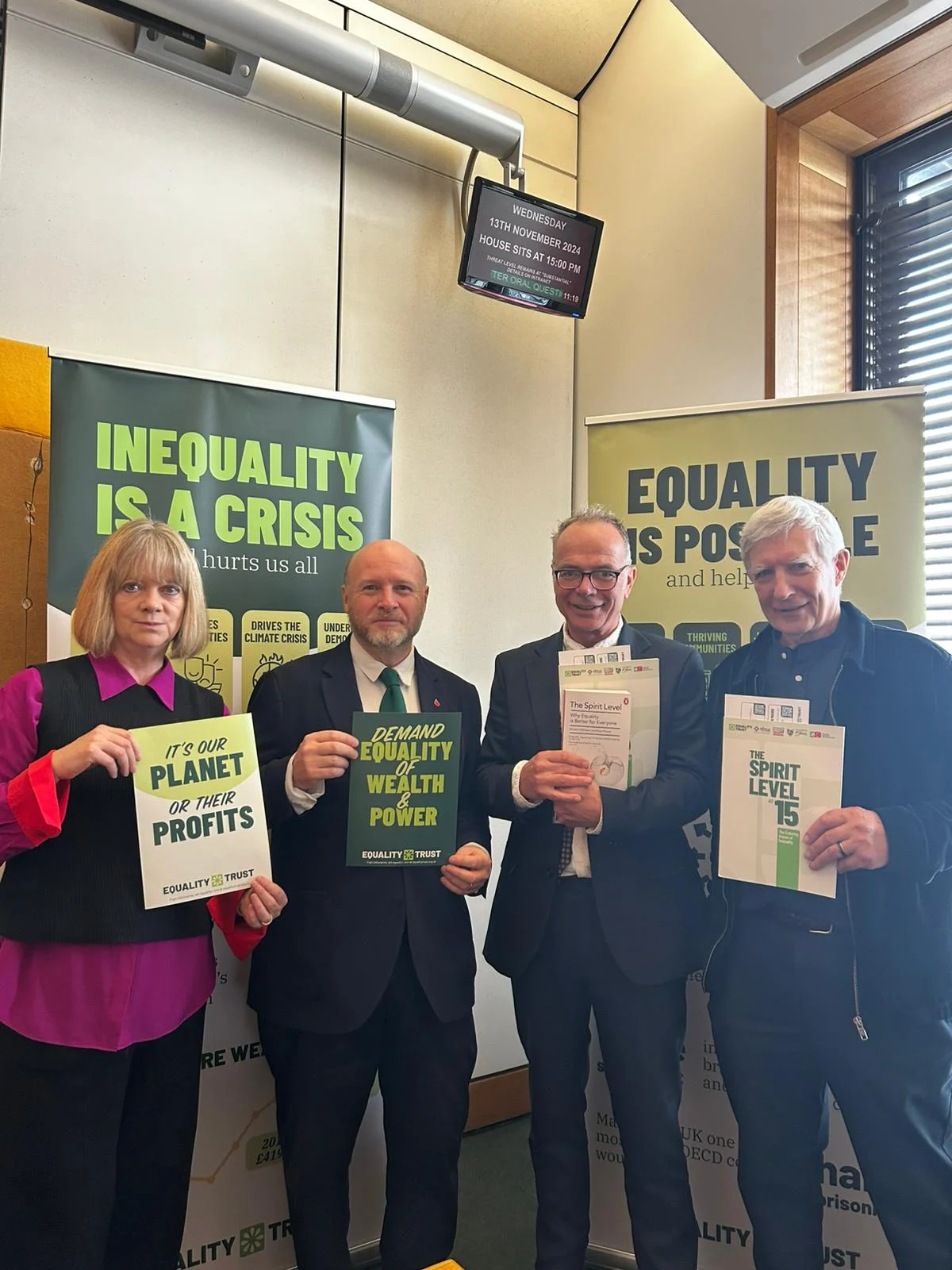
The Equality Trust, a prominent United Kingdom-based advocacy organization dedicated to reducing social and economic inequality, has announced the departure of long-standing Trustee Gerry Boyle. Mr. Boyle has officially stood down from the Board of Trustees after completing two consecutive three-year terms, the maximum duration permitted under the organization’s governing constitution. His exit marks the conclusion of a significant era for the Trust, spanning from 2020 to 2026, a period characterized by profound economic volatility, global health crises, and a shifting landscape for charitable governance in the British third sector.
Mr. Boyle’s tenure was defined by his transition from the private sector and international development to the front lines of UK-based social justice advocacy. Bringing a background in business management and project oversight, he served a critical role on the board’s finance committee, navigating the organization through an increasingly precarious funding environment. His departure comes at a time when the Trust continues to grapple with the long-term effects of national austerity measures and a fundamental restructuring of how social justice organizations are financed in the 21st century.
A Chronology of Advocacy: 2020–2026
When Mr. Boyle joined the Equality Trust in early 2020, the organization was entering a decade of unprecedented challenge. The onset of the COVID-19 pandemic underscored the very disparities the Trust was founded to combat, as health outcomes and economic security were revealed to be deeply bifurcated along class and racial lines. Throughout his first term, Mr. Boyle worked alongside a diverse board of academics, campaigners, and individuals with lived experience to pivot the Trust’s strategy toward immediate crisis response while maintaining its long-term focus on systemic reform.
By his second term, which commenced in 2023, the focus had shifted toward the "Socio-Economic Duty" enshrined in Section 1 of the Equality Act 2010. Although the UK government had historically declined to commence this section of the Act at a national level, the Equality Trust, during Mr. Boyle’s tenure, was instrumental in lobbying local authorities and devolved administrations to adopt the duty voluntarily. This period saw a significant increase in the number of councils across England and Wales committing to assess the impact of their strategic decisions on those living in poverty.
The final years of Mr. Boyle’s service were marked by a intensified focus on youth advocacy. Recognizing that the "sharp end of inequality" often impacts the youngest demographics most severely, the Trust developed new platforms for young voices to influence policy. This initiative aimed to address the widening generational wealth gap and the specific barriers to social mobility faced by those entering the workforce during a period of high inflation and stagnant wage growth.
The Spirit Level: Theoretical Foundations and Empirical Data
The impetus for Mr. Boyle’s involvement with the Equality Trust was rooted in the seminal work The Spirit Level: Why Greater Equality Makes Societies Stronger, authored by Professors Richard Wilkinson and Kate Pickett. The book, which serves as the intellectual foundation for the Trust, provides a comprehensive meta-analysis of data from the OECD and the World Bank.
The data presented in The Spirit Level—and championed by the Trust throughout Mr. Boyle’s tenure—demonstrates a near-perfect correlation between high levels of income inequality and a suite of social "bads." These include:
- Physical and Mental Health: Societies with higher Gini coefficients (a measure of statistical dispersion representing income inequality) consistently report higher rates of obesity, infant mortality, and clinical depression.
- Social Capital: Trust levels are significantly lower in unequal societies, leading to increased social fragmentation and decreased community cohesion.
- Human Capital: Educational attainment and social mobility are restricted in highly unequal nations, as the "ladder" of opportunity becomes too elongated for those at the bottom to climb.
- Security: Rates of incarceration and violent crime are markedly higher in countries with vast wealth disparities, regardless of the overall GDP of the nation.
During his six years on the board, Mr. Boyle emphasized the importance of this evidence-based approach. By framing inequality not merely as a moral failing but as a structural inefficiency that harms the entire population—including the wealthy—the Trust has been able to engage with a broader spectrum of political and business leaders.
Financial Challenges and the Philanthropic Pivot
Perhaps the most significant contribution of Mr. Boyle’s tenure was his oversight of the Trust’s financial sustainability during a period of "lumpy" funding. As a member of the finance committee, he managed the transition away from a reliance on a small number of large-scale institutional grants.
The UK’s philanthropic sector has faced a "perfect storm" of challenges over the last half-decade. First, the continuation of austerity policies has increased the demand for third-sector services, as public funding for social safety nets has retracted. Second, the UK government’s decision to reduce international aid from 0.7% to 0.5% of Gross National Income (GNI) created a ripple effect across the NGO sector. While the Equality Trust focuses on domestic inequality, the cut in global aid budgets increased competition for domestic grants, as larger international charities began vying for the same limited pool of UK-based foundation funding.
Furthermore, the "cost-of-living crisis" that peaked in the mid-2020s placed additional strain on individual giving. Mr. Boyle noted that the Trust’s strategy has had to evolve toward building a broader base of small-scale, recurring donations from supporters. This shift is designed to provide the organization with "maximum freedom" to campaign effectively, as individual donations are typically less restricted than institutional grants, which are often tied to specific, time-limited projects.
Institutional Responses and Broader Implications
The departure of a long-term trustee often serves as a moment of institutional reflection. Sources close to the Trust indicate that the board is currently seeking to recruit new members who can continue Mr. Boyle’s work in bridging the gap between corporate efficiency and social advocacy.
In a statement reflecting on the current state of the sector, analysts at the National Council for Voluntary Organisations (NCVO) suggest that the challenges faced by the Equality Trust are representative of a wider trend. "Small to medium-sized campaigning organizations are finding it increasingly difficult to secure core funding," the analysis states. "The shift toward community-funded models is no longer an option but a necessity for survival in an era where traditional grant-making is becoming more conservative and risk-averse."
The broader implications of the Trust’s work under Mr. Boyle’s watch are visible in the shifting political discourse. While income inequality remains high in the UK—with the top 1% of households holding significantly more wealth than the bottom 50% combined—the "inequality lens" is now more frequently applied to policy discussions regarding housing, healthcare, and climate change. The Trust’s success in keeping these issues on the national agenda, despite a challenging political climate, is viewed by many as a testament to the resilience of its governance.
Conclusion: The Future of the Equality Trust
As Gerry Boyle steps down, the Equality Trust faces a future that is both daunting and ripe with opportunity. The organization remains at the forefront of the movement to implement the Socio-Economic Duty nationwide, a move that proponents argue would revolutionize how the British state interacts with its most vulnerable citizens.
The Trust’s ongoing commitment to diversifying its income streams and empowering youth voices will be the primary legacy of the outgoing board members. While the political and economic background continues to present headwinds for egalitarian outcomes, the framework established over the last six years provides a stable platform for the next generation of trustees.
Mr. Boyle’s departure marks the end of a constitutional cycle, but the "important struggle" he described continues. The Equality Trust is expected to announce new appointments to the board in the coming months, seeking individuals who can match the "smart, motivated, and diverse" profile that has characterized the organization’s leadership through the turbulent first half of the 2020s. For now, the Trust remains a vital voice in the UK’s democratic landscape, persisting in its mission to prove that a more equal society is not only possible but essential for the well-being of all.