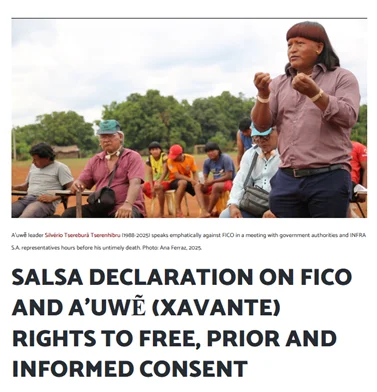
International scholars are raising urgent alarms over what they describe as a severe and systemic breakdown in the application of Free, Prior, and Informed Consent (FPIC) principles concerning the FICO railway project in Brazil. The Society for the Anthropology of Lowland South America (SALSA), a prominent international scholarly organization comprising professors, students, and practitioners in the field, has issued a formal statement condemning the Brazilian National Indian Foundation’s (FUNAI) fragmented and allegedly compromised approach to FPIC consultations. This approach, scholars argue, is fundamentally undermining the rights of multiple Indigenous communities directly impacted by one of Brazil’s most significant and rapidly advancing infrastructure projects.
The FICO railway, a critical component of a broader logistical corridor envisioned to connect the Amazon rainforest to the Atlantic coast, promises substantial economic benefits through increased agricultural exports and mineral extraction. However, its construction path cuts through territories inhabited by various Indigenous Peoples, whose ancestral lands, cultural integrity, and traditional livelihoods are intrinsically linked to the Amazonian ecosystem. The core of the scholars’ criticism lies in FUNAI’s alleged failure to uphold the spirit and letter of FPIC, a cornerstone of international Indigenous rights law, which mandates that Indigenous communities must be consulted and have the right to grant or withhold their consent for projects affecting their lands and resources.
Background: The FICO Railway and Indigenous Territories
The FICO railway project, officially known as the Ferrovia de Integração Centro-Oeste (Western-Central Integration Railway), is a colossal undertaking with far-reaching implications. The project, spearheaded by the Brazilian government and private sector entities, aims to establish a vital transportation link from the agricultural heartland of Mato Grosso to the port of Ilhéus in Bahia. This ambitious infrastructure development is projected to significantly reduce transportation costs for commodities, thereby boosting Brazil’s export capacity.
However, the proposed route of the FICO railway traverses ecologically sensitive areas and, critically, lands traditionally occupied by several Indigenous groups. Among the most vocal are the Auwe Xavante, whose territories are directly in the path of the proposed railway line. Their connection to the land is not merely economic but deeply spiritual and cultural, forming the bedrock of their identity and societal structure. The potential environmental impacts, including habitat fragmentation, increased deforestation, and pollution of water sources, pose existential threats to their way of life. Furthermore, the influx of construction workers and associated activities can lead to social disruption, increased pressure on natural resources, and potential for cultural erosion.
The concept of Free, Prior, and Informed Consent (FPIC) is enshrined in international instruments such as the United Nations Declaration on the Rights of Indigenous Peoples (UNDRIP). It emphasizes a proactive and good-faith consultation process, ensuring that Indigenous Peoples have access to all relevant information in a culturally appropriate manner, understand the potential impacts of a project, and are afforded the genuine opportunity to consent or refuse their consent without coercion or manipulation.
SALSA’s Declaration: A Condemnation of FUNAI’s Practices
The statement released by SALSA, available in English, Portuguese, and Spanish, meticulously details the scholars’ concerns. It asserts that FUNAI’s approach to FPIC in the FICO railway process has been characterized by fragmentation, insufficient information dissemination, and a failure to engage with communities in a truly consultative manner.
The scholars highlight several critical deficiencies:
- Fragmented Consultation Process: Instead of a holistic and unified consultation with all affected communities, FUNAI has reportedly engaged in piecemeal discussions, potentially isolating groups and preventing collective decision-making. This fragmentation can weaken the bargaining power of Indigenous communities and make it easier for project proponents to gain consent from individual, less unified groups.
- Inadequate Information Dissemination: Concerns have been raised about the quality, accessibility, and cultural appropriateness of information provided to Indigenous communities. For FPIC to be meaningful, communities must receive comprehensive details about the project’s scope, potential environmental and social impacts, proposed mitigation measures, and alternatives, all presented in a language and format they can fully comprehend. The scholars suggest this has not been adequately achieved.
- Compromised Autonomy: The SALSA statement implies that the process may have prioritized expediency and project advancement over the genuine autonomy of Indigenous Peoples to make decisions about their territories. This could manifest through undue pressure, selective engagement, or a failure to respect the outcome of consultations where consent is withheld.
- Lack of Independent Oversight: The scholars’ condemnation suggests a perceived lack of independent oversight and accountability within FUNAI’s FPIC processes, leading to a situation where the agency, tasked with protecting Indigenous rights, may be perceived as facilitating projects that undermine them.
The SALSA declaration is not merely an academic critique; it represents a collective voice of concern from experts who have dedicated their careers to understanding and advocating for the rights of Indigenous peoples in South America. Their intervention underscores the gravity of the situation and the potential for widespread and irreversible harm to Indigenous communities and their ancestral lands.
Timeline of Events and Emerging Concerns
While a precise, publicly available chronology of all FPIC consultations related to the FICO railway is scarce, the issues raised by SALSA suggest a pattern of concern that has likely developed over an extended period.
Pre-Project Planning and Initial Consultations: As the FICO railway project moved from conception to planning stages, initial environmental and social impact assessments (ESIAs) would have been conducted. During this phase, the first formal engagements with potentially affected Indigenous communities would have taken place. It is during these early stages that the foundational principles of FPIC are most crucial, as they set the tone for all subsequent interactions. Concerns about the adequacy of these initial consultations likely began to emerge here.
Escalation of Infrastructure Development: As the project gained momentum and secured funding and regulatory approvals, the physical aspects of construction would have commenced or been finalized. This phase typically involves more detailed engineering plans and a clearer understanding of the precise impact zones. During this period, if prior consultations were insufficient, the urgency for comprehensive and meaningful FPIC processes would have intensified, potentially leading to increased friction and disagreement.
Formal Declarations and Scholarly Interventions: The SALSA statement represents a significant escalation in public awareness and scholarly condemnation. Such declarations typically arise after prolonged observation, analysis of available documentation, and, often, direct communication with affected communities or their representatives. The timing of SALSA’s statement suggests that concerns had reached a critical point, necessitating a formal intervention to draw broader attention and exert pressure for corrective action.
Ongoing Advocacy and Potential for Legal Challenges: The current situation implies that advocacy efforts by Indigenous communities and their allies are ongoing. This may involve continued engagement with national and international bodies, media outreach, and potentially legal challenges to project approvals or specific consultation processes deemed illegitimate.
Supporting Data and International Frameworks
The concerns surrounding the FICO railway are amplified by existing data on the scale of infrastructure projects in the Amazon and the historical challenges faced by Indigenous communities in asserting their rights. Brazil is a signatory to the International Labour Organization (ILO) Convention 169, which explicitly recognizes the rights of Indigenous and tribal peoples to FPIC. Furthermore, the UNDRIP, while not a legally binding treaty for all nations, provides a universally recognized framework for the rights of Indigenous Peoples, including their right to self-determination and their right to give or withhold consent for projects affecting their lands.
Data from various environmental and human rights organizations consistently highlight the vulnerability of Indigenous territories to large-scale development projects. Studies have shown a correlation between major infrastructure projects, such as dams, roads, and railways, and increased rates of deforestation, biodiversity loss, and social conflict in Indigenous areas. For instance, reports from the Amazon Environmental Research Institute (IPAM) and the Instituto Socioambiental (ISA) have documented the widespread impacts of agricultural expansion and infrastructure development on Indigenous lands in Brazil. The FICO railway, as a key element in expanding Brazil’s agricultural export capacity, fits within this broader context of economic development often pursued at the expense of Indigenous rights and environmental protection.
The potential economic benefits cited for the FICO railway are substantial. Projections suggest it could reduce freight costs for agricultural products by up to 30%, significantly enhancing Brazil’s competitiveness in the global market. However, these economic projections often do not fully account for the long-term social and environmental costs, including the potential loss of traditional livelihoods, cultural heritage, and ecosystem services that Indigenous communities depend on and help to preserve.
Official Responses and Challenges
FUNAI, as the Brazilian government agency responsible for Indigenous affairs, faces the complex task of balancing national development goals with the constitutional and international rights of Indigenous Peoples. In response to criticisms, FUNAI typically asserts its commitment to upholding Indigenous rights and adhering to legal frameworks, including FPIC. However, the persistent nature of these criticisms from academic bodies like SALSA suggests a disconnect between stated intentions and the practical implementation of FPIC principles.
It is plausible that FUNAI might argue that consultations have been conducted in accordance with existing legal requirements and that progress on the FICO railway is essential for national economic development. They might also point to mitigation measures and compensation packages offered to affected communities as evidence of their efforts. However, the core of the SALSA critique is not necessarily about the absence of any consultation, but about the quality and genuineness of that consultation, and whether it truly empowers communities to exercise their right to consent.
The Brazilian government, under President Lula da Silva, has made pronouncements emphasizing a renewed commitment to environmental protection and Indigenous rights. However, the FICO railway project represents a significant infrastructure initiative that can create tensions between these stated commitments and the economic pressures to boost commodity exports. The government’s approach to resolving these tensions will be a crucial indicator of its genuine commitment to Indigenous sovereignty and sustainable development.
Broader Impact and Implications
The implications of the alleged violations of FPIC in the FICO railway project extend far beyond the immediate impact on the affected Indigenous communities.
- Erosion of Trust: A pattern of inadequate consultation erodes trust between Indigenous communities and the government, making future dialogue and cooperation more difficult. This can lead to prolonged social unrest and conflict.
- Precedent for Future Projects: The handling of FPIC in the FICO railway project sets a precedent for how future large-scale infrastructure projects in Brazil will be conducted. If violations are overlooked or inadequately addressed, it could embolden proponents of other projects to similarly circumvent or weaken FPIC processes.
- International Reputation: Brazil’s adherence to international human rights standards, including those pertaining to Indigenous Peoples, is crucial for its international reputation and its standing in global trade and environmental discussions. Consistent criticisms of FPIC violations can damage this reputation and invite scrutiny from international bodies and trading partners.
- Loss of Indigenous Knowledge and Biodiversity: The displacement or marginalization of Indigenous communities can lead to the loss of invaluable traditional knowledge about sustainable resource management and biodiversity. Indigenous peoples are often the most effective stewards of their ancestral lands, and their dispossession can accelerate environmental degradation.
- Challenges to Democratic Governance: The principle of FPIC is fundamentally about democratic participation and the right of peoples to have a say in decisions that affect their lives. When these rights are compromised, it raises questions about the inclusiveness and fairness of Brazil’s governance structures.
The scholars’ call to action, encouraging individuals to write to Brazilian authorities, including President Lula, the Minister of Indigenous Peoples, and the President of FUNAI, highlights the urgency and the desire for a robust, rights-based resolution. By supporting these communities through advocacy, the international community can play a role in ensuring that Brazil’s development trajectory respects the fundamental rights and ancestral territories of its Indigenous Peoples. The FICO railway project, while potentially offering economic advantages, must not come at the irreversible cost of Indigenous sovereignty and the ecological integrity of the Amazon. The SALSA declaration serves as a critical reminder that true progress must be inclusive, just, and rooted in respect for human rights.