
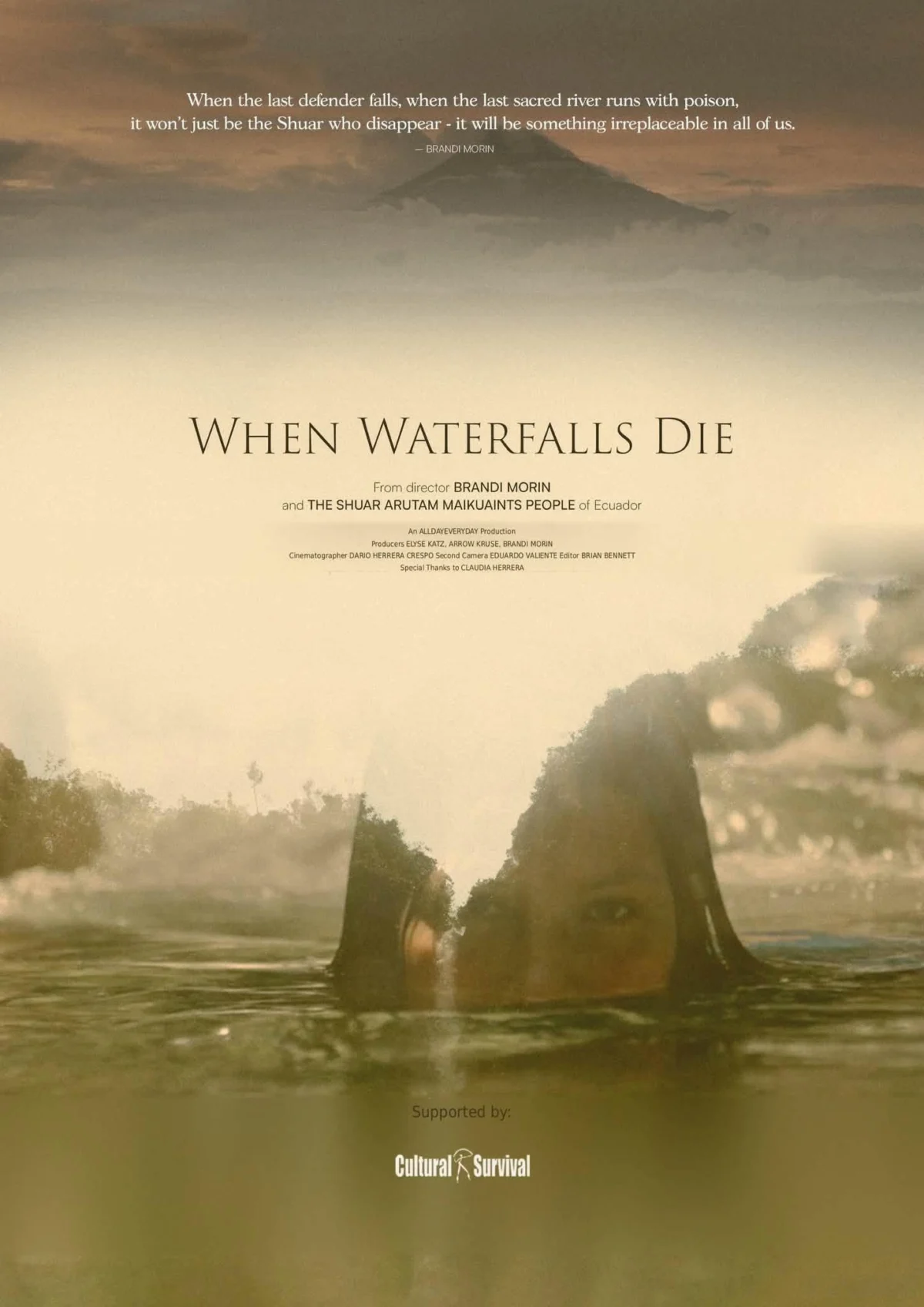
The struggle for the preservation of the Ecuadorian Amazon has entered a critical new phase as the Maikiuants community of the Pueblo Shuar Arutam launches a global campaign to halt an expansive open-pit copper mining project. Their fight is the focal point of a powerful new short documentary, When Waterfalls Die, directed, written, and hosted by award-winning Cree/Iroquois journalist Brandi Morin. Co-produced by AlldayEveryDay and supported by Cultural Survival, the film exposes the high-stakes confrontation between an unvanquished Indigenous population and corporate resource extraction. At the center of the dispute is a 268-square-kilometer (103-square-mile) tract of pristine rainforest slated for industrial transformation by Solaris Resources, a Canadian mining company. The impending development threatens not only an ecosystem of immense biodiversity but also the cultural and physical survival of a community determined to protect its ancestral domain by any means necessary.
Background and Historical Context of the Shuar Resistance
The Pueblo Shuar Arutam possess a storied history of resistance that spans centuries. Long before the arrival of European explorers, the Shuar successfully maintained their autonomy, famously resisting incorporation into the Tahuantinsuyu, the expansive empire of the Incas. Following the arrival of Spanish conquistadors in the 16th century, the Shuar continued to defend their sovereignty with legendary tenacity, earning widespread recognition as one of the few Indigenous groups in the Americas to never be formally conquered by colonial powers.
Today, however, the modern iteration of this historic defense has shifted away from traditional skirmishes toward complex geopolitical, legal, and environmental arenas. The contemporary threat stems from global market demands for critical transition minerals, particularly copper, which is essential for renewable energy technologies, electric vehicles, and global electronics manufacturing. Ecuador, seeking to boost its national economy through foreign direct investment in the mining sector, has increasingly opened its southern Amazonian territories to international corporations. This macroeconomic strategy has placed the Ecuadorian state on a direct collision course with Indigenous nations whose collective territorial rights are ostensibly protected under domestic and international law, creating a volatile legal and social landscape.
The Conflict Over the Warintza Project and Solaris Resources
The core of the current crisis revolves around the Warintza copper-gold project, managed by Solaris Resources. The concession spans vast swaths of primary rainforest that serve as the traditional hunting grounds, spiritual sanctuaries, and permanent settlements for the Shuar communities of Maikiuants and neighboring villages. According to corporate feasibility assessments, the region holds substantial mineral deposits capable of sustaining decades of open-pit extraction.
However, local leaders and environmental advocates argue that the projected benefits of the mine—touted by proponents as a driver of local employment and national revenue generation—come with an unacceptable ecological and social price tag. Open-pit mining inherently involves the large-scale removal of surface vegetation and topsoil, extensive use of local water resources, and the creation of tailings storage facilities that pose catastrophic risks of contamination to vital river systems. For the Maikiuants, whose spiritual connection to the land is anchored by sacred waterfalls, pristine streams, and old-growth canopies, the industrialization of their homeland amounts to an existential erasure.
Chronology of Escalating Tensions
The friction between the Shuar, the Ecuadorian government, and international mining interests did not materialize overnight. The timeline of this modern conflict reflects decades of escalating policy shifts and local pushback:
- Late 20th Century: International mining prospecting intensifies in the Cordillera del Cóndor region, drawing initial resistance from Indigenous federations who organize against unauthorized incursions onto ancestral lands.
- 2008: Ecuador adopts a progressive new constitution, becoming the first nation in the world to officially recognize the Rights of Nature (Derechos de la Naturaleza), establishing a legal framework where ecosystems possess the right to exist, persist, and regenerate.
- 2010s: Mineral concessions are granted and repeatedly contested, leading to shifting corporate ownership and varying degrees of community engagement. Concessions in the Warintza area change hands multiple times as international firms seek to capitalize on rising global commodity prices.
- 2020–2023: Solaris Resources accelerates exploration activities, employing community relations strategies that critics argue divide local populations by securing agreements with select individuals while bypassing broader, legally mandated free, prior, and informed consent (FPIC) processes.
- Present Day: The release of When Waterfalls Die brings international visibility to the Maikiuants community’s uncompromising stance, amplifying grassroots demands for the complete cancellation of mining rights in the territory.
Voices from the Frontlines
The documentary captures the raw urgency of the community’s position through intimate interviews with residents and land defenders who view the crisis as an ultimate test of endurance. Elected leadership from the Maikiuants community issued a stark warning regarding their preparedness for confrontation: “We are ready to defend our territory at all costs. Our ancestors protected this land with their blood, and we are prepared to do the same if necessary.”
This sentiment is echoed by Numii Antun Yankur, a prominent Shuar land defender featured in the film. Highlighting the broader geopolitical implications of their local battle, Yankur noted, “This is not just about the Maikiuants. This is about all Indigenous Peoples facing the same threats. We fight not just for ourselves, but for all who defend the Earth against those who would destroy it for profit.”
Director Brandi Morin brings her extensive background in Indigenous journalism to the project, framing the struggle not merely as an isolated local dispute, but as a critical chapter in the global movement for climate justice and human rights. Through her lens, the documentary highlights the stark contrast between corporate boardrooms and the muddy, biodiverse realities of the Amazonian rainforest where Indigenous guardians maintain a 24-hour vigil.
Legal Contradictions and Constitutional Paradoxes
The situation in the Maikiuants territory underscores a profound legal paradox within modern Ecuador. On one hand, the nation’s 2008 Constitution is internationally celebrated for granting constitutional rights to nature, allowing any citizen or community to sue on behalf of ecosystems to prevent environmental degradation. On the other hand, successive national administrations have aggressively promoted large-scale mining and oil extraction as vital pillars of economic stability, often utilizing police and military forces to secure industrial sites against community blockades.
Legal experts note that this dichotomy creates persistent friction between national development policies and international human rights conventions, most notably the United Nations Declaration on the Rights of Indigenous Peoples (UNDRIP) and International Labour Organization (ILO) Convention 169. Both frameworks explicitly require governments to obtain the genuine, informed consent of Indigenous communities before authorizing extractive projects on their lands. In the case of the Shuar, community leaders maintain that proper, transparent consultation has never taken place, rendering the mining concessions illegitimate under international law.
Implications for Global Green Transitions and Indigenous Rights
As the international community accelerates efforts to decarbonize global economies, the demand for transition minerals has skyrocketed. Copper, nickel, lithium, and cobalt are mined extensively in regions historically inhabited by marginalized and Indigenous populations, particularly in the Global South. The conflict in the Ecuadorian Amazon serves as a microcosm of a much larger global dilemma: how to supply the materials required for renewable energy infrastructure without replicating the destructive colonial practices of the past.
Environmental economists and human rights analysts point out that transitioning away from fossil fuels cannot succeed ethically or sustainably if it relies on the sacrifice of Indigenous homelands and vital global carbon sinks like the Amazon rainforest. The destruction of primary forests for mineral extraction not only violates local sovereignty but also releases vast quantities of stored carbon into the atmosphere, directly undermining broader global climate stabilization goals.
Furthermore, the outcome of the Maikiuants community’s resistance is expected to set a significant legal and political precedent. If the Shuar successfully halt the multi-million-dollar Warintza project, it could empower other Indigenous groups across Latin America and beyond to challenge similar industrial incursions. Conversely, a failure to protect the territory could embolden extractive industries to bypass local opposition with state backing, setting a dangerous standard for environmental protection and human rights enforcement.
Conclusion and Future Outlook
When Waterfalls Die serves as both a cultural artifact and an urgent call to action. By documenting the resilience of the Pueblo Shuar Arutam, the film illuminates the human cost of global resource consumption and challenges viewers to reconsider the true price of technological progress. As the Maikiuants community maintains its watch over the rainforest canopy and sacred waterways, the international spotlight turns toward Quito and corporate headquarters in Canada, where decisions made in the coming months will determine whether ancestral sovereignty and ecological preservation can prevail against the relentless pressures of industrial expansion.




