

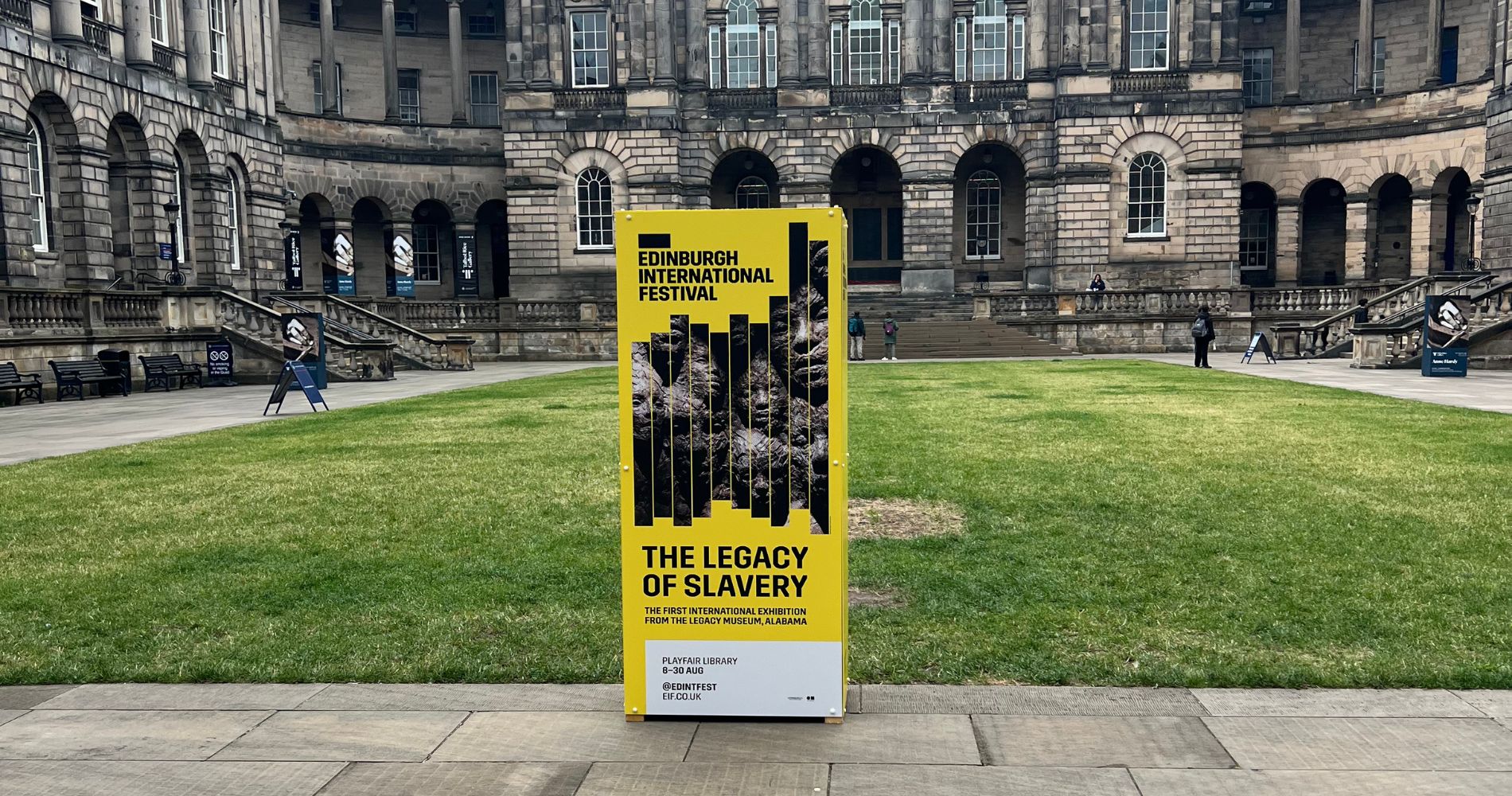
The Equal Justice Initiative (EJI), the Montgomery-based non-profit organization renowned for its dedication to criminal justice reform and historical truth-telling, has officially launched its first international exhibition. Titled The Legacy of Slavery in America, the immersive narrative experience opened this past weekend at the University of Edinburgh’s historic Playfair Library. As part of the prestigious Edinburgh International Festival, the exhibition serves as a condensed, portable iteration of the organization’s flagship Legacy Museum in Alabama, bringing the stark realities of American history to a global audience.
This cross-continental engagement represents a significant milestone for EJI, marking the first time the organization has taken its museum-based narrative beyond the borders of the United States. The exhibition will remain open to the public daily from 10:00 am to 5:00 pm through August 30, providing a critical lens through which to examine the evolution of racial hierarchy from the transatlantic slave trade to the modern era of mass incarceration.
A Chronology of Injustice: From Enslavement to Modernity
The exhibition is structured to trace the arc of American history, illustrating how the foundational myth of racial difference was engineered to justify the brutal economic engine of human trafficking. The narrative journey does not treat slavery as an isolated historical anomaly; rather, it presents it as the primary catalyst for a centuries-long evolution of bigotry.
The chronology presented within the Playfair Library is divided into four distinct yet interconnected chapters:
- The Era of Enslavement (1619–1865): The exhibit details the domestic and transatlantic trade of enslaved Africans, emphasizing how legal and social systems were constructed to dehumanize individuals for economic gain.
- The Era of Racial Terror (1865–1950s): Following the formal abolition of slavery, the exhibition highlights the period of post-Civil War Reconstruction and the subsequent surge in racial terror lynchings—extrajudicial killings used to enforce white supremacy and intimidate Black communities.
- The Era of Codified Segregation (1870s–1960s): This section examines the Jim Crow era, focusing on the systemic implementation of segregation, disenfranchisement, and the denial of basic constitutional rights.
- The Contemporary Era of Over-Incarceration (1970s–Present): The final segment connects the legacy of the previous eras to current criminal justice policies, illustrating how the narrative of racial difference has evolved into modern-day mass incarceration and disparate treatment within the legal system.
Contextualizing the Edinburgh International Festival
The Edinburgh International Festival, established in 1947, was born out of the ashes of World War II. Its founding mission was to heal the deep divisions of a fractured Europe through the arts, fostering international cooperation and cultural exchange. Today, it remains one of the world’s most influential cultural gatherings, annually hosting thousands of performers and spectators.
The 2026 iteration of the festival is uniquely positioned, as it coincides with the 250th anniversary of the founding of the United States. Under the thematic banner of "All Rise," the festival organizers have issued a call to action for artists and audiences alike, urging a collective re-examination of history through the medium of artistic endeavor. By incorporating the EJI exhibition—the first museum experience ever featured in the festival’s history—the organizers are explicitly bridging the gap between historical inquiry and creative expression.
The festival’s opening concert set a powerful tone for this theme, featuring the Jazz at Lincoln Center Orchestra led by Wynton Marsalis. The performance of the 12-movement jazz symphony, All Rise, serves as a musical parallel to the exhibition’s mission. Much like the symphony, the EJI exhibit seeks to harmonize the dissonant realities of history, challenging visitors to see the past with greater clarity and tolerance.
The Intersection of Art and Justice
EJI Executive Director Bryan Stevenson has long argued that the pursuit of justice is not merely a legal or political endeavor but a moral and creative one. During a recent appearance on Democracy Now! alongside host Amy Goodman in Edinburgh, Stevenson emphasized that the most profound human achievements have frequently emerged from the struggles against inequality.
"The relationship between art, music, and justice is deep, profound, and ancient," Stevenson remarked. "So much of the world’s most extraordinary creative works have been shaped by eras of inequality, bigotry, and injustice."
By situating the exhibition within the festival, EJI is utilizing the power of art to animate the data-driven findings found at their permanent sites in Alabama: the Legacy Museum, the National Memorial for Peace and Justice, the Freedom Monument Sculpture Park, and the newly established Montgomery Square. These sites are not merely tourist destinations but are active research and education centers that house thousands of pages of deeply researched written content, thousands of first-person accounts, and extensive visual media.
Analytical Implications: Why Now?
The decision to bring this exhibition to Scotland at this particular juncture is not incidental. The United States is currently navigating a period of intense public debate regarding the teaching of history, systemic inequality, and the future of democratic institutions. By presenting this narrative to an international audience, EJI is highlighting the global dimensions of American racial injustice.
Data consistently supports the necessity of this work. According to EJI’s internal research, the United States leads the world in incarceration rates, with millions of individuals currently held in jails and prisons, a significant percentage of whom are people of color. The exhibition provides the necessary historical backbone to explain these statistics, illustrating that current disparities are not accidental, but the logical conclusion of a long-standing racial hierarchy that was never fully dismantled.
For international visitors, the exhibition offers a sobering look at how the legacy of slavery continues to influence global economic and social policies. The exhibit acts as a pedagogical tool, encouraging audiences to look beyond the American exceptionalism narrative and confront the enduring impact of systemic oppression on human rights and dignity.
Logistics and Accessibility
The exhibition is open to the public free of charge, though admission requires a pre-booked ticket due to high anticipated demand. While walk-ins may be accommodated depending on daily capacity, the festival strongly encourages advanced booking through the official Edinburgh International Festival website.
The choice of the Playfair Library—an architectural landmark of the University of Edinburgh—as the host venue underscores the importance of the event. The quiet, academic nature of the space allows for a contemplative experience, enabling visitors to engage with the sobering materials presented in the exhibits. From short films to intimate oral histories, the experience is designed to be deeply personal and intellectually rigorous.
Looking Toward the Future
The integration of EJI’s work into a global cultural stage like the Edinburgh International Festival suggests a shift in how historical injustices are being addressed on a public scale. It is a move away from compartmentalized academic study and toward a more integrated, public-facing approach where historical truth is woven into the fabric of contemporary arts and culture.
As visitors walk through the exhibits, they are asked to consider not just the history of the United States, but the universal nature of the struggle for justice. The exhibition does not provide easy answers; instead, it demands that the audience participate in the ongoing work of addressing bigotry and inequality. By fostering this dialogue in Scotland, the Equal Justice Initiative is reinforcing the idea that the fight for justice is a global endeavor—one that requires the courage to confront the past to ensure a more equitable future.
As the festival continues through the end of August, the presence of The Legacy of Slavery in America serves as a constant reminder that art, when stripped of its purely decorative purpose, can become a potent catalyst for social change, truth, and reconciliation.




