
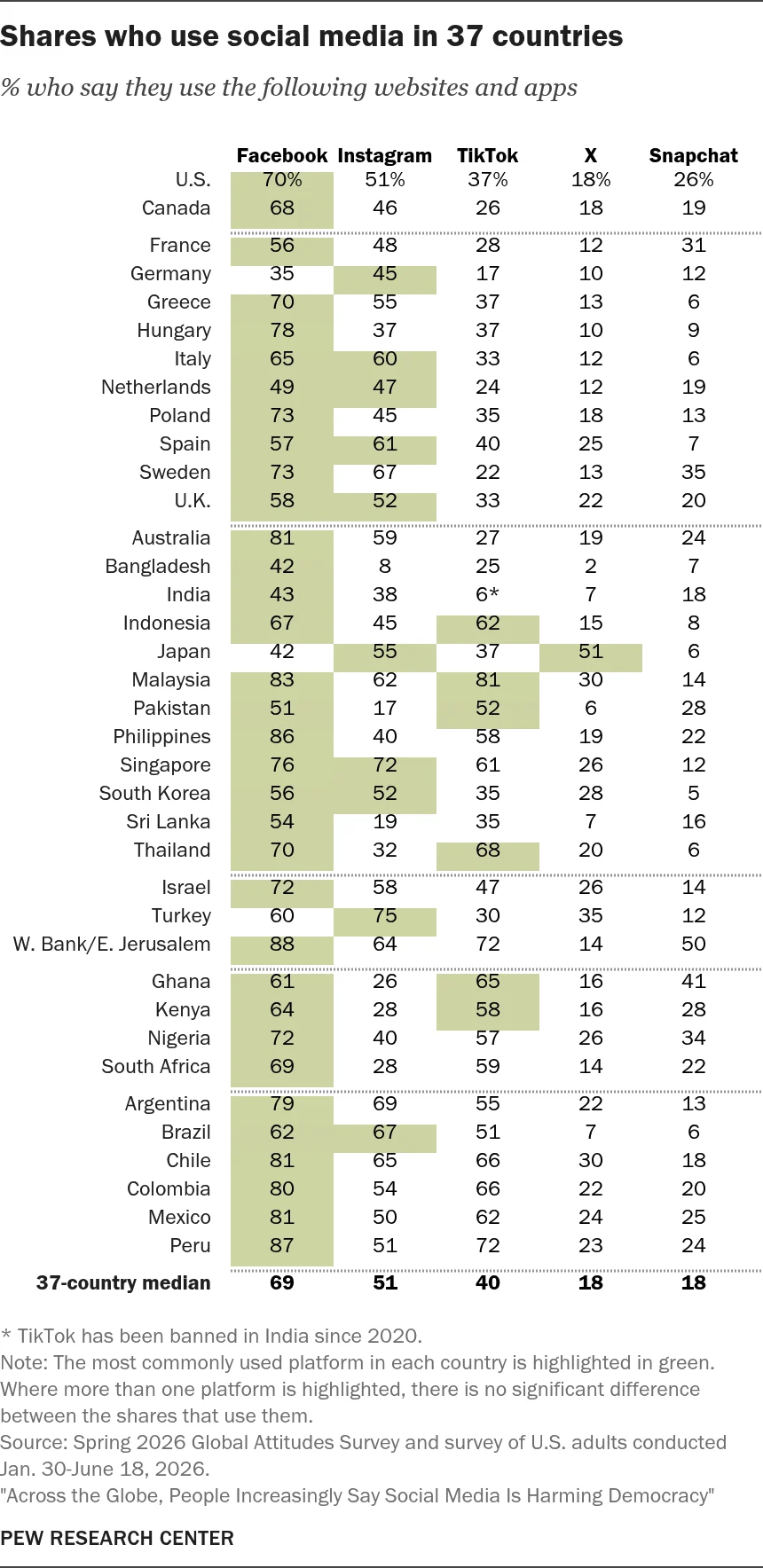
The digital landscape has undergone a profound transformation as social media platforms weave themselves into the fabric of daily life across 37 nations, according to a comprehensive new report from the Pew Research Center that examines both platform saturation and the perceived health of democracy. Conducted between February and June 2026, the research provides a granular look at how 42,151 adults navigate a digital ecosystem dominated by Facebook, Instagram, TikTok, X, and Snapchat. As these platforms continue to evolve, they are increasingly scrutinized for their dual role as both tools for connectivity and catalysts for political polarization and democratic strain.
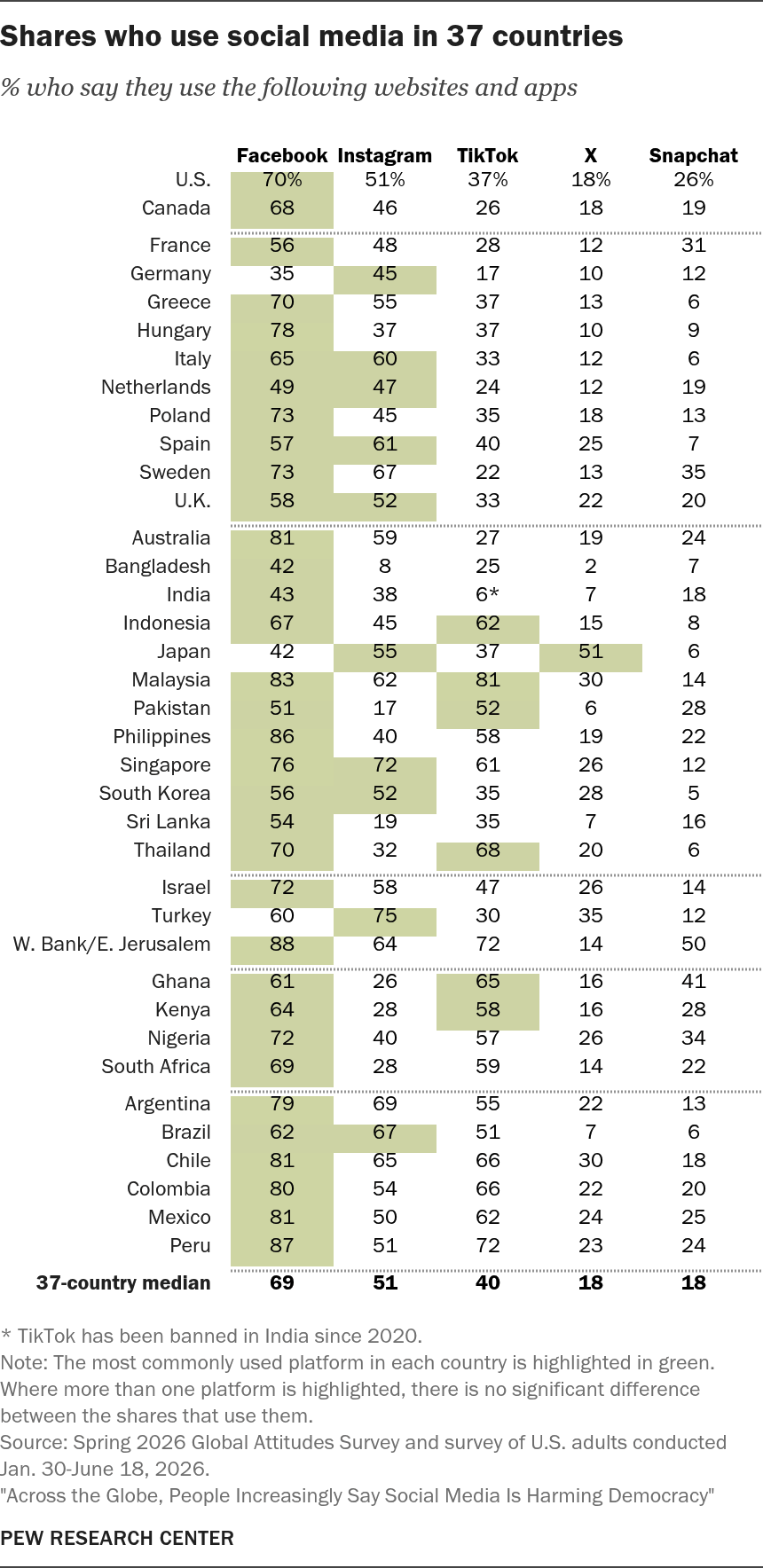
The data reveals that while global connectivity is rising, the "digital divide" remains a persistent factor. Facebook continues to command the largest user base, with a 37-country median of 69% of adults reporting use. Instagram follows at 51%, while TikTok, despite regulatory hurdles in various jurisdictions, has seen a meteoric rise, now reaching 40% of the adult population in the countries surveyed. In contrast, X and Snapchat maintain smaller, more niche footprints, with a 37-country median of 18% each.
A Chronology of Digital Transformation
The path to current adoption levels has been marked by rapid acceleration. As recently as 2023, the social media landscape in middle-income nations—such as Nigeria, Brazil, and Indonesia—was significantly different. During that period, research focused on a different suite of tools, including WhatsApp and Telegram, which have since been supplemented or partially displaced by the growth of short-form video platforms.
The surge in TikTok usage represents one of the most significant shifts in the last three years. In Nigeria, for example, TikTok adoption surged from 25% in 2023 to 57% by mid-2026. Similar double-digit growth occurred in Indonesia, Argentina, and Mexico. This shift suggests that users are pivoting away from text-heavy or static-image platforms toward algorithmically driven, short-form video content. Conversely, X has experienced a period of stagnation or decline in several markets; for instance, usage in Brazil dropped from 22% in 2023 to just 7% in 2026, reflecting a broader trend of users migrating toward platforms that offer more visual or entertainment-focused experiences.
Demographic Divides in Platform Usage
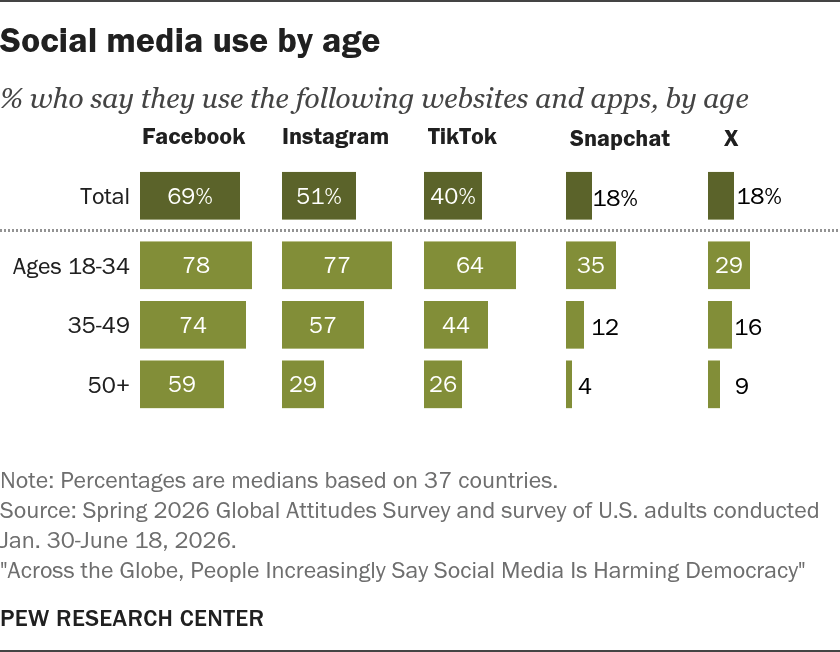
Age remains the primary determinant of social media behavior. Across all 37 nations, adults aged 18 to 34 are far more likely to be "power users"—defined as those who utilize three or more platforms—than their counterparts over 50. This generational gap is particularly stark in the realm of Snapchat, which remains almost exclusively the domain of the youth. In the United Kingdom, 58% of adults under 35 report using Snapchat, compared to a negligible 2% among those over 50.
Educational attainment also plays a role, albeit a complex one. In most middle-income countries, higher education levels correlate with higher social media usage, likely due to greater access to stable internet and advanced hardware. However, in high-income nations like Germany, the Netherlands, and Sweden, this pattern is frequently reversed or flattened, suggesting that in developed economies, social media usage is becoming a ubiquitous utility rather than a marker of socio-economic status.
The Intersection of Technology and Democracy
The timing of this survey is critical. The 2026 data collection coincided with a global climate characterized by heightened political sensitivity. A recurring theme in the broader findings of this research is the increasing public concern regarding the impact of social media on democratic processes. Many respondents expressed that, while social media provides a platform for free expression, it also facilitates the rapid spread of misinformation, deepens ideological silos, and complicates the task of building consensus.
In nations such as Thailand, Israel, and Turkey, ideological orientation has become a significant predictor of platform usage. Individuals on the political left are more likely to be multi-platform users, suggesting that digital engagement may be a strategy for seeking out diverse sources of information or mobilizing for social causes. This disparity highlights a potential "digital echo chamber" effect, where political cohorts increasingly inhabit separate digital ecosystems, potentially hindering cross-partisan dialogue.
Regional Variations and Regulatory Pressures
The report highlights a clear distinction between high-income and middle-income nations regarding how people engage with these services. In middle-income countries, users are statistically more likely to use multiple platforms simultaneously. This may be driven by the need to bypass regional restrictions or to connect with varied social networks that utilize different apps for communication.
Regulatory actions continue to act as a significant "macro-factor" in usage statistics. The long-standing ban on TikTok in India, which has been in place since 2020, continues to depress usage figures compared to other nations with similar demographics. Furthermore, the report notes that in countries experiencing political instability—such as those seeing intermittent internet blackouts—the usage of these platforms often dips or spikes in correlation with civil unrest. When governments restrict access to the internet as a method of quelling protest, it serves as a stark reminder of how fragile digital connectivity is when pitted against state-level authority.
Official Responses and Implications for Governance
While the report does not advocate for specific policies, the data provides a foundation for policymakers to understand the scale of the challenge. The sheer ubiquity of these platforms means that they are no longer merely "private companies" but essential public squares. Regulators in the European Union and beyond have already begun drafting legislation—such as the Digital Services Act—that seeks to force transparency from these platforms regarding their algorithms.
The findings suggest that the challenge for the next decade will not be just "more connectivity," but the quality and safety of that connectivity. As the global population becomes increasingly reliant on these platforms for news and social interaction, the burden of ensuring that these tools support, rather than undermine, the democratic fabric will grow. The shift toward TikTok and away from more traditional platforms like X may also force a shift in how political campaigns and civil society organizations reach the public, moving away from written manifestos toward high-engagement, short-form video content.
Methodological Rigor
The integrity of this data relies on the combination of the American Trends Panel (ATP) and the National Public Opinion Reference Survey (NPORS) for U.S. data, contrasted with the broader, face-to-face or telephone-based Spring 2026 Global Attitudes Survey. By capturing the views of over 42,000 individuals, the Pew Research Center has provided a rare, standardized snapshot of global behavior that is free from the biases of individual platform-provided statistics.
The study confirms that while the world has become more connected through technology, it has also become more fragmented in how it interprets that connectivity. As users in the Global South continue to adopt these platforms at a rapid rate, their influence on the future of the internet will only grow. The interplay between human behavior, corporate algorithms, and democratic institutions will remain one of the defining stories of the late 2020s.
Conclusion
The 2026 data paints a portrait of a world that is deeply entangled with social media, yet increasingly wary of its consequences. Whether through the rise of video-first platforms or the decline of traditional networking sites, the digital experience is in constant flux. As governments and citizens grapple with the implications of this connectivity, the primary challenge remains: how to foster a digital environment that promotes democratic participation while mitigating the risks of manipulation and isolation. With majorities in most countries now using multiple platforms daily, the role of social media in the coming years will be less about the novelty of the technology and more about its profound, systemic impact on how the world chooses to govern itself.




