
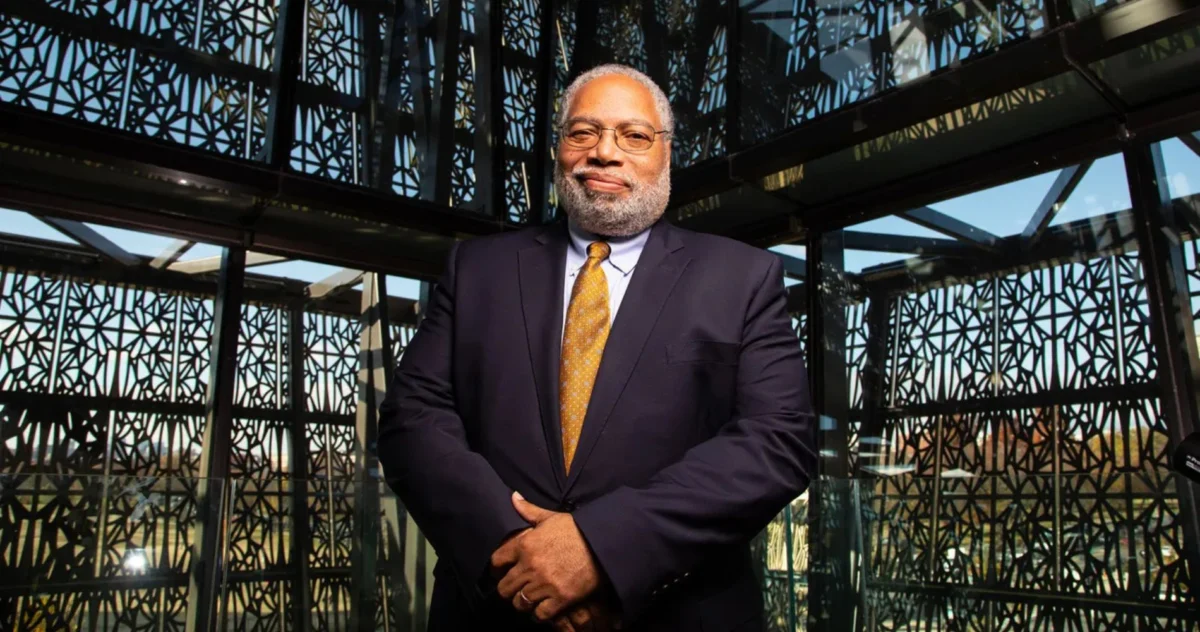
Lonnie G. Bunch III, the 14th secretary of the Smithsonian Institution, announced this week that he will step down from his post at the end of the year, concluding a distinguished seven-year tenure as the leader of the world’s largest museum, education, and research complex. His departure marks the end of a pivotal chapter for the institution, occurring during a period of intense pressure from the Trump administration, which has aggressively challenged the Smithsonian’s curatorial independence and its approach to interpreting American history.
Mr. Bunch, 73, has spent nearly four decades associated with the Smithsonian, rising from an entry-level education specialist to the head of the entire organization. His decision to retire, communicated in a formal letter to staff, reflects on a career defined by the pursuit of historical accuracy and public accessibility. As the first African American and the first professional historian to lead the Smithsonian, his administration has been characterized by a commitment to expanding the scope of what the institution considers worthy of preservation, specifically regarding marginalized voices and complex social narratives.
A Legacy Built on Historical Rigor
The career trajectory of Lonnie G. Bunch III is deeply intertwined with the evolution of the Smithsonian itself. After earning his Ph.D. in American and African American history in 1978, he began his professional journey at the National Air and Space Museum. His expertise soon led him to a founding role at the California African American Museum in Los Angeles, an experience that sharpened his ability to conceptualize public history for diverse audiences.
Upon returning to the Smithsonian, he served as the associate director for curatorial affairs at the National Museum of American History. During this time, he was instrumental in developing "The American Presidency: A Glorious Burden" and successfully acquired the historic Greensboro Lunch Counter—an artifact that became a touchstone for the American Civil Rights Movement. However, his most significant accomplishment came in 2005 when he was appointed the founding director of the National Museum of African American History and Culture. Over the course of 11 years, Mr. Bunch navigated the complexities of congressional funding, private donor relations, and bipartisan diplomacy to open the museum on the National Mall in 2016. The museum quickly became a cultural landmark, consistently ranking among the Smithsonian’s most visited sites.
Chronology of a High-Stakes Tenure
The challenges facing Mr. Bunch during his final years as secretary represent a modern conflict between executive political authority and the autonomy of cultural institutions. The tension escalated throughout 2025 and 2026:
- March 2025: The Trump administration issued an executive order titled "Restoring Truth and Sanity to American History," which explicitly targeted museums receiving federal funds. The order accused institutions of promoting narratives that the administration deemed harmful to American and Western values.
- August 2025: President Trump demanded a "comprehensive internal review" of all Smithsonian operations, publicly criticizing the institution for its focus on the history of slavery and advocating for a shift toward "American exceptionalism."
- July 2026: The administration released a report formally labeling the National Museum of American History as an engine of "extreme political activism."
- September 2026: Following a year of sustained pressure and public friction, Mr. Bunch announced his retirement, effective at the end of the year.
Throughout this period, Mr. Bunch maintained a consistent defense of the Smithsonian’s mandate. In an internal email obtained by NPR, he stated, "At the Smithsonian, our work is driven by scholarship, accuracy, and an uncompromising commitment to tell the fullness of America’s story."
Data and Public Sentiment
Despite the administration’s claims of institutional bias, data suggests that the Smithsonian remains one of the most trusted entities in the United States. Recent polling by YouGov indicates that 37% of Americans have visited a Smithsonian museum, and public trust in museums is exceptionally high. On a trust index where 10 is the maximum, museums scored 7.3, placing them significantly ahead of the federal government (4.5) and nearly on par with public libraries and close family members (7.4).
Furthermore, the public appears largely at odds with the administration’s directives regarding museum content. According to 2025 survey data, 84% of Americans believe it is "very important" for museums to accurately represent the entirety of American history, including topics of systemic inequality, slavery, and historical struggles. A majority of respondents also expressed that the government should not interfere with the intellectual content of exhibits, citing a desire for professional, evidence-based curation over political narratives.
Official Responses and Professional Reaction
The departure of Mr. Bunch has drawn widespread reaction from the academic and cultural communities. Chief Justice John G. Roberts Jr., in his capacity as the Smithsonian’s chancellor, praised Mr. Bunch’s "wisdom, vision, and leadership," noting that he "pursued excellence in the telling of our nation’s story."
However, scholars have expressed deep concern regarding the environment in which this leadership transition is occurring. Sarah Weicksel, executive director of the American Historical Association, stated that the concern surrounding the future of the institution is a "testament to Bunch’s commitment to protecting the Smithsonian’s independence." Samuel J. Redman, a history professor at the University of Massachusetts Amherst, lauded Mr. Bunch for leading with "candor, bravery and thoughtfulness" despite a sustained pressure campaign from the White House.
Filmmaker Ava DuVernay articulated a broader perspective on the significance of his exit, calling it "a profound loss for those who care about America’s history, not its fantasy." She noted that Mr. Bunch had been treated "shamefully" by those seeking to control the national narrative rather than engage with its complexities.
Broader Implications for National Institutions
The pressure exerted on the Smithsonian is not an isolated event; it represents a broader trend of administrative oversight regarding the cultural memory of the nation. Similar actions have been observed across various federal departments:
- National Park Service: Recent directives led to the removal of exhibits detailing the lives of people enslaved by George Washington at historical sites.
- State Department: A painting by Kehinde Wiley was removed from display, with officials characterizing the work—which featured Black subjects—as "aesthetically terrifying."
- Department of Defense: The government has moved to restore Confederate names to military installations and has scrubbed contextual language regarding Confederate memorials from national cemeteries, favoring a more "sanitized" historical account.
These developments suggest a concerted effort to shift the national ethos away from a critical examination of the past. For the Smithsonian, the challenge for the next secretary will be to maintain the institution’s scholarly integrity while navigating a political landscape that is increasingly hostile to historical narratives that do not align with a specific interpretation of American identity.
Looking Ahead: The Future of the Smithsonian
As Mr. Bunch prepares to depart, he leaves behind not only a legacy of institutional growth but also a roadmap for future leadership. During his tenure, he secured significant momentum for two major projects: the Smithsonian American Women’s History Museum and the National Museum of the American Latino. His ability to build these institutions—much like his success with the National Museum of African American History and Culture—relied on a strategy of broad-based coalition building and an insistence that the American story is incomplete without these perspectives.
In his final reflections, Mr. Bunch remained resolute about the necessity of his mission. "Americans are an amazingly brave people, who have accomplished so much," he told The New York Times. "They’ve got to be brave enough to face their own history." He emphasized that the role of the Smithsonian is to resist the impulse to make history "erased, softened and made palatable."
As the search for his successor begins, the institution faces a defining moment. The Smithsonian’s identity as a reservoir of truth—a place where the public can find clarity and education—is currently being tested. The next leader will be tasked with defending that mandate against the "wind and tide" that Mr. Bunch vowed to withstand, ensuring that the Smithsonian remains a space where the nation’s past is explored in all its breadth, depth, and uncomfortable complexity. The institution’s long-term reputation for independence will likely depend on its ability to navigate this period of political volatility while remaining anchored in the scholarly principles that Mr. Bunch defended throughout his four-decade career.




