
France is currently grappling with a profound crisis of confidence as the nation faces a convergence of fiscal strain and civil unrest. Recent weeks have seen hundreds of thousands of citizens take to the streets, transforming major urban centers into hubs of protest against the backdrop of an economy that the vast majority of the population views as fundamentally broken. This wave of public discontent, fueled by grievances over underfunded public education and the crushing weight of a national debt crisis, has reached a fever pitch, forcing the government into a defensive posture.
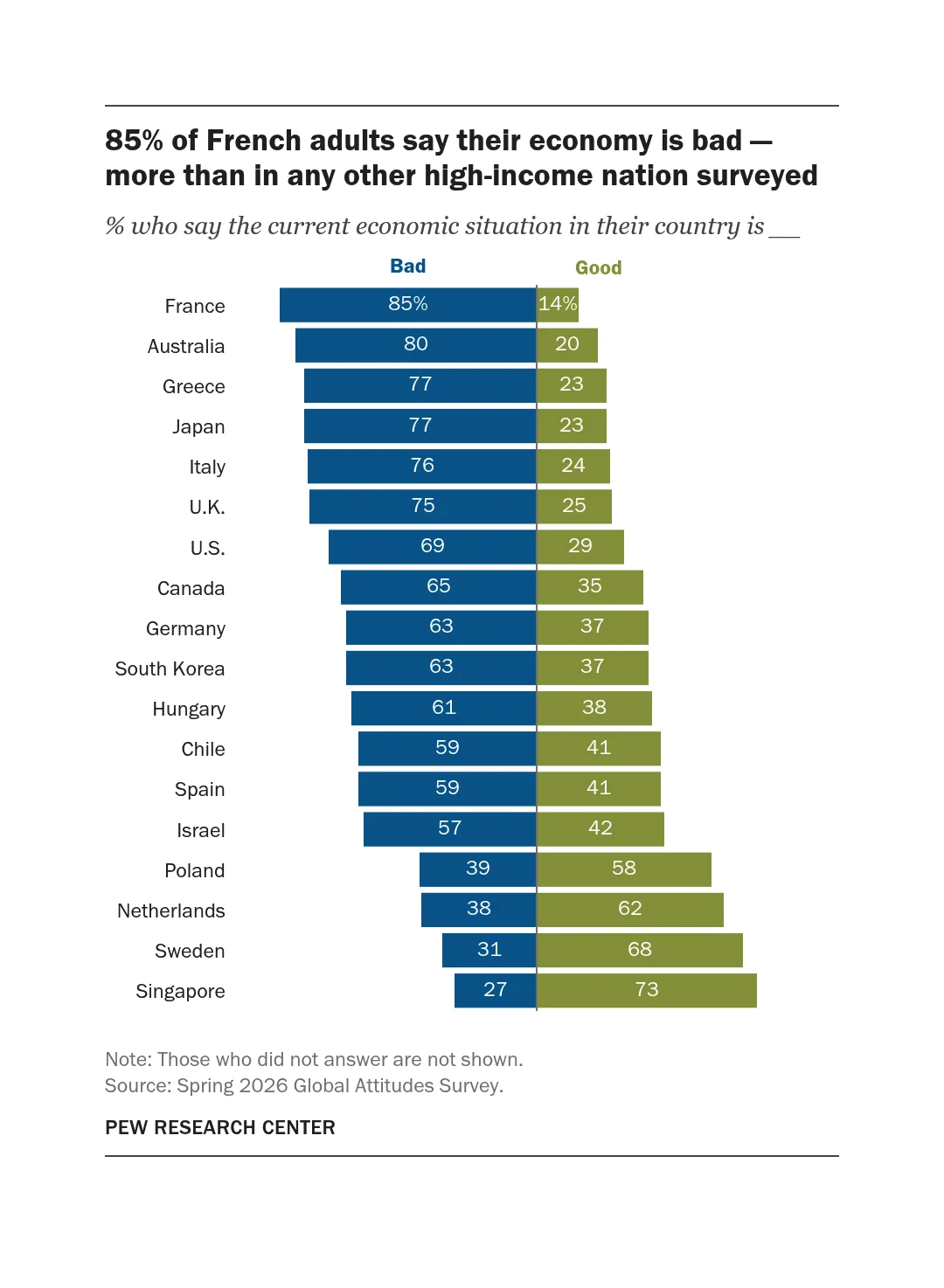
According to a comprehensive analysis conducted by the Pew Research Center in the spring of 2026, 85% of French adults characterize the current economic state of their country as "bad." This figure is not merely a reflection of dissatisfaction; it represents a statistically significant outlier when compared to other high-income nations. In a comparative study of 18 developed economies, France sits at the top of the list for economic pessimism, far exceeding the levels of frustration observed in the United States, Germany, or the United Kingdom.

The Anatomy of a National Discontent
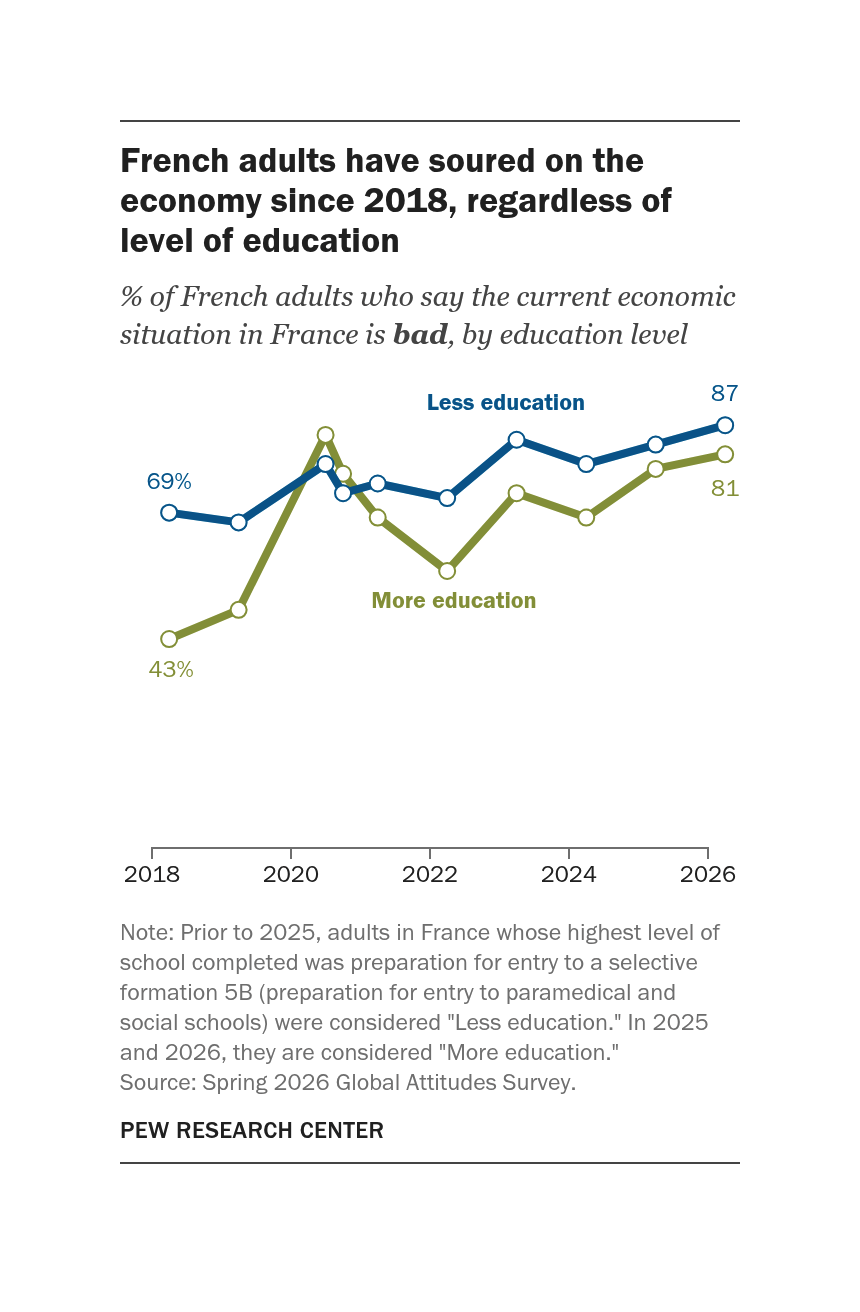
The surge in negative sentiment is not a sudden phenomenon but rather the culmination of years of mounting economic pressure. Data from the Pew Research Center’s Global Attitudes Survey illustrates a steady decline in public perception. As recently as 2018, only a minority of the French public held such a dismal view of the economy. However, the subsequent years—marked by the volatility of the COVID-19 pandemic, inflationary pressures, and energy sector instability—have eroded the public’s faith in the national fiscal trajectory.
The current atmosphere is defined by a sense of systemic neglect. Protesters, particularly those representing student organizations and labor unions, point to crumbling infrastructure within the education system. Overcrowded classrooms and a lack of resources have become symbolic of a broader issue: the perceived failure of the state to maintain essential public services while simultaneously navigating a precarious debt-to-GDP ratio.
Chronology of the 2026 Fiscal Crisis
To understand the current impasse, one must look at the timeline of events that have defined the year:
- February – April 2026: The Pew Research Center fields its survey, capturing a snapshot of public sentiment that reveals 85% of the population is deeply dissatisfied with the economy. This data serves as a precursor to the volatility that would follow in the autumn.
- Summer 2026: Economic indicators in France begin to show signs of stagnation. Concerns regarding sovereign debt management become the focal point of discussions between the Bank of France and the Ministry of Economy.
- September 15, 2026: Minister of the Economy, Finance, and Industrial, Energy and Digital Sovereignty, Roland Lescure, joined by Bank of France Governor Emmanuel Moulin, holds a high-stakes press conference. The officials attempt to project stability, yet the optics of the meeting are overshadowed by growing market skepticism regarding the government’s ability to balance the budget.
- October 2026: Widespread protests erupt across France. The demonstrations, initially localized around student demands for educational reform, rapidly expand into a general movement against the government’s overall fiscal management.
Data-Driven Disillusionment
The depth of this pessimism is pervasive, cutting across age groups, education levels, and political affiliations. Contrary to what one might expect in a polarized society, there is a striking consensus regarding the state of the economy. The survey indicates that both the youngest adults (ages 18 to 34) and those aged 50 and older are almost equally likely to report that the country is in an economic downturn.
Education level, often a wedge issue in economic polling, shows a narrowing gap in the French context. Historically, those with less formal education were significantly more pessimistic than their more educated counterparts. However, in 2026, the gap has shrunk, suggesting that the current economic malaise is being felt across all tiers of the workforce.
The political dimension of this crisis is equally stark. Among those on the ideological right, 91% view the economy negatively. Specifically, supporters of Marine Le Pen’s National Rally exhibit a particularly intense level of disapproval, with 92% describing the situation as "bad" and a majority (58%) going as far as to classify it as "very bad." This suggests that the current economic sentiment is effectively fueling populist rhetoric and may have significant implications for future electoral cycles.
Official Responses and the Challenge of Governance
The government, led by Minister Roland Lescure, faces the difficult task of reconciling market demands for fiscal discipline with the public’s demand for increased social investment. The debt crisis acts as a straitjacket, limiting the administration’s ability to offer concessions to protesters.
In their September briefing, Lescure and Governor Emmanuel Moulin emphasized the necessity of structural reforms to ensure long-term stability. However, these calls for "sovereignty" and "financial prudence" have largely fallen on deaf ears among a public that feels the immediate pain of reduced purchasing power and declining public services. The government’s challenge is not merely technical—it is a crisis of communication and legitimacy. Without a clear path to economic recovery that resonates with the average citizen, the administration risks a protracted period of civil instability that could further paralyze the legislative agenda.
Broader Implications for the European Union
The situation in France holds critical implications for the European Union. As a cornerstone of the Eurozone, a fiscally unstable France creates ripples that extend far beyond its borders. Investors are watching closely to see if the French government can enact the necessary budgetary tightening without triggering a complete breakdown in social order.

If the protests continue to gain momentum, the French government may be forced to choose between satisfying the demands of the European Central Bank’s fiscal mandates or pacifying its own electorate. This dilemma is a microcosm of the wider European struggle to balance post-pandemic recovery, energy independence, and the maintenance of the social welfare state.
Conclusion
The data from the 2026 survey provides a clear, if sobering, insight into the French psyche. It is a nation that feels it has been left behind by a globalized economy that promises growth but delivers stagnation. The protests are the physical manifestation of an 85% dissatisfaction rate—a figure that serves as a warning to policymakers that traditional methods of governance are no longer sufficient.
As France moves into the final quarter of 2026, the focus will remain on whether the government can navigate this dual crisis of public debt and public trust. The outcome will not only determine the tenure of the current administration but will also set a precedent for how European nations manage the social consequences of long-term economic pessimism. The path forward requires more than just fiscal adjustments; it requires a renewed social contract that addresses the fundamental anxieties of a population that has clearly stated it is no longer satisfied with the status quo.




