The federal workforce experienced a significant contraction in 2025, shedding 10.3% of its employees, a net decrease of nearly 238,000 workers. This substantial decline, detailed in a Pew Research Center analysis of recently released government data, marks a pivotal shift in federal employment following a period of relative stability. The analysis of Office of Personnel Management (OPM) data reveals a dramatic increase in separations coupled with a sharp drop in new hires, painting a picture of a rapidly downsized federal bureaucracy.
A Year of Unprecedented Reductions
In 2025, the federal government saw 348,219 individuals leave their positions through various means, including retirements, resignations, and terminations. This figure represents an alarming 80.8% surge in separations compared to the previous year. Concurrently, the influx of new talent dwindled significantly, with only 116,912 individuals joining the federal payroll, a stark 55.6% decrease from 2024. This dual trend of increased departures and diminished recruitment efforts resulted in the most substantial reduction in federal employment in recent history.
Shifting Demographics Within the Federal Workforce
While the overall workforce shrinkage was widespread, the Pew Research Center analysis indicates that younger and less experienced federal employees were disproportionately affected. At the close of 2024, individuals under the age of 35 constituted 18% of the federal workforce. By the end of 2025, this proportion had decreased to 16.8%. Similarly, workers with less than two years of federal service, who typically lack full civil service protections, saw their representation fall from 16.2% to 10.3% of the total workforce. This trend suggests a deliberate strategy to reduce the ranks of probationary and early-career employees.
The OPM, the federal government’s central human resources agency, has ceased publishing detailed demographic data regarding the gender, race, ethnicity, and disability status of federal workers. This change in data availability prevents a comprehensive analysis of how these specific groups were impacted by the workforce reductions, a limitation that was not present in previous analyses conducted by the Pew Research Center in early 2025.
Agency-Specific Declines: A Targeted Approach
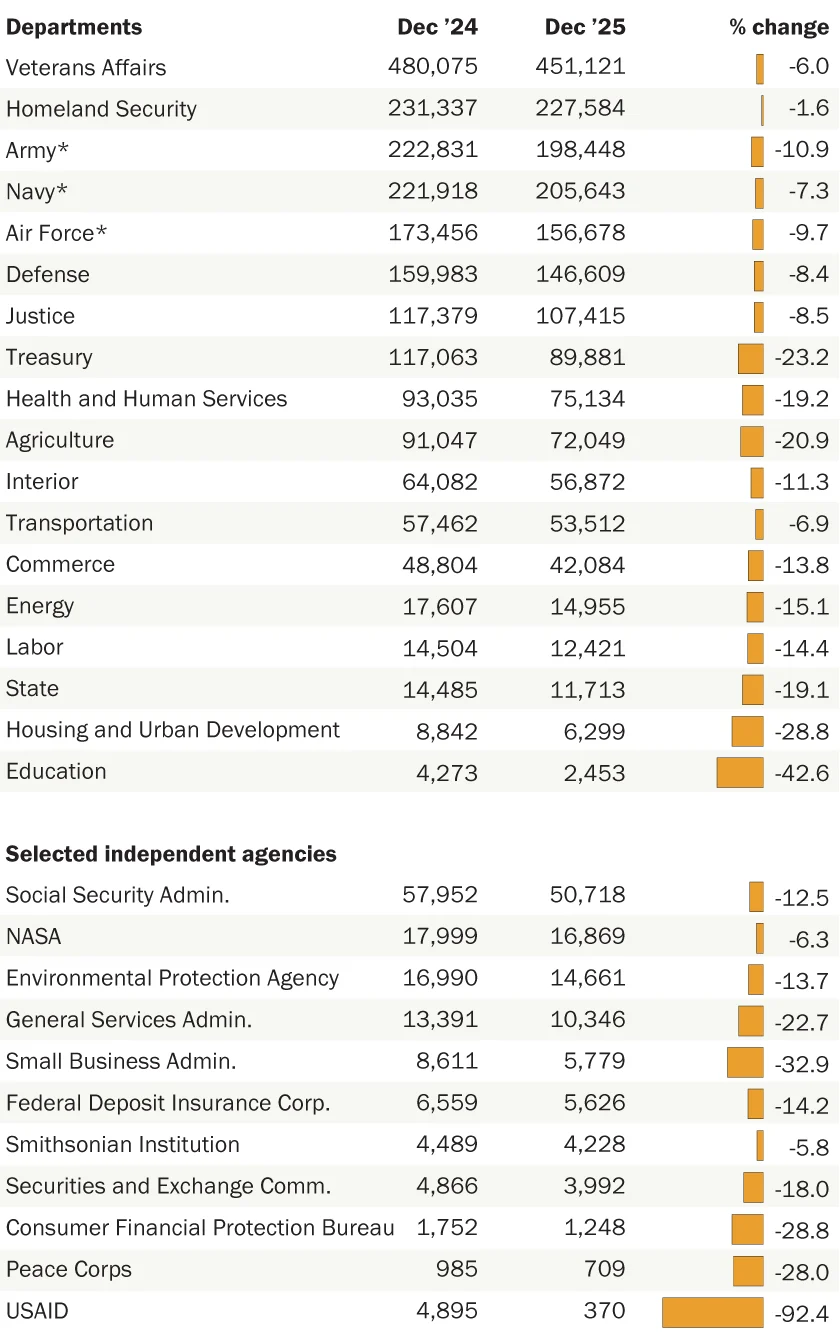
The workforce reductions were not uniformly distributed across federal agencies. Several departments and independent agencies experienced particularly steep declines, indicating targeted downsizing efforts. The Department of Education saw its workforce contract by 42.6%, falling from approximately 4,300 employees in December 2024 to fewer than 2,500 by December 2025. The U.S. Agency for International Development (USAID) experienced an even more dramatic reduction, with its headcount plummeting by 92.4%, from nearly 4,900 employees to a mere 370.

Other significant workforce contractions were observed at the parent agency of the National Endowments for the Arts and the Humanities (-56.6%), AmeriCorps (-43.6%), the Small Business Administration (-32.9%), the U.S. Agency for Global Media (overseeing Voice of America and other international broadcasters, -32.7%), and the National Science Foundation (-30.3%). These substantial cuts suggest a strategic re-evaluation of the roles and scopes of these particular government entities.
Conversely, certain agencies, particularly those within the Department of Homeland Security focused on immigration enforcement, saw growth. Immigration and Customs Enforcement (ICE) added approximately 7,500 workers, an increase of 36.1%, reaching 28,272 employees. Customs and Border Protection (CBP) also experienced a modest rise, from 66,613 to 67,587 employees, a 1.5% increase. However, most other components within Homeland Security, including the Transportation Security Administration (-4.3%), Citizenship and Immigration Services (-11.4%), and the Federal Emergency Management Agency (-14.0%), experienced job losses.
Occupational Shifts: White-Collar Workforce Most Affected
The job cuts predominantly impacted white-collar occupations, which represented 92.1% of the federal workforce at the end of 2024. The headcount in these roles decreased by 10.6% during 2025. Blue-collar occupations experienced a smaller decline of 6.7%.
Within larger occupational categories, significant reductions were noted in:
- Professional and technical occupations: This broad category saw substantial losses, reflecting a broad downsizing across many specialized fields.
- Administrative and support occupations: Reductions in these roles indicate a streamlining of administrative functions across various agencies.
- Management occupations: A decrease in managerial positions suggests a restructuring of organizational hierarchies.
One notable exception to the white-collar decline was the "investigation" occupational group, which remained relatively stable. This stability was largely attributed to increases in border patrol enforcement and customs and border protection roles. These gains offset decreases in compliance inspection, food inspection, aviation safety, and equal opportunity investigation.
Other significant occupational losses included:
- Program management and administration: Reductions in roles focused on overseeing and managing government programs.
- Clerical and administrative support: Cuts in roles related to general office support and record keeping.
- Financial administration and program support: Declines in positions related to financial management and supporting programmatic activities.
Background and Context: A Mandate for Change
The significant workforce reductions in 2025 are largely attributed to the policy directives of the newly inaugurated administration. Following a campaign that often criticized the size and perceived inefficiencies of the federal bureaucracy, the administration signaled its intent to implement substantial changes to the federal workforce. This approach aligns with historical patterns observed following shifts in presidential administrations, although the scale and speed of these particular cuts are noteworthy.
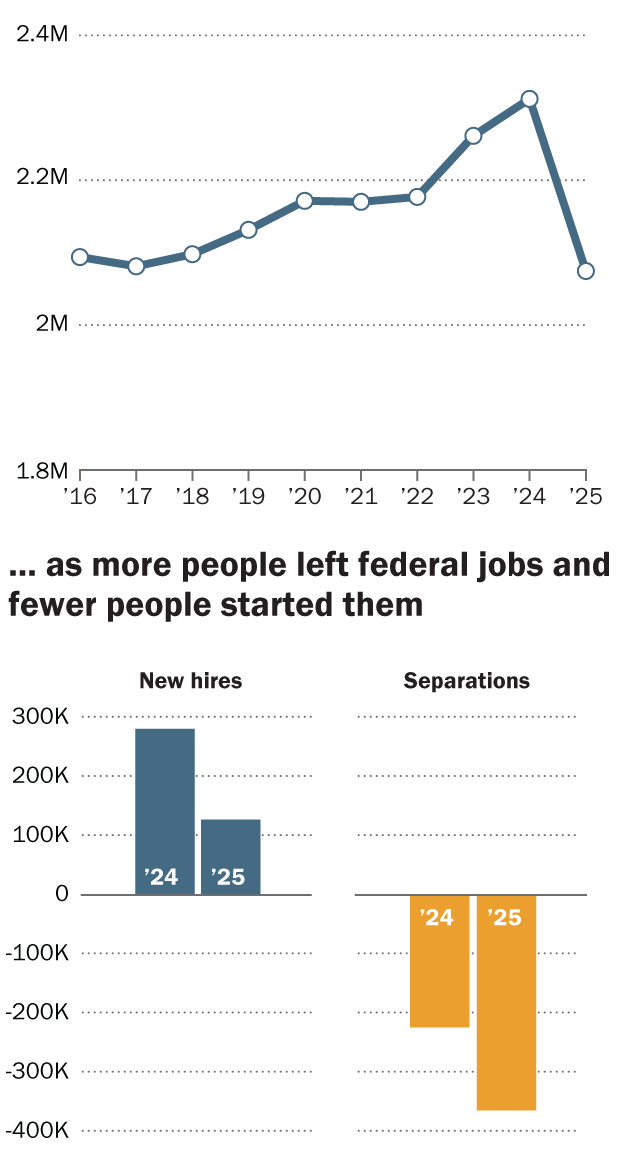
The Pew Research Center’s previous analysis in January 2025 highlighted a federal workforce that had remained relatively stable in the preceding years, with some growth observed in 2023 and 2024. The current data represents a sharp reversal of this trend, indicating a decisive shift in federal employment policy.
Methodology and Data Limitations
The Pew Research Center’s analysis is based on data obtained from the U.S. Office of Personnel Management (OPM) between February 20 and March 10, 2026. The primary method involved comparing workforce data from December 2025 to December 2024 to capture the full year’s changes. The analysis also incorporated OPM data on new hires and separations.
It is important to note certain limitations within the OPM data. Figures for new hires and separations exclude individuals who transferred into or out of positions not publicly reported by OPM. Furthermore, OPM has redacted substantial portions of its data, particularly regarding job locations and employee pay for December 2025, hindering a complete analysis of these aspects. The dataset also excludes certain entities, including most intelligence agencies, the Executive Office of the President (with the exception of the Office of Management and Budget), Congress, the federal judiciary, and quasi-independent organizations like the U.S. Postal Service and the Federal Reserve.
Implications and Future Outlook
The drastic reduction in the federal workforce raises significant questions about the capacity of government agencies to fulfill their mandates. While proponents of the downsizing argue for increased efficiency and reduced taxpayer burden, critics express concerns about potential impacts on essential public services, national security, and the government’s ability to respond to complex challenges.
The disproportionate impact on younger and less experienced workers could also have long-term consequences for institutional knowledge and the pipeline of future federal leaders. The lack of comprehensive demographic data further complicates efforts to assess the full societal impact of these workforce changes. As the federal government navigates this period of significant transformation, ongoing analysis will be crucial to understanding the evolving landscape of public service and its implications for the nation.