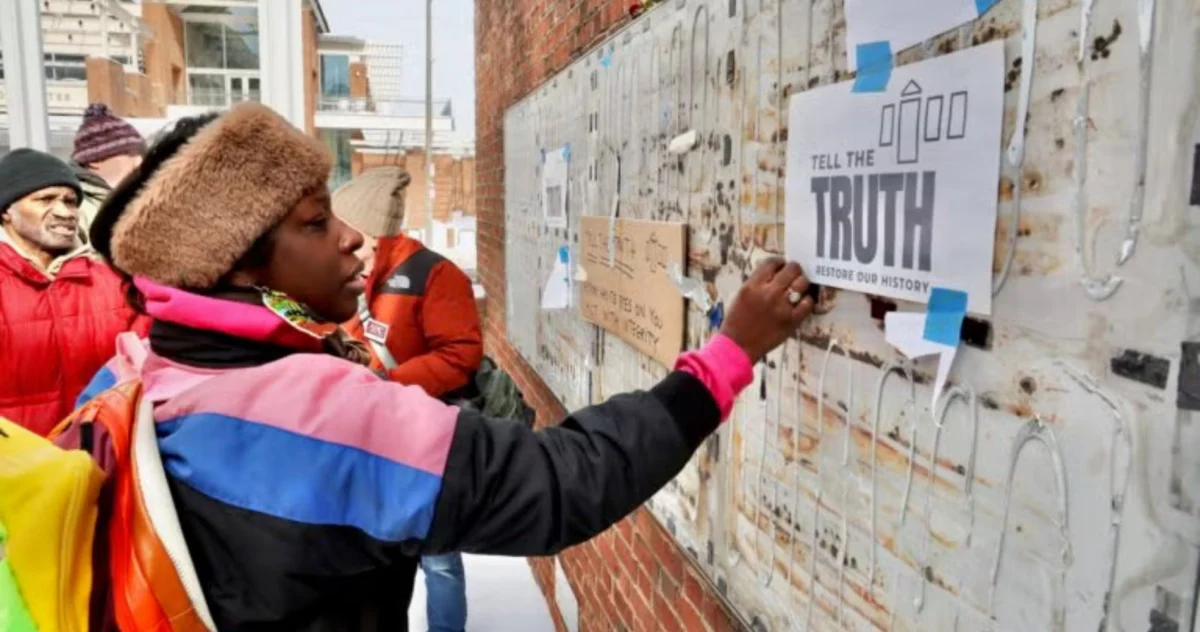
A federal court delivered a significant ruling on Monday, ordering the National Park Service (NPS) to immediately reinstate exhibits at the President’s House in Philadelphia. These crucial displays detail President George Washington’s ownership of enslaved people and illuminate the lives of individuals held in bondage by the nation’s first president. The decision comes after the City of Philadelphia initiated legal action against the NPS following the removal of these vital historical panels, displays, and video exhibits on January 22, 2026, which had provided information about slavery and the specific individuals enslaved at the site.
The court, in granting the city’s motion for a preliminary injunction, explicitly commanded the NPS to "reinstall all panels, displays, and video exhibits that were previously in place" and to "prevent any additions, removals, destruction, or further changes of any kind to the President’s House site." This ruling marks a pivotal moment in the ongoing national discourse regarding the presentation of America’s complex history, particularly the often-uncomfortable truths intertwined with the nation’s founding ideals.
The Genesis of a Contested Historical Site
The President’s House site holds profound historical significance, marking the precise location of the executive mansion where George Washington resided during his presidency (1790-1797) and where John Adams later lived (1797-1800) while Philadelphia served as the temporary capital of the United States. It was here, just steps from what would become Independence Hall, that the nascent American republic grappled with the profound contradiction of its foundational principles of liberty and equality coexisting with the institution of chattel slavery.
The modern recognition of the site’s dual legacy began in the early 2000s when archaeological excavations confirmed the footprint of the original presidential residence. Simultaneously, historical research brought to light compelling evidence of the nine enslaved Africans whom President Washington brought to Philadelphia: Oney Judge, Austin, Christopher Sheels, Giles, Hercules Posey, Joe Richardson, Moll, Paris, and Richmond. These individuals were not merely background figures but central to the daily operations of the presidential household. Historians uncovered Washington’s deliberate practice of rotating these enslaved individuals in and out of Pennsylvania, a state that had enacted a gradual abolition law in 1780. This calculated rotation, typically occurring every six months, was designed to circumvent the state’s provision that would have granted freedom to enslaved persons who resided in Pennsylvania for a continuous period of six months. This legal maneuver underscored the lengths to which even the nation’s revered founder went to maintain his human property, even in a state moving towards abolition.
The discovery of this historical context ignited a powerful civic movement. In 2003, the U.S. House of Representatives formally urged the National Park Service to commemorate the lives of the people enslaved by President Washington at the site. Recognizing the imperative to present a more complete and honest narrative, the City of Philadelphia, alongside numerous historical and community organizations, invested millions of dollars into developing an interpretive exhibition. This collaborative effort aimed to "tell an honest story about American history and the founding of this country and the role that slavery and enslaved Africans had," as noted by city officials.
"Freedom and Slavery in the Making of a New Nation"
The culmination of these efforts was the opening of "President’s House: Freedom and Slavery in the Making of a New Nation" in December 2010. The exhibit was meticulously designed to explore the "paradox of freedom and slavery" that defined the nation’s birth. It juxtaposed the ideals articulated in the Declaration of Independence, penned just meters away, with the harsh realities faced by enslaved individuals within the presidential household. Visitors were invited to confront the complexities of a nation founded on liberty while simultaneously upholding and profiting from human bondage.
A central figure in the exhibit’s narrative was Oney Judge, who served as Martha Washington’s personal maid. In 1796, Judge famously escaped from the President’s House and successfully fled to freedom in New Hampshire, evading repeated attempts by the Washingtons to recapture her. Her story became a powerful symbol of resistance and the yearning for liberty that transcended the legal bonds of slavery. In recognition of this profound narrative, the NPS in 2022 officially designated the President’s House as a National Underground Railroad Network to Freedom site. This designation acknowledged how Judge’s struggle for freedom represented the country’s gradual, albeit often painful, progress away from the horrors of slavery and towards a future where the founding ideals of "Life, Liberty and the pursuit of Happiness" could potentially be embodied for every American.
The exhibit was widely praised for its nuanced approach, offering a space for reflection on the profound moral compromises inherent in the nation’s early history. It served as a critical educational resource, drawing thousands of visitors annually, including school groups, international tourists, and researchers, all seeking a deeper understanding of America’s origins.
The Controversial Removal and Legal Challenge
The tranquility surrounding the exhibit was shattered on January 22, 2026, when the National Park Service, under directives originating from a prior presidential administration, removed the interpretive panels, displays, and video exhibits that referenced slavery and the lives of the enslaved individuals. This action sparked immediate outrage and concern among historians, civic leaders, and the public. The City of Philadelphia, viewing the removal as a direct assault on historical accuracy and public trust, swiftly filed a lawsuit in federal court to compel the NPS to restore the exhibits.
During the court hearing, lawyers representing the Justice Department offered "no evidence" or "reasoned explanation" to justify the removal. Their primary defense rested on an executive order from the previous administration, which had directed federal agencies, including the NPS, to review and remove materials deemed to "inappropriately disparage Americans" and specifically cited Independence National Historical Park as a site promoting "corrosive ideology." This argument implied that presenting the historical reality of slavery, particularly in connection with a revered figure like Washington, constituted an inappropriate disparagement.
The Court’s Resounding Rejection of Historical Erasure
The federal court’s 40-page decision meticulously dismantled the government’s arguments, delivering a forceful rebuke to the attempt to alter the historical narrative. The court found that the NPS, by removing the exhibit, had ironically committed the very act the executive order purported to condemn: "replacing objective facts with a distorted narrative driven by ideology rather than truth."
"It is not disputed that President Washington owned slaves," the court stated unequivocally. "And yet, in its argument, the government claims it alone has the power to erase, alter, remove and hide historical accounts on taxpayer and local government-funded monuments within its control." The court viewed this assertion as a dangerous precedent, challenging the very foundation of historical inquiry and public access to factual information.
The court went further, drawing a stark parallel to George Orwell’s dystopian novel "1984," where a "Ministry of Truth" was tasked with rewriting history to suit the government’s agenda. The court found the government’s argument disturbingly reminiscent of this fictional scenario, stating, "The government here likewise asserts truth is no longer self-evident, but rather the property of the elected chief magistrate and his appointees and delegees, at his whim to be scraped clean, hidden, or overwritten. And why? Solely because, as Defendants state, it has the power."
The Justice Department’s contention that "the Government gets to choose the message it wants to convey" was firmly rejected by the court. The ruling clarified that while the government has discretion, "An agency… cannot arbitrarily decide what is true, based on its own whims or the whims of the new leadership." The court emphasized that while the government is free to convey its preferred message elsewhere, it cannot do so by "wiping away the history of the greatest Founding Father’s management of persons he held in bondage" at a site specifically designed to illuminate that history.
Irreparable Harm to Public Memory and Education
Central to the court’s decision was its finding of "irreparable harm" should the exhibits not be restored. The City of Philadelphia had powerfully argued that the removal would result in "a loss of access to historical truth, an undermining of the public trust, and an inability to recount its own story in preparation for the semiquincentennial." The court concurred, asserting that the removal "constitutes erasure, undermines public trust, and compromises the integrity of public memory."
The court underscored the unique role of the President’s House, stating that it represents the City "fulfilling an obligation to tell the truth—the whole, complicated truth." The removal, it found, stripped the site of that truth, depriving the public of essential educational opportunities designed to be free and accessible. The court emphasized that the displays and exhibits were "not mere decorations to be taken down and redisplayed," but rather "a memorial to ‘men, women, and children of African descent who lived, worked, and died as enslaved people in the United States of America,’ a tribute to their struggle for freedom, and an enduring reminder of the inherent contradictions emanating from this country’s founding."
Crucially, the court found that all visitors would be harmed by the removal. "Each person who visits the President’s House and does not learn of the realities of founding-era slavery receives a false account of this country’s history," the ruling concluded. This point highlights the court’s recognition of the exhibit’s role in providing a complete and accurate understanding of American history, not just for specific groups but for the entire public.
Broader Implications and Future of Historical Interpretation
The federal court’s ruling sends a clear message about the imperative of historical accuracy and the dangers of politically motivated historical revisionism. It affirms the right of local governments and the public to ensure that federal agencies uphold agreements and present comprehensive historical narratives, even when those narratives are challenging.
City of Philadelphia officials, including Mayor Cherelle Parker, lauded the decision. "This ruling is a victory for historical truth and for the integrity of public education," Mayor Parker stated in a press conference following the announcement. "Our city has a responsibility to confront all aspects of our past, and that includes the uncomfortable truths about slavery at the very highest levels of our founding government. We look forward to seeing these essential exhibits restored and continuing our work to prepare for the nation’s Semiquincentennial in 2026 with a full and honest account of our history."
Historians and scholars specializing in early American history and African American studies also expressed strong support for the ruling. Dr. Annette Gordon-Reed, a Pulitzer Prize-winning historian, commented, "This decision is vital. It reinforces the principle that historical sites should be places of learning, not instruments for political agendas. To omit the stories of enslaved people from the President’s House is to fundamentally misunderstand the American founding."
The National Park Service, while bound by the court’s order, has yet to issue a detailed statement on its compliance plan. The ruling sets a precedent that could influence how historical sites across the nation interpret complex or controversial aspects of American history, particularly those involving slavery, Indigenous peoples, and other marginalized groups. It underscores the importance of local partnerships and stakeholder engagement in the development and maintenance of interpretive exhibits at federal parks.
As the United States approaches its 250th anniversary in 2026, the year of the original exhibit removal, this ruling gains even greater significance. It underscores the nation’s ongoing struggle to reconcile its ideals with its historical realities. The President’s House exhibit, once restored, will continue to serve as a powerful reminder that understanding the full story of America, with all its inherent contradictions, is essential for a truly informed and just society. The court’s decision ensures that the uncomfortable but undeniable truth of slavery at the highest echelons of the early American republic will not be erased from the public consciousness, standing as a testament to the enduring power of history and the rule of law.