Faith-based radio stations constitute a significant and widespread component of the American media landscape, reaching an overwhelming majority of the population. A comprehensive analysis by the Pew Research Center, conducted under the auspices of the Pew-Knight Initiative, reveals that over 4,000 terrestrial religious stations broadcast across the United States. This number represents approximately a quarter of the more than 17,000 FCC-licensed AM and FM stations nationwide, underscoring the substantial presence of religious content in the broadcast spectrum. The Pew-Knight Initiative, a collaborative research program funded by The Pew Charitable Trusts and the John S. and James L. Knight Foundation, aims to foster new research into how Americans consume civic information, shape their beliefs and identities, and participate in their communities. Pew Research Center, a nonpartisan fact tank, provides data-driven insights, while the Knight Foundation champions informed and engaged communities.
This particular report delves into the characteristics of AM and FM radio stations that primarily broadcast religious or faith-based content, examining their programming, listener demographics, and the motivations behind tune-in. The research was undertaken to enhance public and decision-maker understanding of the diverse sources Americans utilize for information, a critical aspect of Pew Research Center’s ongoing agenda concerning news habits and media consumption. The pervasive nature of religious radio, audible in nearly every corner of the U.S., positions it as a notable element of the national media ecosystem.
Extensive Geographic Coverage: Faith on the Airwaves
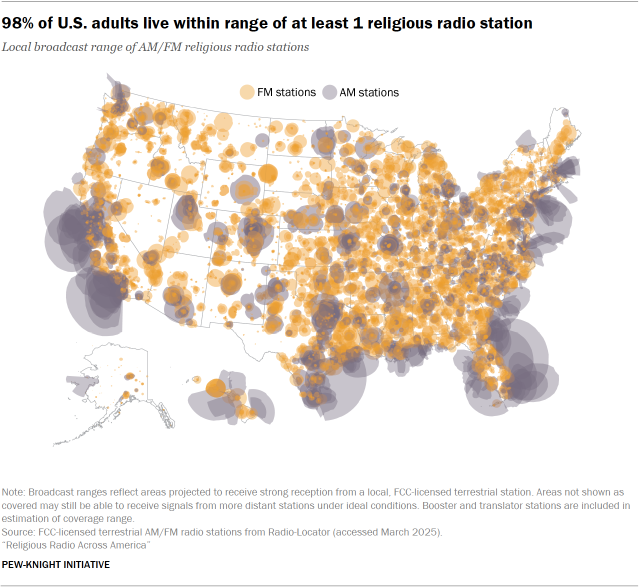
The findings indicate that religious radio stations are strategically distributed across the United States, with both independent and syndicated programming available in every region. Crucially, the Pew Research Center’s analysis demonstrates that an astonishing 98% of U.S. adults live within the local coverage area of at least one religious radio station. On average, individuals can access six different religious broadcasts from their home locations. This extensive reach extends to the nation’s geography, with approximately two-thirds of the entire U.S. landmass and a near-universal 99% of urban areas falling within the broadcast range of at least one religious station.

While urban areas are consistently well-served, the intensity of religious radio coverage varies by region. The South emerges as the region with the highest concentration of religious radio stations, where 87% of the total landmass is covered by at least one such station. This regional concentration aligns with demographic data from the Center’s 2023-24 Religious Landscape Study, which indicates that Southerners tend to identify with religion more frequently than residents of other regions, with 74% reporting religious affiliation, including 68% identifying as Christian.
In contrast, other regions exhibit lower levels of religious radio coverage:
- The Northeast: While urban areas are generally covered, the landmass coverage by religious radio stations is significantly lower, standing at 38%.
- The Midwest: Similar to the Northeast, the Midwest shows moderate coverage, with 66% of its landmass within range of a religious station.
- The West: This region presents the lowest coverage, with only 33% of its landmass accessible by religious radio broadcasts.
State-Level Variations in Religious Radio Presence
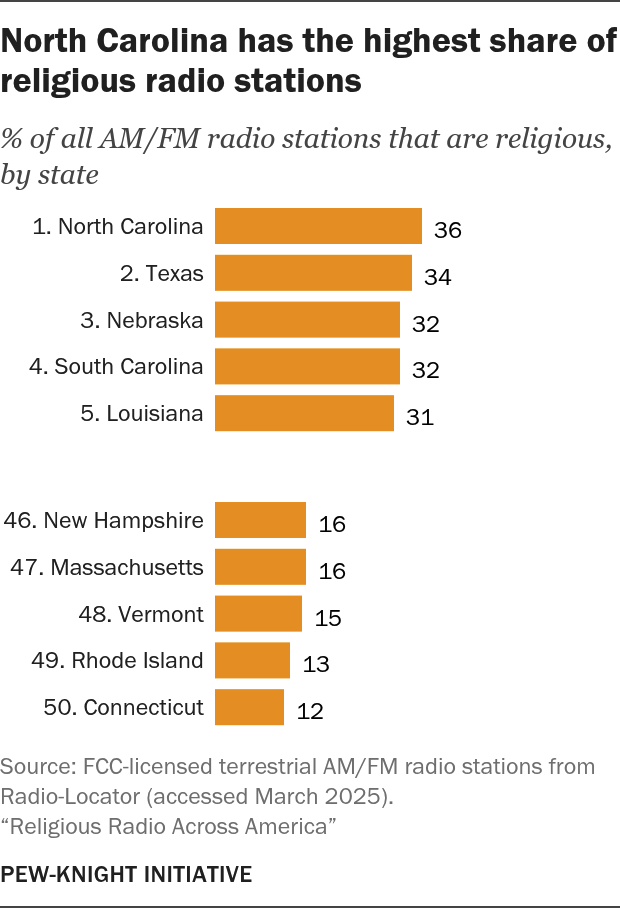
Delving deeper into state-level data reveals considerable disparities in the proportion of religious radio stations. North Carolina leads the nation, with a remarkable 36% of its AM and FM stations dedicated to religious programming. Texas follows closely with 34%, and Nebraska and South Carolina each report 32%. Louisiana rounds out the top five states with 31% of its stations broadcasting religious content.
Conversely, states in the Northeast exhibit the lowest percentages of religious radio stations. Connecticut has the smallest share, with just 12% of its stations being faith-based, followed by Rhode Island at 13%, Vermont at 15%, and Massachusetts and New Hampshire both at 16%.
The median state in the U.S. boasts approximately 76 religious radio stations within its borders. Texas leads in absolute numbers, hosting 433 stations. While the overall percentage of religious stations might be lower in some states, the ratio of religious stations to residents can be higher in states with large geographic areas and dispersed populations. For instance, Wyoming has 6.6 religious stations per 100,000 residents, and Alaska has 7.3, reflecting a strategic approach to serving sparsely populated areas.
Ownership Structures: Consolidation and Independence
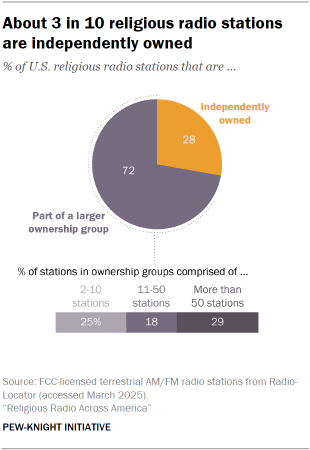
The ownership landscape of religious radio stations reveals a complex interplay between large broadcasting groups and independent entities. Analysis of FCC licenses indicates that a substantial portion of religious radio stations are part of extensive ownership networks. Approximately 30% of these stations belong to large ownership groups, each operating more than 50 individual stations.
The most prominent entity in this category is the Educational Media Foundation (EMF). EMF operates the widely recognized Air1 and K-LOVE radio networks, boasting ownership of hundreds of stations across the country, alongside a significant online streaming platform and a podcast network. This consolidation allows for the syndication of content and a unified brand presence, maximizing reach and influence.
Beyond these large conglomerates, 42% of religious stations are affiliated with small or medium-sized ownership groups. A significant segment, 28% of religious stations, operates independently, meaning they are licensed to an entity that owns no other radio stations. This independent ownership model allows for localized programming and a direct connection to specific community needs and preferences.
A notable distinction emerges when comparing the broadcast practices of religious and nonreligious stations within ownership groups. While similar proportions of both types of stations belong to such groups, religious stations are far more inclined to share broadcast content online. The majority of nonreligious stations that stream online typically do so from unique broadcast URLs, even if their licensee manages multiple stations. In contrast, a typical religious radio station offering a web stream is often one of five stations sharing the same online feed, indicative of a coordinated digital strategy.
Furthermore, many religious radio stations carry popular syndicated programs, regardless of their ownership structure. Shows like "Unshackled" and "Turning Point" are featured on the broadcast schedules of approximately half of all religious radio stations. "Focus on the Family" is broadcast on 44% of these stations. The widespread availability of these syndicated programs underscores a shared commitment to delivering consistent spiritual and faith-based messages across diverse platforms. Importantly, nearly all of these popular syndicated shows are accessible beyond traditional radio waves, with 99 out of the 100 most widely carried programs available on demand through podcasts or platforms like YouTube, further broadening their audience and impact.
Methodology and Research Context
This comprehensive study on religious radio in the U.S. was conducted by Pew Research Center, drawing on three primary data sources to provide a holistic view of station distribution, programming characteristics, and listener motivations. The research was funded by the Pew-Knight Initiative, a program dedicated to supporting research that illuminates how Americans engage with information, form their identities, and participate in civic life. Pew Research Center itself is a nonpartisan, non-advocacy organization committed to informing the public about critical issues, attitudes, and trends shaping the world. The John S. and James L. Knight Foundation, as a social investor, supports initiatives aimed at fostering informed and engaged communities.
The motivation behind this research stems from Pew Research Center’s long-standing dedication to understanding news habits and media consumption patterns. Recognizing that religious radio stations are a significant and accessible source of information for many Americans, the Center sought to provide a detailed analysis of this often-overlooked segment of the media landscape. The study’s methodology, detailed survey questions, and topline responses are publicly available for further examination.
Implications for Media Consumption and Community Engagement
The findings of this study have several significant implications for understanding media consumption and community engagement in the United States. The pervasive reach of religious radio suggests that faith-based broadcasting plays a crucial role in the information diets of a substantial portion of the population. For many, these stations may serve as primary sources of news, spiritual guidance, and community connection. The prevalence of syndicated content indicates a shared set of values and messaging being disseminated across a wide network of stations, potentially fostering a sense of shared identity and purpose among listeners.
The concentration of religious radio in the South, coupled with higher religious identification in that region, highlights the interconnectedness of cultural and media landscapes. As the media environment continues to evolve, the enduring presence and accessibility of religious radio underscore its continued relevance as a platform for communication and community building. The study’s detailed analysis of ownership structures and content syndication also sheds light on the strategic dissemination of faith-based messages and the potential for these networks to influence public discourse and individual beliefs. The accessibility of popular programs through digital channels further emphasizes the adaptability of religious broadcasting in the modern media age, ensuring its continued reach and engagement with diverse audiences.