A comprehensive new report, jointly funded by The Pew Charitable Trusts and the John S. and James L. Knight Foundation through the Pew-Knight Initiative, sheds light on the diverse ways Americans consume religious audio programming and its significance in their lives. The research, based on a survey of 5,023 U.S. adults conducted between June 9 and June 15, 2025, reveals that nearly half of all Americans engage with religious content through various platforms, from traditional AM/FM radio to modern podcasts and streaming services. This in-depth analysis explores the demographics of these listeners, their preferred listening methods, and the underlying motivations that draw them to religious audio content.
The Pew-Knight Initiative, a partnership dedicated to fostering new research on civic information consumption, belief formation, identity development, and community engagement, has once again provided crucial insights into the American public sphere. Pew Research Center, a nonpartisan fact tank, collaborates with Knight Foundation, a social investor focused on building informed and engaged communities, to illuminate complex societal trends. This particular report, "Religious Radio Across America," is a cornerstone of the Pew-Knight Initiative’s ongoing research agenda on news habits and media consumption, highlighting the substantial role religious radio plays within the nation’s media landscape.
Understanding the Landscape of Religious Audio Content
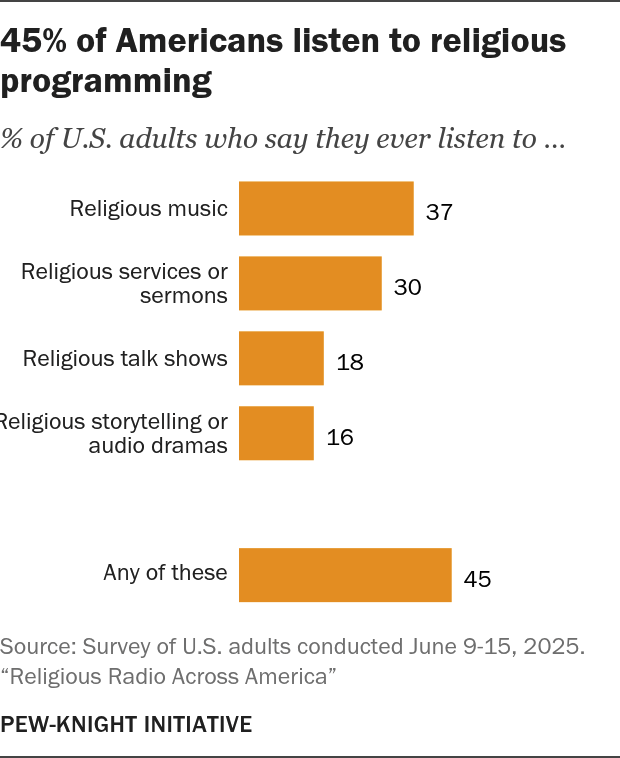
The study delves into the characteristics of religious audio programming, encompassing a wide spectrum of content. This includes religious music, talk shows, live services or sermons, and storytelling or audio dramas. The research aims to understand not only who listens to this content but also the primary reasons behind their engagement. Religious radio stations, with their widespread reach across the United States, represent a significant, though often under-examined, component of the American media ecosystem.
Who Listens to Religious Programming?
The findings indicate that a substantial portion of the U.S. adult population tunes into religious audio programming. Specifically, 45% of Americans report listening to at least one type of religious programming. This engagement varies significantly across different religious and demographic groups.

-
Religious Affiliation: White evangelical Protestants (76%) and Black Protestants (84%) show the highest rates of listening to religious programming. Catholics and White nonevangelical Protestants also demonstrate considerable engagement, with about four-in-ten in each group reporting listening. Interestingly, 39% of those identifying with a religion other than Christianity tune into religious programming, with a notable preference for online platforms over traditional radio. Conversely, religiously unaffiliated individuals, often referred to as "nones," are the least likely to engage, though 18% still report listening.
-
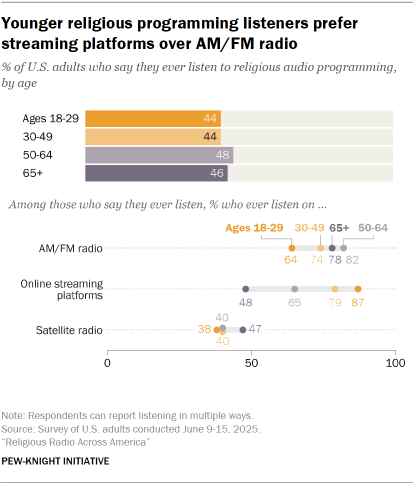
Age and Partisanship: Generational differences in listening habits are apparent. While 44% of adults aged 18 to 49 listen to religious programming, this figure rises slightly to 47% for those aged 50 and older. However, older adults are more inclined to listen to sermons and services. A more pronounced partisan divide exists: 53% of Republicans and Republican-leaning independents listen to religious programming, compared to 38% of Democrats and Democratic leaners. These patterns align with broader trends in religious affiliation, where a larger majority of Republicans (around eight-in-ten) identify with a religion compared to Democrats (around six-in-ten), and a higher proportion of older adults are religiously affiliated.
Preferred Platforms for Religious Audio Consumption
The study highlights the evolving media consumption habits of religious programming listeners. While traditional radio remains a significant platform, digital avenues are increasingly important, especially for younger audiences.
-
Cross-Platform Engagement: Three-quarters of all religious programming listeners (75%) report using AM or FM radio at least occasionally. A comparable share (70%) utilizes online streaming or podcast platforms, and 41% listen via satellite radio.
-
Generational Platform Preferences: A clear generational divide emerges in platform preference. A substantial majority of listeners aged 50 and older (82%) rely on AM or FM radio. In stark contrast, 87% of listeners aged 18 to 29 prefer online streaming platforms. This trend underscores the growing importance of digital media for reaching younger religious audiences.
-
Listening Environments: Regardless of the platform, the most common environments for listening to religious audio programming are at home (93%) and in a car (87%). Public spaces (55%) and workplaces (51%) are also reported listening locations for a significant portion of the audience.
Motivations Behind Listening to Religious Programming
The reasons Americans engage with religious audio content are multifaceted, extending beyond mere religious observance to encompass personal well-being, guidance, and entertainment.
-
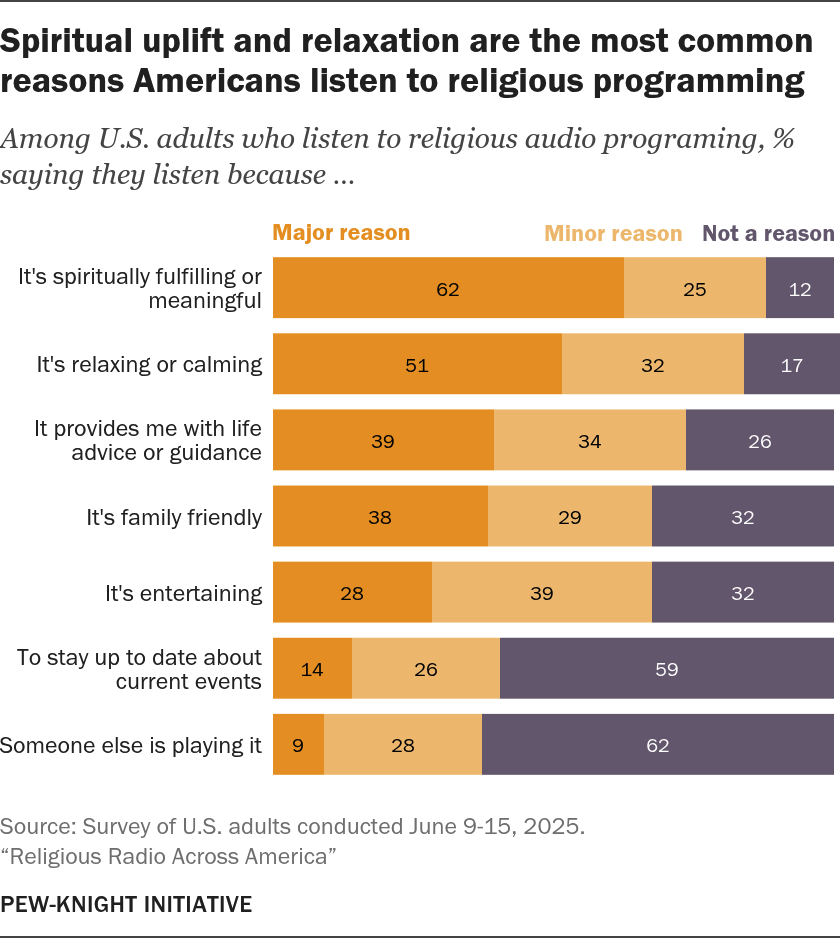
Spiritual and Emotional Benefits: A significant driver for listeners is the pursuit of spiritual fulfillment and emotional well-being. 62% of listeners cite that the programming is "spiritually fulfilling or meaningful" as a major reason for listening, while 51% find it "relaxing or calming." These findings suggest that religious audio content serves as a source of comfort, reflection, and spiritual connection for many.
-
Guidance and Life Advice: A substantial number of listeners turn to religious programming for guidance and advice on navigating life’s challenges. 39% consider receiving "life advice or guidance" a major reason for their listening habits. This indicates a perceived utility of the content in offering practical wisdom and moral direction.
-
Family-Friendly Content and Entertainment: The family-friendly nature of religious programming is a draw for 38% of listeners, making it a comfortable choice for shared listening. Additionally, 28% find the content entertaining, suggesting that religious programming can also offer engaging and enjoyable experiences.
-
Limited Interest in Current Events: In contrast to other media, staying informed about current events is not a primary motivator for listening to religious programming. Only 14% consider it a major reason, and a substantial 59% state it is not a reason for their listening at all.
Impact and Influence of Religious Programming
The engagement with religious audio programming extends beyond passive listening, influencing listeners’ actions and personal lives in various ways.
-
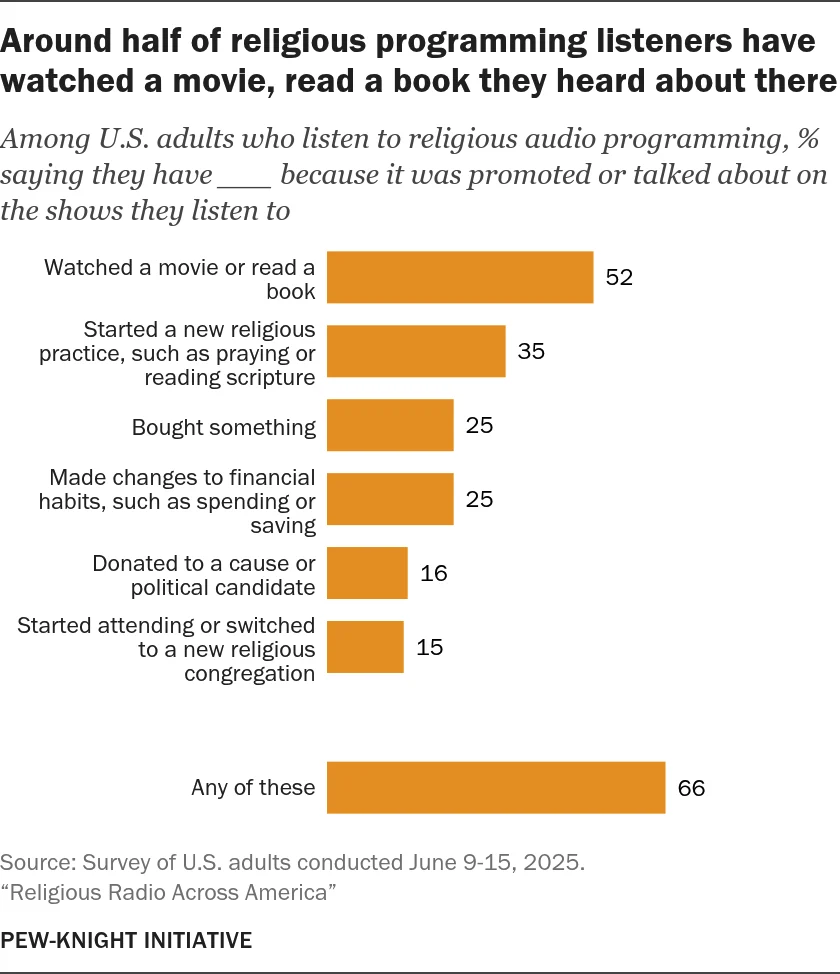
Behavioral Influence: A significant majority of listeners (66%) report taking at least one action as a result of content heard on religious programming. The most common actions include watching a promoted movie or reading a book (52%) and starting a new religious practice, such as praying or reading scripture (35%). A quarter of listeners have purchased something advertised or made changes to their financial habits.
-
Support for Religious Media: Financial support for religious media is prevalent, with 21% of listeners having directly donated to a religious radio station, show, or podcast. This behavior is more common among Republican listeners and White evangelical Protestants, highlighting a strong sense of community and commitment among certain segments of the audience.
-
Alignment of Views: Listeners generally feel that the religious views expressed in the programming align with their own beliefs. 72% report that the content is very or somewhat similar to their personal views, and 74% find it similar to the views of their congregation. However, a notable portion of Democratic listeners (21%) perceive a divergence between the programming’s views and their own, compared to 13% of Republican listeners.
Broader Context and Implications
This research from the Pew-Knight Initiative offers valuable insights into the evolving media consumption patterns of Americans, particularly concerning religious content. The sustained presence and evolving delivery methods of religious audio programming underscore its enduring appeal and its role in shaping spiritual, emotional, and even practical aspects of listeners’ lives.
The findings suggest that religious audio programming serves as more than just a source of spiritual instruction; it acts as a community-building tool, a source of guidance, and a platform for shared values. The generational shift towards digital platforms for accessing religious content highlights the need for religious organizations and broadcasters to adapt their strategies to effectively reach younger demographics. Furthermore, the influence of this programming on consumer behavior and personal practices indicates a significant, albeit subtle, impact on American society.
As religious affiliation and media consumption continue to evolve, understanding these nuanced interactions with religious audio programming becomes increasingly critical for researchers, media producers, and faith leaders alike. The Pew-Knight Initiative’s continued commitment to exploring these vital areas promises to provide further illumination on the dynamic relationship between faith, media, and the American public. The detailed methodology, survey questions, and topline responses are publicly available, allowing for further analysis and exploration of these significant findings.