The U.S. Supreme Court is currently deliberating the constitutionality of an executive order issued by President Donald Trump that seeks to significantly alter the long-standing practice of birthright citizenship in the United States. This pivotal legal challenge, formally known as Trump v. Barbara, centers on an executive action that would deny U.S. citizenship to children born within the nation’s borders if their mothers are unauthorized immigrants or possess legal temporary status at the time of birth, and if the father is neither a U.S. citizen nor a lawful permanent resident. The outcome of this case carries profound implications for immigration policy, national identity, and the interpretation of the U.S. Constitution.
Constitutional Foundation and Historical Context
Birthright citizenship in the United States is rooted in the Citizenship Clause of the 14th Amendment to the Constitution, ratified in 1868. This amendment states, "All persons born or naturalized in the United States, and subject to the jurisdiction thereof, are citizens of the United States and of the State wherein they reside." For over a century, legal scholars and the courts have consistently interpreted this clause to confer citizenship automatically to virtually all individuals born on U.S. soil, irrespective of their parents’ immigration status. This principle, often referred to as jus soli (right of soil), has been a cornerstone of American identity and a powerful magnet for immigration.
The executive order, however, attempts to reinterpret the phrase "subject to the jurisdiction thereof." Proponents of the order argue that individuals present in the U.S. without authorization are not fully "subject to the jurisdiction" of the United States in the same way as citizens or legal residents. This interpretation is contested by a broad consensus of legal experts, who maintain that the historical intent and established legal precedent of the 14th Amendment clearly encompass all individuals born within U.S. territory.
Timeline of the Executive Order and Legal Challenge
The genesis of this legal battle can be traced to President Trump’s persistent questioning of birthright citizenship, particularly concerning children born to undocumented immigrants. He frequently voiced his intention to end this practice, which he characterized as unfair to those who followed legal immigration pathways.
- October 2018: President Trump publicly stated his intention to end birthright citizenship via executive order.
- January 2025: The executive order in question, titled "Protecting the Meaning and Value of American Citizenship," is issued. This order mandates that federal agencies, particularly those involved in birth registration and immigration, deny citizenship to children born in the U.S. under specific parental immigration circumstances. The order specifies that citizenship would be denied if the mother is an unauthorized immigrant or holds temporary legal status, and the father is not a U.S. citizen or lawful permanent resident.
- Early 2026: Legal challenges to the executive order are filed across various federal courts. The Biden administration, inheriting the order, defends its legality.
- Mid-2026: A federal district court rules against the executive order, deeming it unconstitutional. This ruling is appealed.
- Late 2026: The case progresses through appellate courts, with differing opinions emerging. Ultimately, the matter is certified for review by the U.S. Supreme Court.
- April 1, 2027: The U.S. Supreme Court hears oral arguments in Trump v. Barbara. The court’s decision is anticipated to have far-reaching consequences.
Data and Demographics: Understanding the Potential Impact
While the precise number of individuals affected by such a policy shift is difficult to quantify definitively due to the dynamic nature of immigration status and family structures, data from the Pew Research Center provides crucial insights into the demographics involved.
According to Pew Research Center estimates, in 2023, approximately 320,000 babies were born in the U.S. to mothers who were either unauthorized immigrants or held legal temporary status. This figure represents about 9% of the 3.6 million births recorded in the U.S. that year.
Crucially, the executive order’s proposed restrictions would have directly impacted an estimated 260,000 of these births, specifically those where the father was not a U.S. citizen or lawful permanent resident. These numbers highlight the significant scale of potential change, affecting tens of thousands of children annually.
Historical Trends in Births to Unauthorized Immigrant Mothers:

The number of births to unauthorized immigrant mothers has experienced notable fluctuations over the past few decades, often mirroring broader trends in the unauthorized immigrant population.
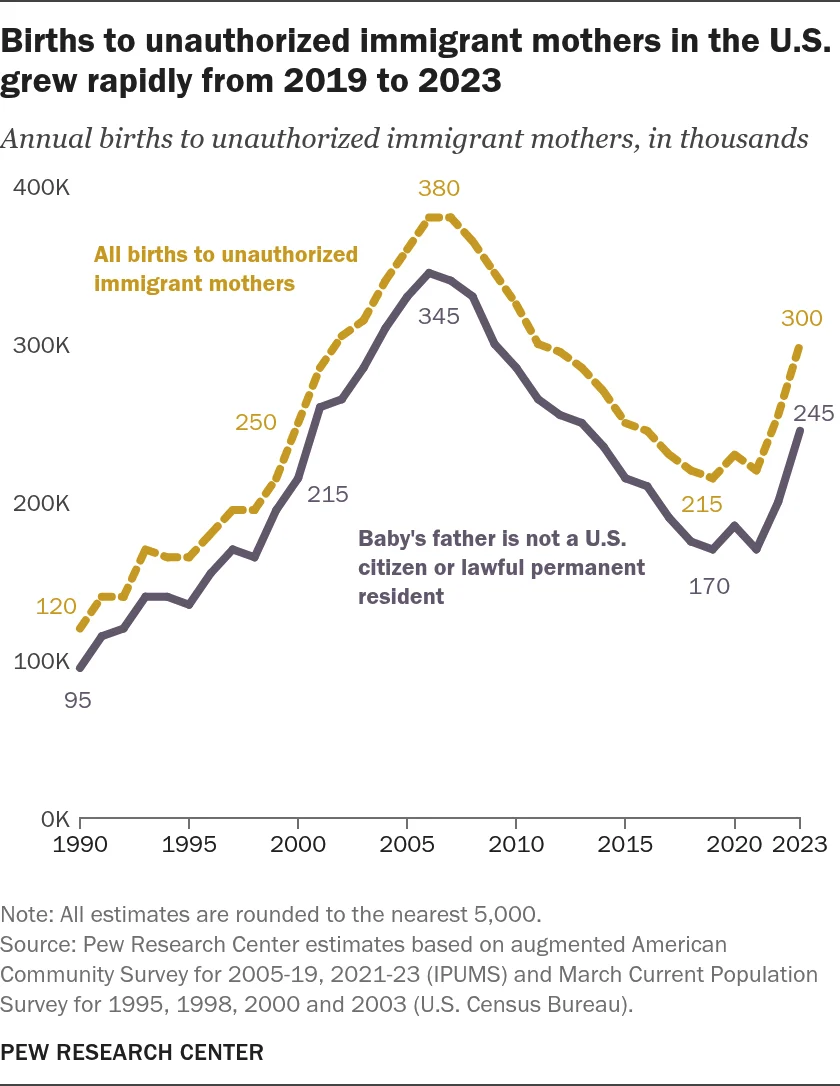
- 1990-2007: During a period of substantial growth in the unauthorized immigrant population, births to unauthorized immigrant mothers more than tripled, rising from approximately 120,000 in 1990 to a peak of around 380,000 in 2006. In 1990, these births constituted about 3% of all U.S. births, a proportion that grew to 9% by 2006.
- 2007-2019: Following the peak, there was a significant decline in births to unauthorized immigrant mothers, dropping by over 40% to approximately 215,000 by 2019. This decrease was attributed to several factors, including a slower growth and eventual decline in the unauthorized immigrant population, an aging of the existing unauthorized population (leading to lower birth rates), and a general decline in U.S. fertility rates.
- 2019-2023: A marked reversal occurred from 2019 to 2023, with annual births to unauthorized immigrant mothers surging to 300,000. This increase directly correlates with a rapid rise in the U.S. unauthorized immigrant population during the same period.
Broader Implications for the U.S.-Born Population:
The potential impact extends beyond immediate newborns. Pew Research Center data indicates that between 2006 and 2023, an estimated 5.1 million children were born to unauthorized immigrant mothers. Of these, nearly 4.4 million had fathers who were not U.S. citizens or lawful permanent residents. If the executive order had been in effect during this period, these children would not have been granted U.S. citizenship at birth.
As of 2023, an estimated 4.6 million children born in the U.S. were living with at least one unauthorized immigrant parent. An additional 1.4 million U.S.-born adults lived with at least one unauthorized immigrant parent, bringing the total to over 6 million individuals. A significant portion of these individuals—3 million children and 1 million adults—do not have a father with legal residency status. These are U.S. citizens by birth, but under the proposed policy, they would represent a substantial addition to the unauthorized population if their citizenship were revoked.
Births to Mothers with Legal Temporary Status:
The executive order also addresses children born to mothers with legal temporary immigration status. Births to this group have remained relatively stable, hovering between 15,000 and 30,000 annually since the late 1990s, with 20,000 births in 2023. These categories include foreign students, temporary workers, and individuals on various other visas.
A subset of these births, estimated at around 9,000 in 2023 according to National Center for Health Statistics data, involves mothers who are residents of foreign countries and come to the U.S. specifically to give birth, often referred to as "birth tourists." These births are generally not included in the count of births to mothers with legal temporary status residing in the U.S. For mothers with legal temporary status who are residing in the U.S., the status of their children at birth, under the proposed order, would be contingent on the father’s status. Given the temporary nature of their own status, many of these children might not retain a pathway to long-term residency in the U.S.
Legal Arguments and Potential Outcomes:
The Supreme Court’s deliberation will likely focus on the interpretation of the 14th Amendment and the scope of executive authority.
- Arguments for Upholding the Executive Order: Supporters of the order emphasize the principle that citizenship should be a reward for adherence to immigration laws. They argue that the phrase "subject to the jurisdiction thereof" implies a lawful presence and commitment to U.S. laws, which they contend is absent in the case of unauthorized immigrants. They may also cite historical instances where citizenship was not automatically granted to certain groups, such as Native Americans before specific legislation.
- Arguments Against the Executive Order: Opponents, including a vast majority of legal scholars and immigration advocacy groups, argue that the 14th Amendment’s language is clear and intentionally broad to prevent the creation of a stateless underclass. They point to landmark Supreme Court cases like United States v. Wong Kim Ark (1898), which affirmed birthright citizenship for children born in the U.S. to Chinese parents who were lawfully resident merchants, as a crucial precedent. They warn that revoking birthright citizenship would undermine fundamental constitutional principles, create immense social and economic disruption, and potentially lead to statelessness for millions.
Reactions and Broader Societal Impact:
The debate surrounding birthright citizenship has ignited strong reactions across the political spectrum and within various communities.
- Proponents of the Executive Order: Often express concerns about national sovereignty, border security, and the perceived strain on social services. They argue that ending birthright citizenship for children of unauthorized immigrants would act as a deterrent to illegal immigration.
- Opponents of the Executive Order: Emphasize humanitarian concerns, the constitutional rights of individuals, and the potential for widespread social injustice. They warn of a future where a significant segment of the population born in the U.S. could be rendered stateless or face perpetual uncertainty regarding their legal status. This group includes civil rights organizations, religious leaders, and many business groups who rely on a stable workforce.
- Public Opinion: Polls have consistently shown a divided public on the issue. While a majority generally supports birthright citizenship, there is a notable segment of the population, particularly among certain political affiliations, that favors restricting it for children of unauthorized immigrants. This division underscores the contentious nature of immigration policy in the United States.
The Supreme Court’s decision in Trump v. Barbara will not only determine the immediate future of birthright citizenship but also send a powerful message about the evolving interpretation of the U.S. Constitution and the nation’s commitment to inclusivity. The case represents a critical juncture in the ongoing national conversation about immigration, identity, and the very definition of American citizenship. The justices’ ruling is expected to have profound and lasting effects on millions of lives and the future demographic landscape of the United States.