The Pew-Knight Initiative, a collaborative effort by The Pew Charitable Trusts and the John S. and James L. Knight Foundation, has released a comprehensive study examining the landscape of religious radio programming across the United States. The research delves into the characteristics of AM and FM stations that primarily broadcast faith-based content, the music they feature, and the demographics and motivations of their listeners. This in-depth analysis, funded by a partnership dedicated to fostering informed and engaged communities, provides a nuanced understanding of a significant, yet often overlooked, segment of the American media ecosystem.
The Pew Research Center, known for its nonpartisan and nonadvocacy approach to informing the public on critical issues, attitudes, and trends, undertook this study as part of its ongoing commitment to researching news habits and media consumption. Religious radio stations, accessible in most parts of the country, represent a substantial portion of the nation’s media environment. Understanding the content they offer and who tunes in is therefore crucial for a complete picture of how Americans engage with information and entertainment.
Methodology: A Multi-faceted Approach to Understanding Religious Radio
To construct a comprehensive overview of religious radio, the Pew Research Center employed a robust methodology, drawing from three primary data sources. This multifaceted approach allowed for a broad examination of station distribution, programming content, and listener preferences.
The study’s findings are derived from an extensive analysis of radio programming and listener surveys. Specifically, researchers collected data on over 300,000 songs played on religious stations in July 2025, utilizing the AudD music recognition API to identify artists and genres. This allowed for a detailed examination of the musical landscape of religious radio. Furthermore, the report incorporates data on the content and characteristics of FCC-licensed terrestrial AM/FM religious radio stations, providing a broad look at the stations themselves. Finally, listener surveys were conducted to understand audience demographics and the reasons individuals choose to tune into religious programming. The full questionnaire, detailed responses, and methodology are available for public review, underscoring the study’s commitment to transparency.
The Dominance of Music in Religious Radio Programming
Music forms the bedrock of the American experience with religious programming. The Pew research indicates that approximately 37% of U.S. adults report listening to religious music, highlighting its significant appeal. Across the nation’s religious radio stations, music occupies a substantial portion of airtime, accounting for around half of all programming.

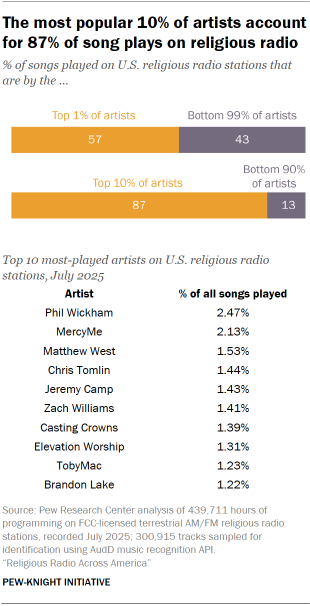
The analysis of over 300,000 songs played on these stations revealed a diverse musical output, featuring nearly 14,000 distinct artists and a wide array of Christian music genres, alongside some non-Christian offerings. However, despite this breadth, a significant concentration of airplay is directed towards a relatively limited selection of genres and artists. Listeners are most likely to encounter contemporary Christian music (CCM) and worship music. Strikingly, a mere 10 artists were responsible for 16% of all songs played during the study period.
Genre Breakdown: A Deep Dive into Musical Preferences
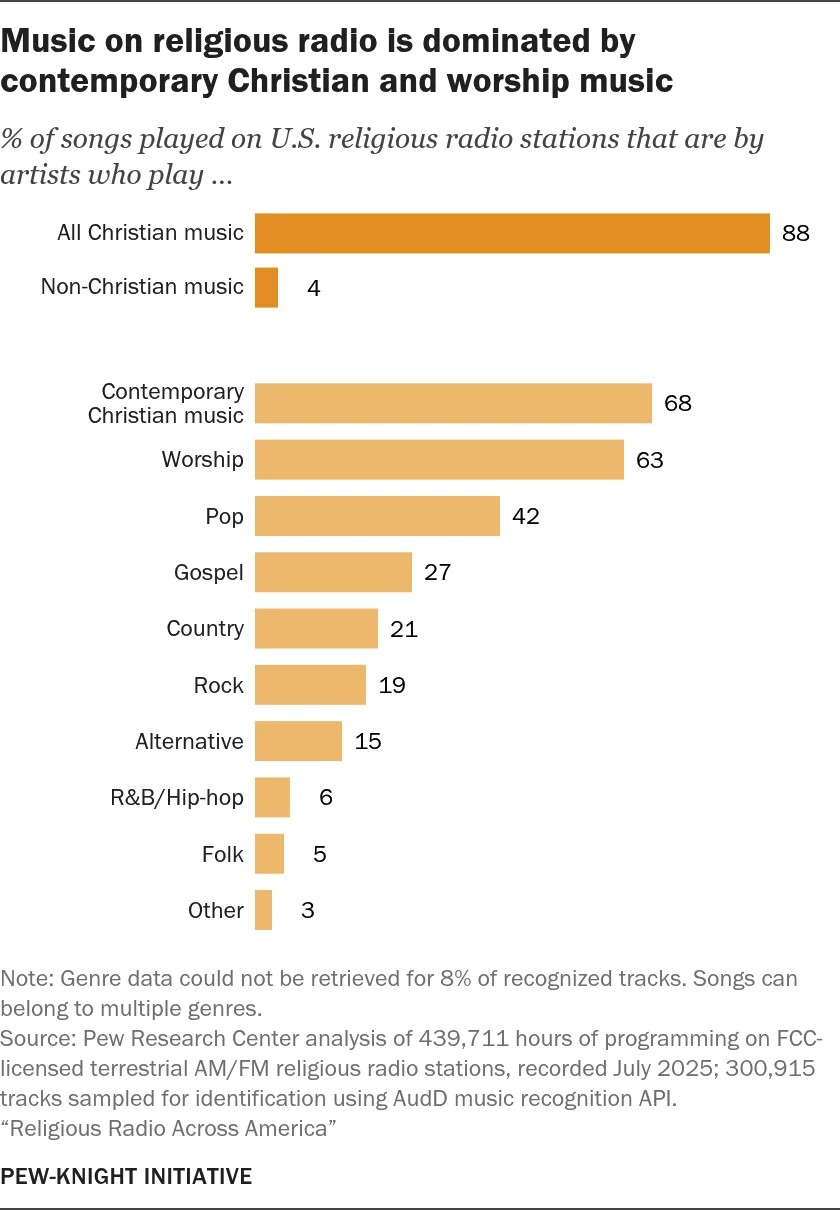
The vast majority of music broadcast on U.S. religious radio stations, an impressive 88%, can be categorized as Christian music. Non-Christian music represents a much smaller fraction, accounting for only 4% of the analyzed tracks. The remaining 8% could not be definitively categorized by genre.
Within the Christian music umbrella, contemporary Christian music (CCM) and worship music emerge as the dominant forces, with approximately 68% and 63% of songs, respectively, falling into these categories. Other prominent genres include Pop (42%), Gospel (27%), Country (21%), and Rock (19%). Alternative music also registers a notable presence at 15%. Genres like R&B/Hip-hop (6%), Folk (5%), and "Other" (3%) represent smaller but still present components of the religious radio music landscape.
It is important to note that many artists on religious radio are versatile, performing across multiple genres. The most frequent genre combinations include CCM/worship and CCM/pop.
Regional differences in musical programming were also identified. Stations in the Southern United States exhibit a stronger inclination towards gospel music, with 41% of their song plays featuring gospel artists, compared to 20% in other regions. Similarly, Christian country music is more prevalent in the South, making up 30% of song plays, versus 17% elsewhere. Consequently, Southern stations tend to feature less worship, pop, and rock music than their counterparts in other parts of the country.
The Concentration of Airtime: A Few Artists Dominate

The study’s findings underscore a significant trend of artist concentration on religious radio. While nearly 14,000 artists were identified in the sampled music, the airtime is heavily skewed towards a select group of popular performers. The top 10 artists alone accounted for 16% of all song plays in July 2025. This elite group includes prominent contemporary Christian artists such as Phil Wickham, Matthew West, and the band MercyMe. Phil Wickham, in particular, received more airtime than any other artist during the studied month, representing approximately 2.5% of all song plays. His tracks were also notably present on the Billboard Christian Airplay chart during this period.
The dominance of these top artists is further emphasized by their longevity in the music industry. All but one of the top 10 artists had been releasing music prior to 2010, with several boasting careers that extend back to the 1990s or even earlier. This suggests a strong preference for established artists within the religious radio format.
In contrast, the remaining 90% of artists collectively accounted for a mere 13% of song plays, highlighting the significant disparity in exposure. This concentration of airtime suggests that while the genre may feature a broad spectrum of artists, listener engagement and station programming decisions tend to favor a core group of well-known performers.
Programming Rhythms: When Music Takes Center Stage
Across all U.S. religious radio stations, music constitutes 52% of the total programming time. However, the proportion of music listeners hear can vary depending on the time of day. Music is most prominent during the evening hours, from 7 p.m. to midnight, when it comprises 60% of all broadcast content. Conversely, music is least prevalent during the morning drive time slot (6 a.m. to 10 a.m.), making up only 47% of broadcast time.
The nature of religious radio programming is not monolithic. A substantial portion of stations, 37%, focus primarily on music. Another significant segment, 35%, dedicates the majority of their airtime to talk programming. The remaining 28% offer a more balanced mix of talk and music.
Stations that feature an even split between talk and music tend to maintain this balance throughout the day. However, even these stations see a marked increase in music programming during the evening hours, with music content rising to 71% of their broadcast time between 7 p.m. and midnight. This pattern suggests a strategic programming approach, where music serves as a primary draw during specific listening periods, particularly in the evenings.
Implications and Broader Context
The Pew-Knight Initiative’s research offers valuable insights into the media consumption habits of a significant segment of the American population. The strong reliance on established artists and dominant genres within religious radio programming suggests a landscape that prioritizes familiarity and a consistent message. This may reflect a desire among listeners for content that aligns with their faith and values, delivered by artists they know and trust.
The study also highlights the potential for greater diversity and emerging artists within the religious music sphere. While the current landscape favors established acts, the sheer number of artists identified indicates a vibrant creative community. Future research could explore the pathways for new artists to gain traction on religious radio and the potential impact of greater genre diversification on listener engagement.
Furthermore, the findings provide a crucial benchmark for understanding the role of religious media in shaping beliefs, identities, and community engagement, which are central to the Pew-Knight Initiative’s overarching mission. As Americans navigate an increasingly complex media environment, understanding the specific niches like religious radio offers a window into how diverse communities access and process information relevant to their lives and values. The research serves as a vital resource for broadcasters, artists, policymakers, and the public interested in the multifaceted ways faith is communicated and experienced through media. The ongoing work of the Pew-Knight Initiative promises to continue shedding light on these critical aspects of American civic life.