A comprehensive new report from the Pew Research Center reveals a significant public perception of evolving global influence, with Americans observing shifts in the power of both the United States and other major world players. The survey, conducted in March 2026 among 3,507 U.S. adults, highlights a complex and often divided American view on the current world order and the nation’s place within it. The findings underscore a period of considerable flux, marked by differing interpretations of national strength and influence across the political spectrum.
Methodology and Scope of the Research
The Pew Research Center’s report, "American Views on the Global Power Landscape," aims to provide the public, media, and policymakers with a deeper understanding of how Americans perceive the United States’ role in the world and the potential changes in its influence. This analysis builds upon decades of prior survey research by the Center, offering a nuanced look at evolving public sentiment. The data was gathered from March 23 to 29, 2026, utilizing the Pew Research Center’s American Trends Panel, a nationally representative sample of U.S. adults. The full questionnaire, detailed responses, and survey methodology are publicly available, ensuring transparency in the research process.
Perceptions of Shifting Global Influence
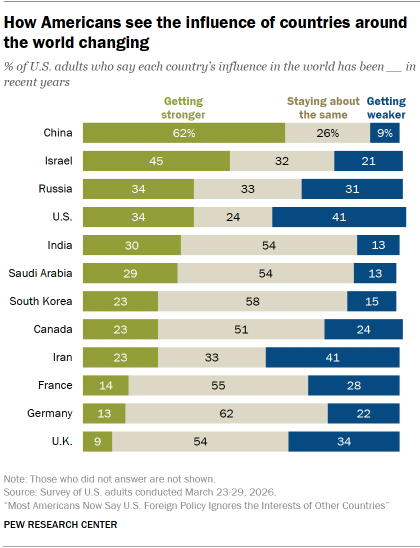
The core of the report lies in Americans’ assessments of the changing influence of twelve key countries. The survey asked participants whether each nation’s global influence had been growing stronger, weakening, or remaining about the same in recent years. The results paint a picture of a world in motion, with few countries perceived as static in their international standing.

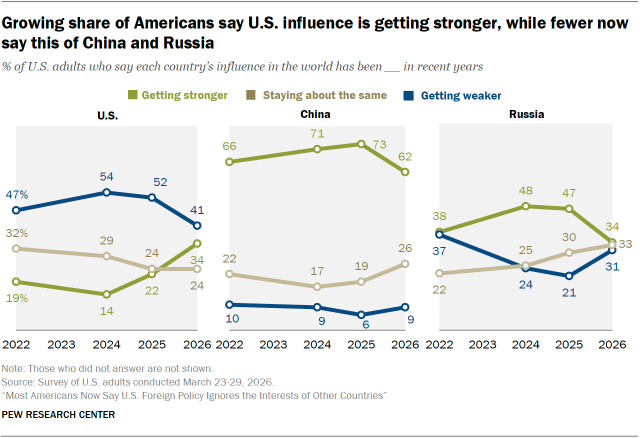
A central finding is the divergence in how Americans view the United States’ own influence. While the most common sentiment expressed is that U.S. influence has been weakening, the proportion of Americans holding this view has decreased by 11 percentage points since 2025. Concurrently, there has been a notable rise in the number of Americans who believe U.S. influence is strengthening. This shift is particularly pronounced among Republicans.
The Republican Shift: Renewed Confidence in U.S. Strength?
The data reveals a significant recalibration of views among Republicans and Republican-leaning independents. In the current survey, Republicans are substantially more likely to assert that U.S. influence is growing stronger compared to previous years, a sentiment that has not been as prevalent since the Pew Research Center began tracking this specific question in 2022. Conversely, the proportion of Republicans who believe U.S. influence is weakening has declined considerably. This suggests a potential resurgence of optimism regarding America’s global standing within the Republican base, potentially influenced by recent geopolitical developments or a shift in perceived national leadership effectiveness.
China and Russia: A Shifting Narrative
The perceptions of China and Russia’s global influence also show marked changes. While a majority of Americans (62%) still believe China’s influence is growing, this figure represents a decrease from previous years. This softening sentiment suggests that challenges or setbacks faced by China, or perhaps increased scrutiny of its global activities, may be impacting American public perception.
Russia’s perceived influence has also seen a decline in the view that it is strengthening. Americans are now 13 percentage points less likely to hold this opinion compared to 2025. The perception of Russia’s global standing has become more evenly distributed, with roughly one-third of Americans now believing its influence is growing, weakening, or staying the same. This fragmentation of opinion on Russia may reflect a more complex understanding of its capabilities and limitations, or perhaps a more cautious approach to assessing its long-term trajectory.
Partisan Divides: A Deepening Chasm
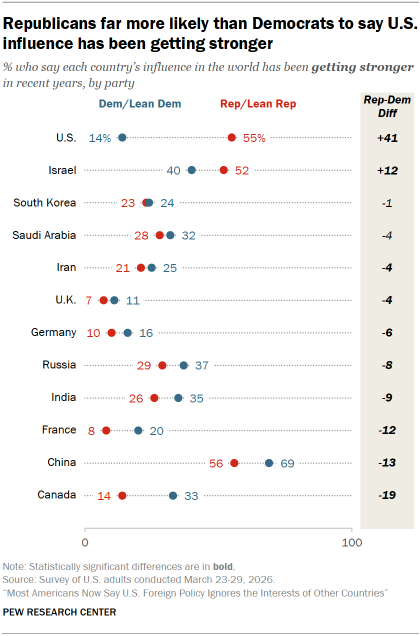
The report starkly illustrates the partisan divide in how Americans interpret global power dynamics. The most significant divergences are observed when assessing the influence of the United States itself. As noted, a substantial majority of Republicans (55%) believe U.S. influence is strengthening, a stark contrast to the 14% of Democrats and Democratic-leaning independents who share this view. This disparity highlights a fundamental difference in how the two major parties perceive the nation’s current standing and its future prospects on the world stage.
Beyond the U.S., Republicans are also more inclined to believe that Israel’s influence is growing. This observation is particularly pronounced among Republicans aged 65 and older, with 62% of this demographic seeing Israel’s influence strengthening, a significantly higher proportion than observed in any other age group across both parties.
In contrast, Democrats tend to express a more expansive view of growing influence for a wider array of countries, encompassing both traditional allies and perceived adversaries. However, even within this group, China is the only nation among a select group of six (which also includes Canada, France, Germany, Iran, and Russia) where a majority of Democrats perceive its influence as strengthening.
Evolving Partisan Ratings: A Look at Trends
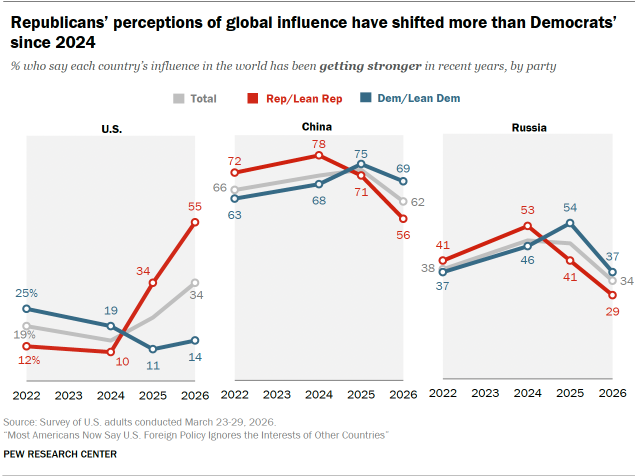
The shifts in perception are not merely static snapshots but reveal dynamic changes over time. While ratings for several countries are moving in broadly similar directions across parties, the magnitude of these shifts varies significantly, with Republicans demonstrating more pronounced changes in their views, particularly since the end of the Biden administration.
The proportion of Republicans who believe U.S. influence is growing has surged by 21 percentage points since last year and a remarkable 45 percentage points since 2024. In contrast, the increase among Democrats has been a more modest 3 percentage points since last year, and their perception has actually decreased since the Biden administration. This suggests a potential recalibration of Republican perspectives, possibly influenced by the current political climate or specific policy initiatives.
Similar trends are evident in views on China. Among Republicans, the percentage who believe China’s influence is strengthening has dropped by 22 percentage points since 2024, to 56%. While the proportion of Democrats viewing China as strengthening has also decreased from its 2025 peak, their current perception is roughly equivalent to that of two years ago.
Russia’s perceived influence shows a comparable pattern. The share of Democrats who believed Russia’s influence was strengthening peaked at 54% in 2025 before declining to 37% in the current survey. However, looking at the broader two-year trend, Republicans have experienced a more substantial shift, with the percentage who see Russia strengthening falling by 24 percentage points since 2024.
Regarding Iran, Republicans are now 22 percentage points more likely to state that its influence is weakening compared to 2025. Democrats also show an increased likelihood of perceiving Iran’s influence as weakening, although the change is less pronounced at 6 percentage points.
Ideological Nuances Within Partisan Blocs
The Pew report further dissects these perceptions by examining ideological differences within both Republican and Democratic parties. Among Republicans, it is conservative Republicans who are particularly likely to believe that the global influence of the United States and Israel is strengthening. This suggests a strong alignment between conservative ideology and a perception of enhanced American and Israeli power.
Conservative Republicans also exhibit a greater tendency to view the influence of European powers as waning. While a majority of Americans perceive the United Kingdom’s influence as remaining stable, approximately half of conservative Republicans believe it has been weakening. This indicates a potential skepticism towards traditional European alliances or a perception that these nations are not keeping pace with emerging global powers.
Within the Democratic party, liberal Democrats distinguish themselves from their more moderate and conservative counterparts. They are more likely to perceive a strengthening influence for Saudi Arabia, India, and Israel. Conversely, liberal Democrats are more inclined than other Democrats to believe that the United States’ own global influence has weakened in recent years, with 72% holding this view compared to 56% of moderate and conservative Democrats. Mirroring the conservative Republican perspective, liberal Democrats also express a greater likelihood of seeing the U.K.’s influence slipping.
Age as a Factor in Global Influence Perceptions
Age also emerges as a significant variable in how Americans perceive the global influence of various nations. While the specific data points are detailed in accompanying charts, the general trend suggests that older demographics may hold different views on the trajectory of global powers compared to younger generations. This could be attributed to differing life experiences, historical contexts, and exposure to global events throughout their lives. For instance, the strong perception of U.S. and Israeli strengthening among older Republicans hints at a potential correlation between age and a more traditionalist or nationalistic view of global power dynamics.
Implications for U.S. Foreign Policy and Public Discourse
The Pew Research Center’s findings provide critical insights into the evolving American psyche regarding international affairs. The perceived shifts in global influence, particularly the nuanced and often contradictory views on the United States’ own standing, have significant implications for U.S. foreign policy formulation and public discourse.
The strong partisan divergence on U.S. influence suggests that domestic political considerations will continue to play a pivotal role in shaping foreign policy debates. Any administration will need to navigate these deeply entrenched divisions to build consensus and project a unified vision on the international stage. The differing perceptions of China and Russia also indicate that Americans are not monolithic in their assessment of key geopolitical rivals, underscoring the need for targeted communication and strategic engagement.
Furthermore, the report’s emphasis on ideological and age-related differences within partisan blocs highlights the complexity of American public opinion. Policymakers must consider these granular distinctions to craft effective strategies that resonate with diverse segments of the electorate. As the global landscape continues to transform, understanding these perceptions will be crucial for the United States to effectively chart its course and maintain its influence in a multipolar world. The ongoing dialogue about America’s role and its place among rising and evolving global powers will undoubtedly remain a central theme in both domestic politics and international relations for the foreseeable future.