More than four years after Russia’s full-scale invasion of Ukraine, American public opinion regarding the ongoing conflict remains deeply divided along partisan lines, according to a comprehensive new survey by the Pew Research Center. The report, released on April 23, 2026, reveals persistent disagreements between Republicans and Democrats on the appropriate level of U.S. support for Ukraine, confidence in leadership, and the overall perception of Russia’s role on the global stage. The findings underscore the complex and evolving landscape of American foreign policy engagement in a protracted international crisis.
The survey, conducted from March 23 to 29, 2026, with 3,507 U.S. adults, builds upon previous Pew Research Center analyses of American views on Russia and Ukraine. This latest data provides a critical snapshot of public sentiment as the conflict enters its fifth year, highlighting shifts and continuities in a matter of significant geopolitical importance.
American Public Divided on U.S. Support for Ukraine
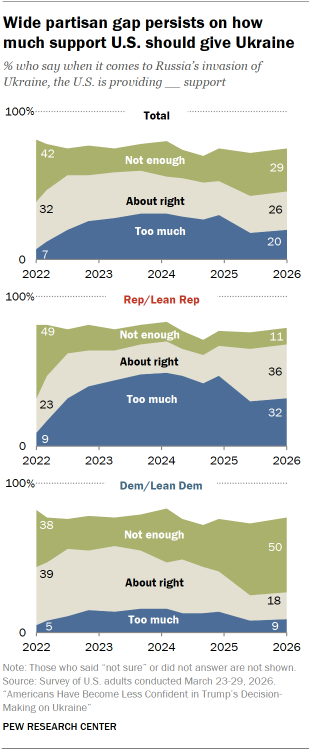
A central finding of the Pew Research Center report is the stark partisan divergence on the question of U.S. aid to Ukraine. Americans express mixed views on the extent of support their country should provide, with nearly a quarter (26%) believing the U.S. is offering about the right amount. However, a significant portion (29%) feel that Ukraine is not receiving enough support, while 20% contend that the U.S. is providing too much.

This distribution reveals a widening chasm between political ideologies. Democrats and Democratic-leaning independents are substantially more likely than their Republican counterparts to advocate for increased assistance. Specifically, 50% of Democrats believe the U.S. is not providing enough support to Ukraine, a figure more than four times higher than the 11% of Republicans who share this sentiment. This disparity in views has been a consistent feature of American public opinion on the war, with the gap widening significantly in 2025 and maintaining its breadth into 2026.
Conversely, Republicans and Republican-leaning independents are more inclined to express concern about the level of U.S. involvement. The 20% of all Americans who feel the U.S. provides too much support is largely concentrated within the Republican base. This sentiment regarding excessive support has remained relatively stable since August 2025, though it has seen a slight decrease from February 2025, when 30% of all Americans held this view.
The data suggests that the duration of the conflict, now spanning over four years since Russia’s initial invasion in February 2022, has not led to a broad consensus on U.S. policy. Instead, pre-existing political fault lines appear to be reinforcing and exacerbating differing perspectives on America’s role in global conflicts.
Confidence in Leadership: Trump vs. Zelenskyy
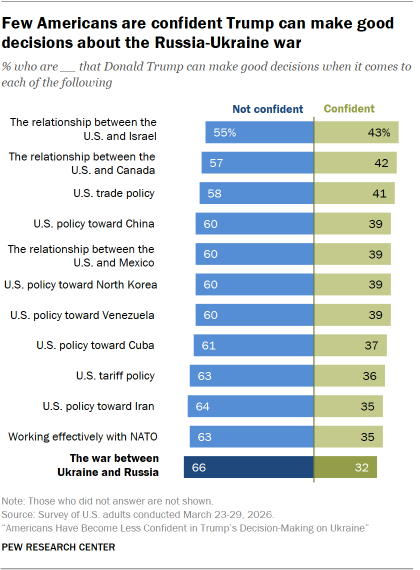
The survey also delves into the confidence Americans place in key leaders involved in the conflict, revealing significant partisan divides once again. When it comes to former President Donald Trump’s decision-making regarding the Russia-Ukraine war, confidence levels are notably low. Overall, approximately two-thirds of Americans (66%) express a lack of confidence in Trump’s ability to make sound decisions on this issue. This places his handling of the Russia-Ukraine war among the lowest-rated foreign policy challenges he has faced, according to the Pew Research Center’s broader analysis of his foreign policy decision-making.
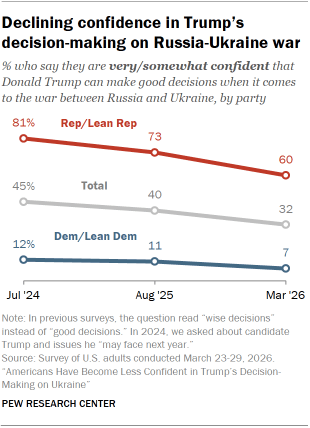
Only about a third of U.S. adults (32%) report being at least somewhat confident in Trump’s capacity to navigate the complexities of the war. This confidence is heavily skewed along party lines: a substantial 60% of Republicans express confidence, a stark contrast to the mere 7% of Democrats who feel the same. Conservative Republicans, in particular, show a higher degree of confidence (68%) compared to their moderate and liberal counterparts (46%).
The report indicates a decline in overall confidence in Trump’s handling of the war. While 40% expressed high confidence in August 2025, this figure has dropped to 32% by March 2026, a decrease observed among both Republicans (-13 percentage points) and Democrats (-4 points). This erosion of confidence, even within his own party, suggests a growing skepticism or perhaps a fatigue with the prolonged nature of the conflict and its perceived outcomes under his potential leadership.
In contrast, Ukrainian President Volodymyr Zelenskyy garners more confidence among U.S. adults, though partisan differences persist. Half of U.S. adults express confidence in Zelenskyy to act appropriately in world affairs, while 40% lack confidence. Notably, 9% of respondents indicated they had never heard of the Ukrainian leader, a figure that warrants attention in terms of public awareness.
While Democrats (69%) remain significantly more likely than Republicans (34%) to express confidence in Zelenskyy, the Republican view has seen a slight positive shift since the previous year, gaining 4 percentage points. The confidence levels among Democrats have remained relatively stable. This indicates that while partisan affiliations still heavily influence perceptions, there might be a subtle recalibration in how Republicans view the Ukrainian leader, potentially influenced by ongoing developments in the war and international diplomacy.
Personal Salience of the Conflict
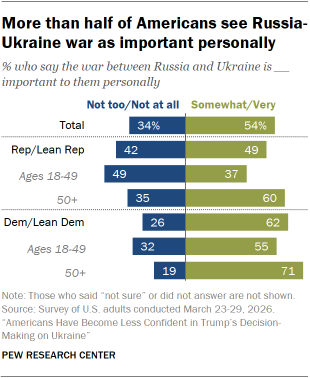
The survey also probes the degree to which the Russia-Ukraine war is perceived as personally important by Americans. A majority (54%) state that the war holds at least some personal importance, while 34% feel it does not. A smaller segment (12%) remains unsure.
Interestingly, the proportion of Americans who consider the war personally important has seen a slight decrease from 2024 (59%) to 2026 (54%). However, the period between 2025 and 2026 showed no significant change in this regard.
Partisanship plays a role here as well, with Democrats (62%) more likely than Republicans (49%) to deem the conflict personally significant. Age also emerges as a factor within these partisan groups. Older Democrats (50 and older) are more likely to feel the war’s personal importance (71%) than younger Democrats (18-49, 55%). Similarly, older Republicans (60%) express a stronger sense of personal importance compared to younger Republicans (37%). This suggests that generational perspectives and potentially differing life experiences contribute to how individuals connect with distant geopolitical events.
Evolving Perceptions of Russia
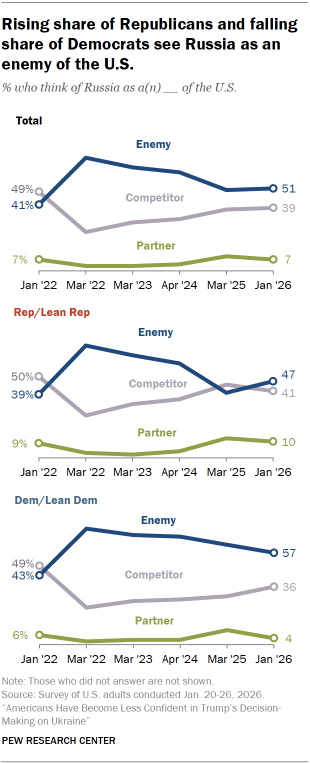
The Pew Research Center’s findings also shed light on how Americans perceive Russia’s role in the international arena. In a separate survey conducted in late January 2026, a plurality of Americans (51%) identified Russia as an enemy of the U.S. A substantial 39% viewed Russia as a competitor, and a smaller fraction (7%) considered it a partner.
These figures have remained largely consistent year-over-year. However, the partisan divide regarding Russia as an enemy has narrowed. While previously standing at 22 percentage points, the gap has now reduced to 10 points. This shift is attributed to an increase in Republicans viewing Russia as an enemy (from 40% to 47% over the past year) while Democrats have shown a slight decrease in this sentiment (from 62% to 57%).
This evolving perception among Republicans is significant. For the first time since 2024, more Republicans now classify Russia as an enemy rather than a competitor. This suggests a hardening stance towards Russia within the Republican base, potentially influenced by ongoing Russian aggression and its perceived threat to international stability.
Conversely, younger Americans, defined as those under 50, appear to hold slightly less adversarial views of Russia compared to their older counterparts. Forty percent of adults under 50 view Russia as an enemy, in contrast to 62% of those aged 50 and older. This generational difference could reflect varying exposure to historical narratives, differing priorities in foreign policy, or a general tendency for younger demographics to perceive international relations in more nuanced, less confrontational terms.
Overarching Negative Sentiment Towards Russia and Putin
The overwhelmingly negative sentiment towards Russia and its leadership is a consistent theme across the survey data. A substantial 83% of U.S. adults hold an unfavorable view of Russia, a sentiment shared by large majorities within both Republican and Democratic parties.
Similarly, opinions regarding Russian President Vladimir Putin remain deeply negative. Large majorities across the political spectrum express little to no confidence in Putin’s ability to act appropriately on the world stage. These unfavorable views of both Russia and Putin have remained remarkably stable over the past year and have been consistently negative since well before the full-scale invasion of Ukraine. This sustained disapproval underscores a deep-seated distrust and opposition to Russia’s current trajectory and leadership within the American public.
Context and Methodology
The Pew Research Center’s commitment to understanding public opinion on critical global issues is evident in the detailed methodology behind this report. The survey on U.S. views of the Russia-Ukraine war was conducted among 3,507 adults who are members of the Center’s American Trends Panel, a nationally representative online survey group. The data aims to reflect the views of the entire U.S. adult population.
Views on Russia as a partner, enemy, or competitor were derived from an earlier survey of 8,512 U.S. adults conducted between January 20 and January 26, 2026. This approach allows for a comprehensive understanding of the nuances in public perception, linking general attitudes towards the conflict with specific views on key actors and their policies. The detailed questionnaire, topline responses, and full survey methodology are publicly available, ensuring transparency and allowing for further academic and public scrutiny.
Implications and Future Outlook
The findings of this Pew Research Center report carry significant implications for U.S. foreign policy and political discourse. The persistent partisan divide on Ukraine support suggests that any sustained U.S. commitment to the conflict will continue to be a point of political contention. This division could impact the predictability and consistency of U.S. aid and diplomatic engagement, potentially influencing the strategic calculations of both Ukraine and Russia.
The differing levels of confidence in Trump and Zelenskyy also highlight the impact of leadership perceptions on public opinion. As the U.S. political landscape evolves, these confidence metrics will be crucial indicators of public willingness to support specific foreign policy approaches.
The hardening of views towards Russia among Republicans, coupled with the consistent broad disapproval of both the country and its leadership, indicates a strong consensus on the adversarial nature of the U.S.-Russia relationship. However, the nuanced generational differences in these perceptions may foreshadow future shifts in foreign policy attitudes as younger demographics gain greater influence.
As the war in Ukraine continues to be a defining geopolitical event of the early 21st century, understanding these evolving American public opinion trends is vital for policymakers, international observers, and the broader public alike. The Pew Research Center’s ongoing work provides an indispensable resource for navigating this complex and consequential international challenge.