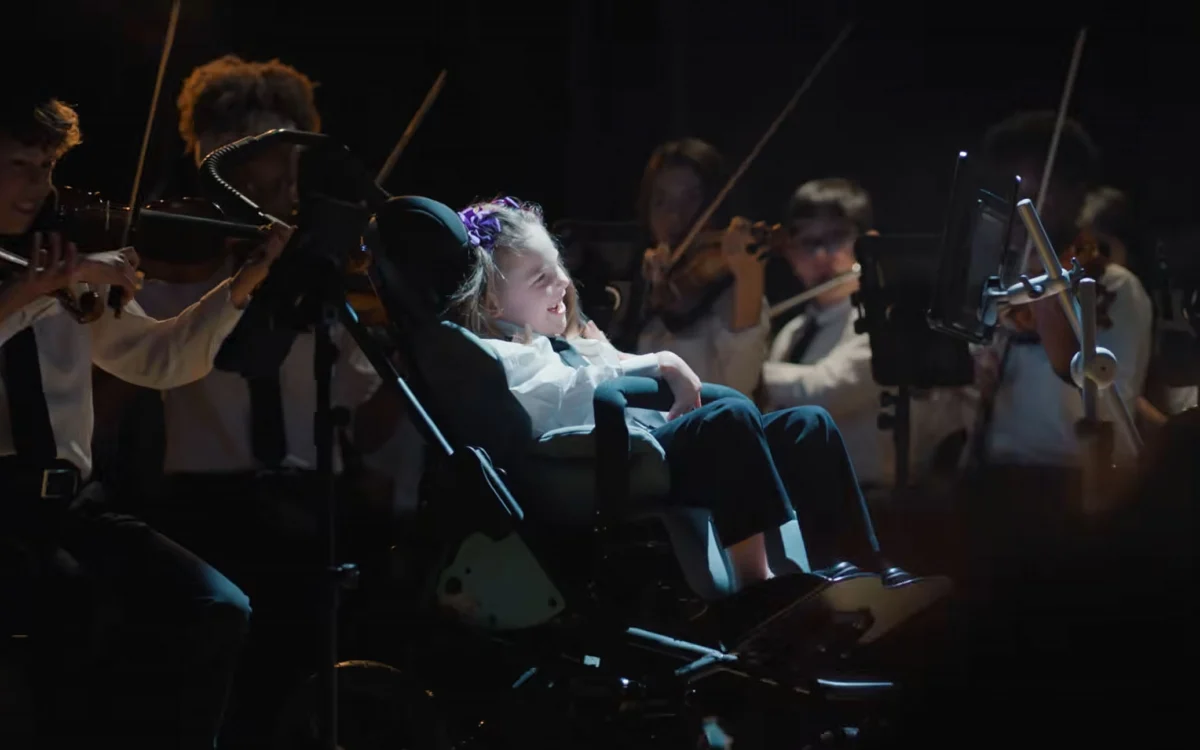
In a heartwarming AT&T commercial, 7-year-old Remi Schreiber is center stage, her gaze precisely controlling a digital piano to perform a solo rendition of the iconic "Rocky" theme song, "Gonna Fly Now." This powerful depiction is not a far-fetched fantasy but a testament to Remi’s remarkable journey, enabled by cutting-edge assistive technology. Remi lives with hypoxic ischemic encephalopathy (HIE), a severe brain injury caused by oxygen deprivation at birth, and cerebral palsy. These conditions affect her motor control and communication abilities, often requiring her to use a wheelchair or gait walker. While Remi’s verbal communication is limited to a few words like "yes" and "hi," she has developed a rich, personalized sign language with her family, a testament to her innate drive to connect and express herself.
A Symphony of Innovation: Assistive Technology as a Gateway to Expression
Remi’s world is expanding exponentially, thanks to the transformative power of assistive technology. Central to her newfound capabilities is a specialized tablet device developed by Tobii Dynavox. This sophisticated tool allows Remi to navigate and interact with digital platforms using only her eye movements, precisely directing a cursor to select options on the screen.
"Remi started using her communication device at 8 months old," shares her mother, Kayla Schreiber, who herself is a recreational therapist at Luke’s Rehabilitation Medical Center. "When the speech therapist first brought it in, I confess, I had my doubts. I thought, ‘You don’t think she’ll talk? What about screen time?’" Kayla adds with a laugh, reflecting on the initial apprehension. "Now, look at what she can do with it."
The device has become an indispensable tool for Remi, opening up a universe of possibilities. She uses it to immerse herself in music, both listening and actively playing, capture memories through photography, enjoy visual content via videos, and delve into stories with audiobooks. More importantly, it serves as her voice, enabling her to communicate with her parents, Kody Schreiber, and her younger sisters, Graci, 5, and Quinli, 2.
"She uses it to FaceTime and for playing music; she has a lot of books that she’ll have on Audible books," her mother elaborates. "That is her autonomy." The journey to this level of independence began early. Remi engaged with games designed to hone her eye-tracking skills, quickly demonstrating a natural aptitude for the technology. "When she got her Apple version around 4 years old, that’s when she could start playing music," Kayla notes, highlighting a significant milestone in Remi’s technological engagement.
From Local Therapies to Hollywood Spotlight
Remi’s family is dedicated to providing her with the best possible support, including attending intensive therapy camps. It was during one of these sessions in Denver that a therapist informed them about AT&T’s search for a child fitting a very specific profile: someone between the ages of 7 and 12 who possessed a passion for music and utilized eye-gaze technology. AT&T was looking to showcase how their network supports such connections.
The Schreibers, recognizing the unique opportunity, submitted an audition video. Their submission resonated, and they were quickly invited to Los Angeles in early March for filming. The experience culminated in Remi’s starring role in a series of AT&T commercials.
The commercials, titled "Remi Rocks," "Remi Rocks – Her Story," and the shorter "Remi’s Rehearsal," offer glimpses into Remi’s vibrant world. While Remi is the undeniable star, her parents, Kayla and Kody, also make brief appearances in the longer versions, underscoring the family’s collective journey. The filming took place at a school that was actively in session, a detail that impressed Kayla. "For the AT&T commercial, honestly, they were so accommodating," she stated. "The school was still in session during all of it, which blew my mind. They were worried about the school being ADA and accessible."
The creative team behind the commercials, including actor Arturo Castro who plays the teacher in the classroom scene, worked closely with the Schreibers to ensure authenticity. The other children featured alongside Remi are members of the Los Angeles Youth Orchestra, adding a genuine musical element to the narrative. The orchestra members appear in the classroom setting and with Remi on a school stage, performing for an audience.
Understanding the Medical Landscape: HIE and Cerebral Palsy
Remi’s medical journey is complex. Locally, she receives comprehensive care from a team of therapists and specialists, including those at Providence. Pediatric neurologist Dr. M. Edward Haws, who sees Remi at Providence Child Neurology, provides crucial insight into her condition. He explains that Remi’s HIE at birth resulted in brain damage.
"So now, the circuits that normally would control speech, motor movements and would help you develop into normal milestones like running, talking, playing, laughing, those circuits are damaged," Dr. Haws articulates. "As kids get older, we call the effect of that brain damage, cerebral palsy." This medical understanding underscores the profound impact of assistive technology on individuals like Remi.
The Mechanics of Eye-Gaze: A Digital Bridge to the World
Dr. Haws elaborates on the intricate workings of eye-gaze technology, likening it to a digital extension of a person’s will. "There’s a little dot that shows up on the screen that shows where her eyes are going, like a (computer) mouse essentially, so her eye gaze becomes the mouse," he explains. This seemingly simple mechanism allows Remi to "activate different buttons on the screen and control different aspects. It has helped her express thoughts and feelings and explore her world." This technological bridge is not just about control; it’s about liberation, allowing her mind to transcend physical limitations.
Educational Integration and Community Support
Remi attends Sunrise Elementary in a general education class, where she participates in music lessons once a week. Her educational experience is further enhanced by a dedicated speech therapist within the school district. "They have started to work with Remi and upload homework on Google Drive, so she can submit it to her teachers," Kayla Schreiber mentions. "They get really creative in how she can participate." This proactive approach to inclusion within the educational system is vital for Remi’s development and social integration.
The cost of assistive devices can be a significant barrier. However, organizations like Elevations Spokane play a crucial role by offering grants to help cover expenses not borne by insurance. Dr. Haws emphasizes the profound difference these devices make: "A lot of kids with her condition, HIE and cerebral palsy, either don’t have communication, or their communication is unidentified because they don’t necessarily have a great capacity to express themselves." He commends Remi’s support network, stating, "It says a lot about her speech therapists and parents that they were willing and took the time to learn how she communicates."
Dr. Haws further highlights the remarkable resilience of Remi’s cognitive abilities: "I don’t think there are a lot of kids as impaired as her who still have the capacity to think and communicate as well as she can. It’s even more meaningful because her body is much more impaired than her brain is. This allows her brain to escape." This sentiment underscores the profound liberation that technology offers.
Evolving Communication: From Folders to Spelling
Remi’s communication skills are continuously evolving. She is now beginning to utilize a keyboard of letters to form words, moving beyond pre-programmed folders. Initially, she relied on a system of folders containing descriptions of her desires, such as a favorite dessert. "She has what is like a talking app with different folders such as food," her mother explains. "It breaks down categories for her. It’s how she can communicate, and attached to that is a keyboard," she adds. "If she can’t find something, she’ll go to the first letter. It will try to help her find the word."
As her linguistic abilities grow, Remi is increasingly bypassing these structured folders, demonstrating a nascent ability to spell and construct her own sentences. This progression signifies a deepening command of language and a desire for more nuanced expression.
A Father’s Perspective and the Power of Representation
Kody Schreiber, who owns a German auto repair shop, echoes the amazement shared by his wife. "It just broadened her horizons," he states, reflecting on the impact of technology. "You view it as a crutch at first, but you see the benefits." This initial perception of a "crutch" quickly transforms into an understanding of empowerment and expanded capability.
Both parents were deeply moved by the AT&T commercials. "They did such a great job keeping it authentic," Kayla Schreiber shared. "They kept Remi her fully authentic self, and they worked with her. It’s shown inclusion, a huge representation of just what a communication device can really help do, and not to judge a book by its cover." The commercials serve as a powerful advertisement not only for AT&T’s network but also for the boundless potential of individuals with disabilities when provided with the right tools and opportunities. They highlight the importance of inclusion and the ability of technology to bridge divides and reveal the true capabilities that lie within.
The story of Remi Schreiber is a compelling narrative of resilience, technological innovation, and the unwavering dedication of a family. Her journey, amplified by her role in the AT&T commercials, serves as an inspiring example of how assistive technology can unlock potential, foster independence, and allow every voice, no matter how it is expressed, to be heard.