Recent headlines have painted a stark picture for the polling industry, suggesting an existential threat from emerging technologies and fraudulent practices. The landscape of public opinion research, once a relatively straightforward endeavor of surveying human voices, is now being complicated by the advent of artificial intelligence and the persistent issue of compromised data. While some companies are exploring the use of AI to predict public sentiment, others are leveraging it to manipulate survey results at an unprecedented scale. Compounding these challenges are ongoing data quality issues within certain survey methodologies, often attributed to "bogus respondents" who participate without genuine intent. For the public and policymakers alike, discerning trustworthy polling data in this evolving environment has become an increasingly complex task.
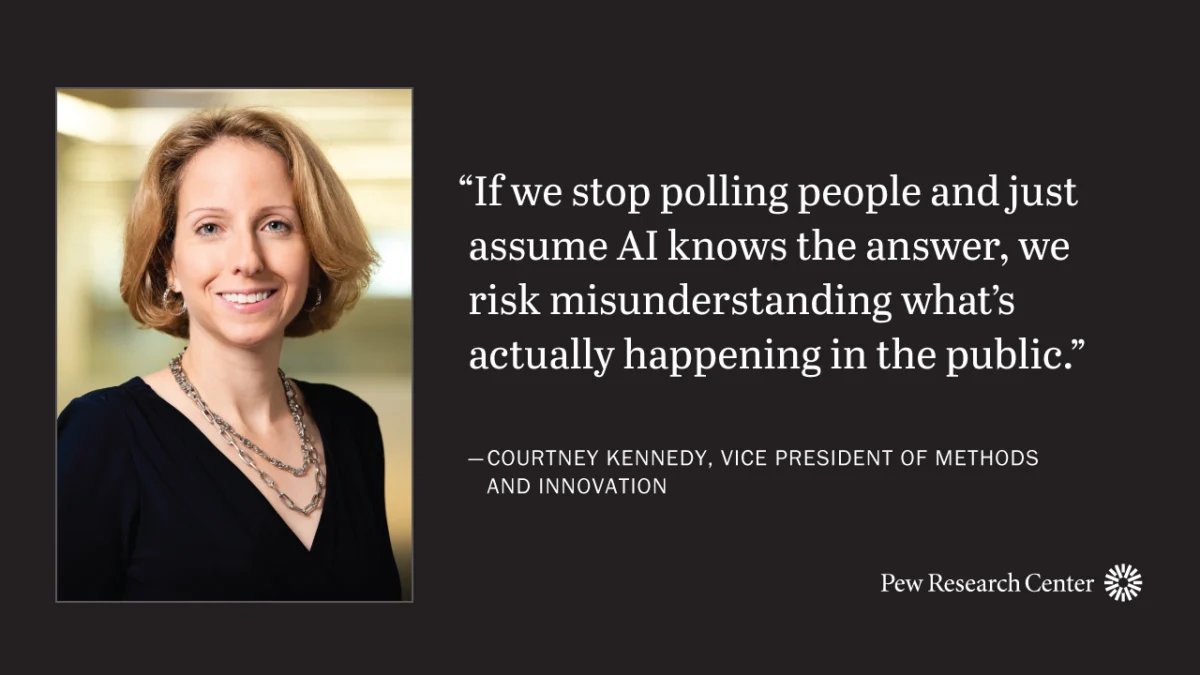
Courtney Kennedy, Vice President of Methods and Innovation at the Pew Research Center, a leading nonpartisan fact tank, addressed these pressing concerns in a recent Q&A session, offering insights into the challenges and the enduring principles of credible public opinion research. The Pew Research Center, known for its rigorous methodological standards, is at the forefront of navigating these new frontiers, emphasizing its commitment to capturing authentic human perspectives.
The Allure and Peril of "Silicon Sampling"
A novel and increasingly discussed practice involves companies employing artificial intelligence to simulate public opinion, a phenomenon sometimes dubbed "silicon sampling." Instead of directly engaging with individuals, these firms prompt AI models with questions to generate hypothetical responses, aiming to understand what people might think. This approach raises fundamental questions about the nature of public opinion and the very definition of polling.
"No. We only interview real people," emphatically stated Kennedy when asked if the Pew Research Center engages in silicon sampling. "We don’t use AI to tell us what the public thinks. There are ethical and scientific concerns with using AI to replace humans in public opinion surveys."
The core of Kennedy’s concern lies in the inherent value of human experience and voice in the polling process. Polling, at its heart, is a mechanism for democracy, allowing citizens to express their views, needs, and concerns to those in power. It serves as a vital conduit for understanding societal hardships, informing policy decisions, and holding leaders accountable. The risk, as Kennedy articulates, is that by outsourcing this crucial task to AI, we could fall into a dangerous misapprehension of the public’s true sentiments and lived realities.
Beyond the philosophical objections, scientific concerns also loom large. While Pew Research Center has conducted internal, experimental research into AI’s capabilities as a human interview substitute, its findings underscore significant limitations. Studies have revealed that AI-generated estimates often exhibit a tendency to stereotype demographic groups, struggle to accurately represent diverse viewpoints (particularly those of Republicans compared to Democrats), and tend to understate the nuanced spectrum of disagreement present in public opinion. While AI technology is rapidly advancing, and may eventually achieve a greater fidelity in mimicking human responses, the fundamental ethos of polling remains rooted in the direct engagement with actual individuals.
The Shadow of AI-Generated Fraud
The sophistication of AI has also opened new avenues for malicious actors seeking to undermine the integrity of surveys. Reports have surfaced detailing how bad actors are employing AI to generate fake survey responses at scale, a practice that poses a significant threat to certain types of polling.
"No. That threat applies to ‘opt-in’ surveys," Kennedy clarified, distinguishing this threat from Pew’s methodology. "Those are polls that people can proactively sign up to take – for example, by responding to social media ads offering a reward for taking a survey. Since it’s easy to adopt a fake identity online, opt-in polling opens the door to AI and bad actors seeking to commit fraud."
The ease with which fake identities can be created online, coupled with the financial incentives offered in many opt-in surveys, creates a fertile ground for large-scale manipulation. These fraudulent activities can range from creating multiple bot accounts to rapidly completing surveys for monetary gain, to more sophisticated operations aimed at skewing poll results for political or commercial advantage. The potential for financial reward is substantial; an individual could hypothetically earn tens of thousands of dollars per month by deploying AI-powered bots across numerous opt-in surveys.
The Pew Research Center circumvents this vulnerability by exclusively utilizing probability-based sampling. This method involves the random selection of individuals from a comprehensive list of U.S. home addresses, with initial contact made via traditional mail. Each year, only a carefully curated sample of the population is invited to participate. The low probability of any single individual being selected, and the inability for people to self-enroll or nominate themselves, effectively neutralizes the threat of bad actors infiltrating their survey panels through fraudulent means.

Even within the context of their own probability-based panels, the potential for respondents to misuse AI is considered, though the scale of the threat is dramatically reduced. "With a probability panel like the one we use at Pew Research Center, that kind of large-scale fraud isn’t possible," Kennedy explained. "You can’t create multiple accounts or take surveys all day. Our respondents each have a single account, take an average of fewer than two surveys per month and receive an average of $11 per survey. Someone using AI to answer our surveys could hypothetically earn $22 per month – not exactly a huge payday for cheating." This stark contrast in potential earnings highlights the disincentive for fraudulent behavior within a rigorously managed probability-based system.
The Persistent Problem of Bogus Respondents
Beyond the direct manipulation by AI, the issue of "bogus respondents" continues to plague certain survey methodologies, particularly opt-in surveys. These are individuals who participate in surveys without any genuine intention of providing truthful or thoughtful answers. Their primary motivation is typically to complete surveys as quickly as possible to secure monetary rewards.
A common characteristic of bogus respondents is a propensity to provide uniformly positive answers, such as "yes" or "approve." This tendency can lead to significantly skewed results, prompting what Kennedy termed "false conclusions" and forcing news organizations to retract stories that were based on potentially compromised opt-in poll data. Examples include reports based on questionable survey findings about the prevalence of certain beliefs or behaviors, which later proved to be inaccurate due to the compromised nature of the data.
The fundamental driver behind the existence of bogus respondents is the open-enrollment nature of many opt-in surveys. These platforms actively encourage anyone interested to sign up, inadvertently creating an environment where individuals seeking quick financial gain can easily bypass the need for genuine engagement. In contrast, rigorous survey research, like that conducted by Pew, emphasizes careful recruitment processes where individuals are selected by the researchers, not self-selected.
Nuances of Opt-In vs. Probability-Based Sampling
While the challenges associated with opt-in surveys are significant, Kennedy acknowledged that they are not universally problematic. In certain scenarios, opt-in polls can yield results comparable to those from probability-based surveys. For instance, when the primary objective is to measure the broad opinion of all adults on a topic of general interest, such as presidential approval ratings, the outcomes from both methodologies might align.
However, a substantial body of research indicates that opt-in polls are prone to generating erroneous data when assessing specific demographics or less common phenomena. This includes data concerning younger adults and estimates of relatively rare behaviors. These rare behaviors can encompass a wide spectrum, from belief in conspiracy theories to affiliation with specific religious groups, military service history, or even support for political violence. The limitations of opt-in sampling become particularly apparent when trying to capture the nuances of diverse populations or behaviors that are not widely prevalent.
The Enduring Value of Probability-Based Polling
Despite the complexities, probability-based polls remain the gold standard for reliable public opinion research. Kennedy stressed that while a probability-based sample provides the strongest foundation, it is not an infallible guarantee of accuracy. "It’s important to assess how respondents were recruited, but it’s not all that matters," she cautioned. "For example, in recent elections, there have been examples of probability-based polls that were not weighted properly and, as a result, were way off."
Proper weighting, a statistical process that adjusts the sample to reflect the known demographics of the population, is crucial for ensuring that the survey results are representative. A well-designed poll, from its inception through its analysis, is essential for trustworthiness.
The higher cost associated with probability-based surveys, such as those conducted by the Pew Research Center, is directly attributable to the rigorous and resource-intensive nature of their methodology. Recruiting participants offline, through mail to residential addresses, and ensuring random selection so that nearly all U.S. adults have an equal chance of participation, are time-consuming and labor-intensive processes. Furthermore, offering respondents the flexibility to answer via web or phone accommodates different preferences and accessibility needs, enhancing participation rates but also increasing operational costs. These deliberate efforts to maintain methodological integrity are the bedrock upon which credible public opinion research is built.
As the field of polling navigates these evolving challenges, the commitment to robust methodologies, transparency, and the fundamental principle of capturing authentic human voices remains paramount. The insights offered by Courtney Kennedy underscore that while technology presents new hurdles, the core values of reliable research – rigorous sampling, ethical data collection, and a dedication to understanding the genuine perspectives of the public – are more critical than ever.