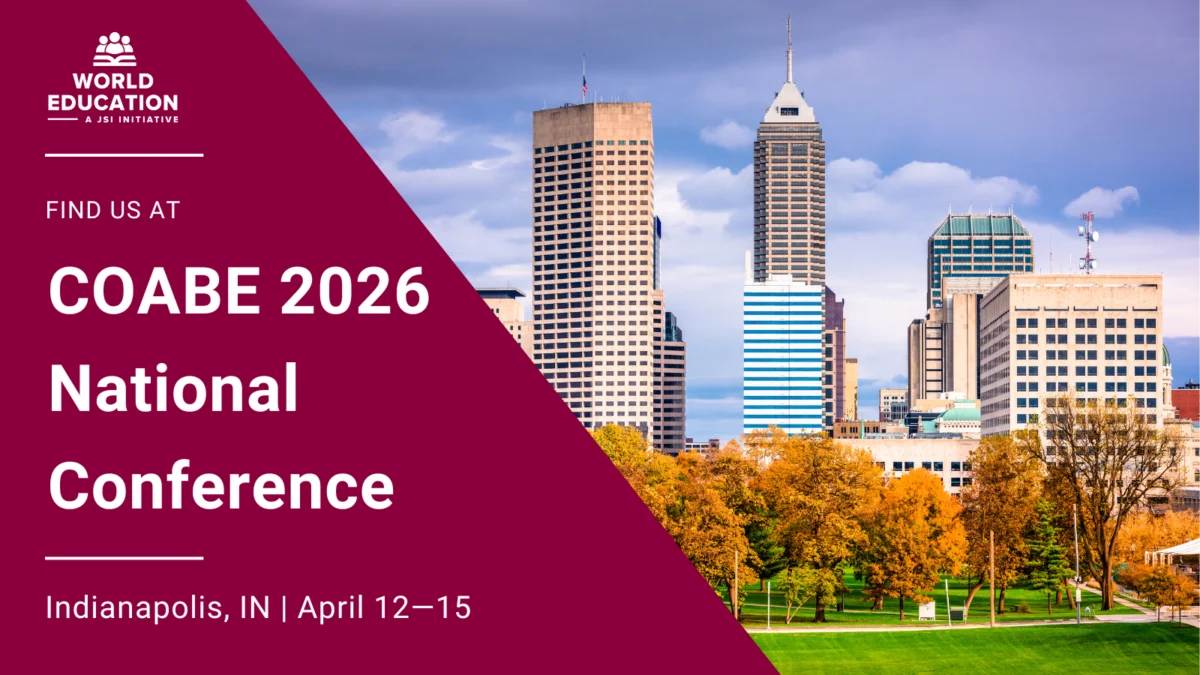
World Education, a prominent initiative of JSI Research & Training Institute, Inc., has officially announced its extensive participation in the Commission on Adult Basic Education (COABE) 2026 National Conference. Set to take place in Indianapolis, Indiana, from April 12 to April 15, 2026, the conference represents the largest annual gathering of adult education professionals in the United States. World Education’s delegation of experts will lead multiple sessions focused on the most pressing challenges and opportunities in the field, ranging from the integration of Generative Artificial Intelligence (AI) in the classroom to the systemic implementation of digital literacy frameworks. As adult education programs nationwide face increasing pressure to prepare learners for a technology-driven workforce, the insights shared by World Education are expected to set the benchmark for instructional excellence and policy development for the coming years.
The COABE National Conference serves as a critical nexus for more than 79,000 educators, administrators, and stakeholders who provide services to the estimated 36 million adults in the United States who lack basic literacy and numeracy skills. The 2026 iteration in Indianapolis arrives at a pivotal moment when the digital divide is no longer just about access to hardware, but about the "usage gap"—the ability to navigate complex digital ecosystems and leverage emerging technologies like AI. World Education’s presence at the JW Marriott Indianapolis will highlight the organization’s dual role as a research-driven innovator and a practical implementation partner for state and local education agencies.
A Chronological Overview of World Education at COABE 2026
The conference schedule for World Education reflects a comprehensive approach to adult learning, beginning with foundational digital skills and culminating in advanced pedagogical strategies for online instruction.
Monday, April 13: Driving Skills and Policy Implementation
The first full day of programming on Monday, April 13, focuses on the transition from high-level policy to classroom-level execution. The day begins at 8:00 AM in the JW Grand Ballroom 2 with a session titled "Using BRIDGES Skills Checklists to Drive Digital Skills Development in Any Context." Led by Jeff Goumas, this session introduces a structured framework for assessing and developing digital competencies. The BRIDGES framework is designed to be adaptable, ensuring that whether a learner is in a rural community center or an urban vocational school, the path to digital proficiency remains clear and measurable.
Later in the morning, from 11:50 AM to 1:00 PM, Sandy Goodman and Catalina González will present "From Policy to Practice: Implementation Lessons from Boston’s Digital Literacy Initiative" in the JW Grand Ballroom 4. This session is particularly significant as it offers a case study of municipal-level intervention. Boston has long been a testing ground for integrated digital equity, and the World Education presenters will analyze how local government policy can effectively translate into tangible gains for adult learners.
The afternoon concludes with a research-heavy session in Room 205 from 3:50 PM to 5:00 PM. "Practical Solutions from Research: Digital Tools to Support Teaching and Learning from the CREATE Network" will feature Jen Vanek and Jeff Goumas alongside partners from the American Institutes for Research (AIR). This presentation highlights the work of the CREATE Network, a collaborative effort funded by the Institute of Education Sciences (IES) to conduct rigorous research on technology-supported learning.
Tuesday, April 14: The AI Frontier and Open Educational Resources
Tuesday’s agenda shifts toward the future of the workforce, with a heavy emphasis on Artificial Intelligence. At 8:00 AM, Rachel Riggs will lead "Aligning AI Literacy with Learning and Work Goals in Adult Ed" in the JW Grand Ballroom 3. As AI continues to reshape the labor market, World Education argues that AI literacy must be treated as a core competency for adult learners to ensure they are not left behind in the "algorithmic economy."
Mid-day, the focus turns to curriculum accessibility. Jen Vanek and Jeff Goumas, joined by Stephen Sireci of UMass Amherst, will present "Free and Open Online Literacy Curriculum: Leveraging SkillBlox and ASAP for Adult Readers" from 11:50 AM to 1:00 PM. SkillBlox, a flagship project of World Education, allows educators to curate and organize open educational resources (OER) into customized learning plans, significantly reducing the cost of high-quality materials for underfunded programs.
The afternoon of April 14 features two concurrent sessions at 2:00 PM. In Room 206, Vanek and Goumas will collaborate with Stephanie Cronen and Neha Nanda of AIR to present "Practitioner-Friendly Findings: How to Leverage Free Research-based Resources to Teach In-Demand Skills." Simultaneously, in the JW Grand Ballroom 3, Rachel Riggs will return to the stage for "Generative AI and the EdTech Maker Space: Leveraging GenAI to Fill Learning Resource Gaps." This session explores how educators can use AI not just as a teaching tool, but as a content creation engine to build bespoke learning materials that reflect the diverse lived experiences of their students.
Wednesday, April 15: Professional Development and Instructional Design
The final day of the conference focuses on the sustainability of the adult education workforce. At 11:50 AM, Dani Scherer will present "Maximum Impact Professional Development: A Three-Pronged Approach" in Room 209. This session addresses the high turnover rates in the adult education sector by proposing a professional development model that emphasizes peer learning, technical mastery, and emotional resilience.
The conference concludes with two sessions led by Eliana Stanislawski. The first, "EdTech in Action: Structuring a Digital Literacy Learning Series for Adult Educators" at 1:30 PM, provides a blueprint for administrators to train their staff. The final session at 3:00 PM, "Engaging Strategies for Online Instruction of Literacy-Level Adults," addresses one of the most difficult challenges in the field: how to effectively teach reading and writing to beginners through a digital screen.
Supporting Data: The Urgent Need for Digital Equity
The significance of World Education’s contributions is underscored by recent data regarding adult literacy and digital access in the United States. According to the Program for the International Assessment of Adult Competencies (PIAAC), approximately 16% of U.S. adults possess low literacy skills, while nearly one-third of the workforce lacks even basic digital skills.
Furthermore, a 2023 report by the National Skills Coalition found that 92% of jobs now require digital skills, yet a significant portion of the adult education population lacks the home broadband or devices necessary to practice these skills outside of the classroom. World Education’s focus on "Practical Solutions" and "Free and Open" resources directly addresses this resource gap, providing tools that can be utilized on mobile devices and in low-bandwidth environments.
The inclusion of Generative AI in the 2026 program is a response to the rapid adoption of the technology in the private sector. World Education’s research indicates that without intentional intervention, the "AI divide" could exacerbate existing inequalities. By training educators to use tools like SkillBlox and AI-driven content creators, World Education aims to democratize access to advanced learning technologies.
Broader Impact and Industry Implications
The participation of World Education at COABE 2026 is expected to influence national policy discussions. By presenting alongside organizations like the American Institutes for Research and UMass Amherst, World Education bridges the gap between academic theory and frontline practice.
Industry analysts suggest that the emphasis on "Policy to Practice" (as seen in the Boston initiative session) is a necessary step toward securing increased federal funding under the Workforce Innovation and Opportunity Act (WIOA). Demonstrating that digital literacy programs can be scaled and measured is essential for convincing lawmakers of the return on investment in adult education.
Furthermore, the focus on the "EdTech Maker Space" signals a shift in the role of the adult educator. No longer just a deliverer of pre-packaged curriculum, the modern educator is becoming a curator and creator of digital content. World Education’s sessions provide the technical training necessary for this professional evolution, ensuring that the human element remains at the center of the technological revolution.
Official Stance and Future Outlook
World Education remains committed to the philosophy that education is a fundamental human right that must adapt to the digital age. The organization’s leadership emphasizes that their presence at COABE 2026 is not just about sharing information, but about building "enduring partnerships across regions and sectors."
"World Education fosters enduring partnerships to advance education outcomes for all," the organization stated in a briefing regarding the conference. "We offer education systems strengthening, program design and implementation, applied research and evaluation, capacity development, and policy development services."
As Indianapolis prepares to host thousands of educators in April 2026, the work of World Education stands as a testament to the resilience and innovation of the adult education sector. By tackling the complexities of AI, the nuances of digital literacy, and the realities of professional development, World Education is helping to ensure that the 36 million adults in need of basic education have a clear, supported, and technologically-empowered path toward economic mobility and social integration. The sessions scheduled for COABE 2026 are more than just presentations; they are a roadmap for the future of adult learning in an increasingly digital world.