As the United States stands on the cusp of its 250th anniversary, a comprehensive new report from the Pew Research Center paints a complex portrait of the national mood. While a pervasive sense of dissatisfaction colors the current outlook, with a majority believing the nation’s best days are behind it, the data also reveals persistent undercurrents of hope and a recent, albeit modest, uptick in optimism regarding the future. This nuanced sentiment, shaped by historical trends, political alignments, and generational perspectives, offers a critical snapshot of American public opinion as the nation approaches a significant milestone.

The research, drawing on extensive survey data collected by the Pew Research Center’s American Trends Panel, delves into the views of U.S. adults regarding the nation’s current trajectory and their expectations for its future. Conducted between April 6-12, 2026, with a margin of error of plus or minus 1.9 percentage points, the study utilized responses from 3,592 U.S. adults. This analysis builds upon a rich history of Pew Research Center’s work in tracking the public’s sentiment, providing a vital context for understanding the enduring themes and emerging trends in American attitudes.
A Nation Grappling with Dissatisfaction
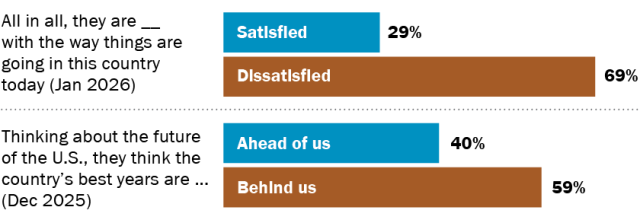
The overarching finding of the report is a predominantly negative sentiment regarding the state of the nation. In surveys conducted over the past year, a stark majority of Americans have expressed dissatisfaction with the way things are going in the United States. This sentiment is amplified by the widespread belief that the country’s most prosperous periods are in the past. A Pew Research Center survey from December 2025 revealed that 59% of U.S. adults felt that the nation’s best years were behind it, a sentiment echoed in a January 2026 poll where 69% reported dissatisfaction with the country’s current direction.
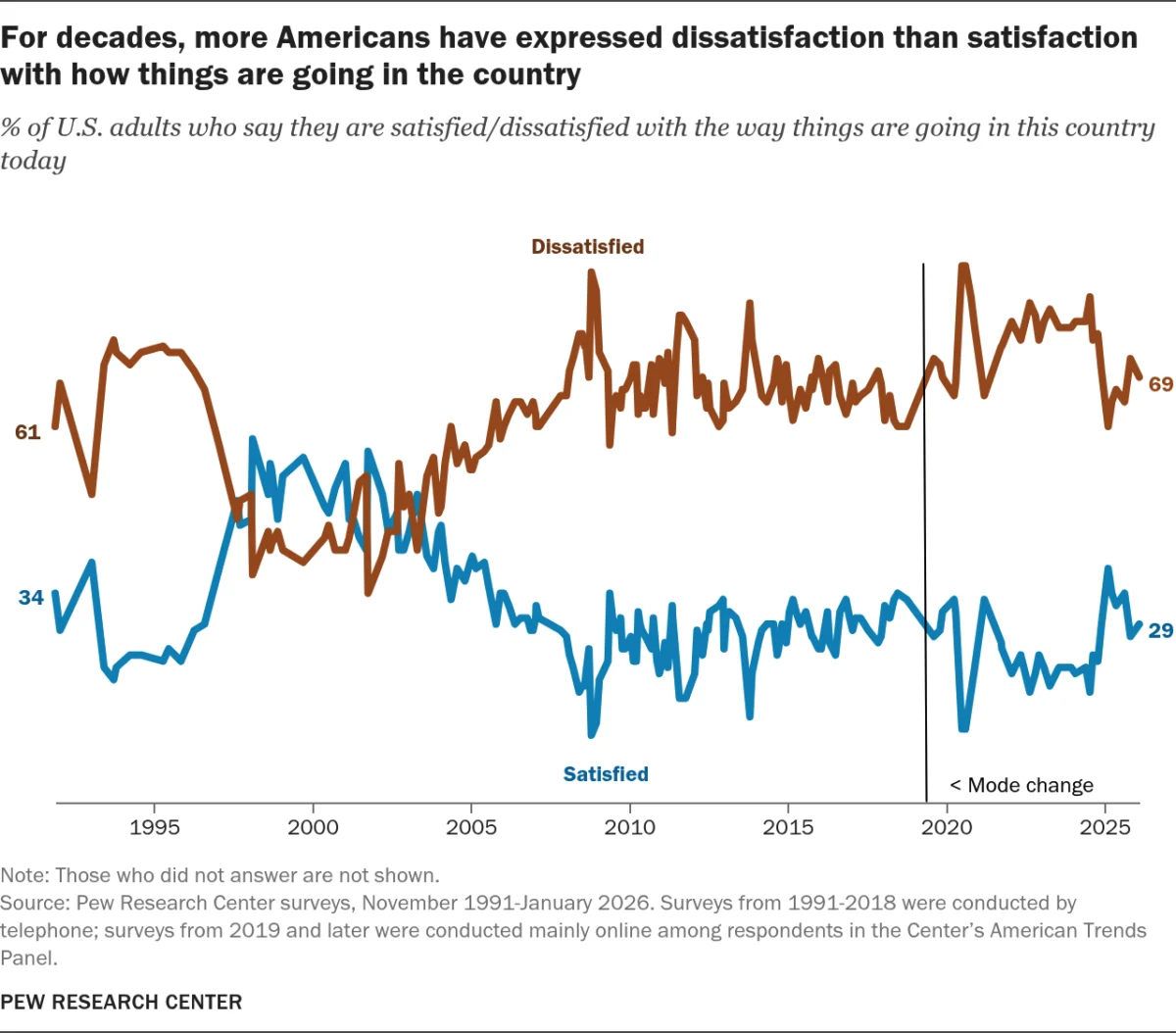
This prevailing dissatisfaction is not a new phenomenon. Historical data from Pew Research Center surveys, stretching back to the early 1990s, consistently shows a greater proportion of Americans expressing dissatisfaction than satisfaction with the nation’s direction. While there have been periods of relative optimism, such as the late 1990s, the general trend over the past three decades has leaned towards a more critical view of the country’s trajectory. The COVID-19 pandemic, for instance, saw satisfaction levels dip significantly, with a notable surge in dissatisfaction in mid-2020. While there has been a slight rebound in satisfaction since the pandemic’s peak, the balance of opinion has remained negative for over two decades.
The erosion of trust in institutions and fellow citizens further contributes to this somber national mood. In recent years, Americans have shown decreasing trust in each other and in key institutions, including the federal government, major political parties, the mainstream media, and higher education. This decline in social capital and institutional confidence is a significant backdrop against which current national sentiments are being formed. When compared to citizens in other high-income countries, Americans also express greater dissatisfaction with the functioning of their democracy and harbor doubts about the moral character of their fellow citizens, as indicated by research from early 2026.

Pessimism for the Future, Yet Glimmers of Hope
Looking ahead to the year 2050, the outlook for many Americans is tinged with pessimism. Over half of U.S. adults anticipate a weaker economy, a diminished global standing for the United States, increased political polarization, and a less effective system of government. These forward-looking concerns reflect a deep-seated apprehension about the nation’s long-term prospects.
However, amidst this prevailing sense of unease, pockets of optimism persist. When asked about the future in general terms, a majority of Americans report feeling hopeful, and a substantial portion also feel happy when contemplating days to come. Furthermore, opinions on the nation’s overall future are nearly evenly split, with 48% expressing optimism and 51% expressing pessimism. This duality suggests that while specific concerns about the country’s trajectory weigh heavily, a fundamental sense of hopefulness about the future, and for personal well-being, remains intact for a significant segment of the population.

Signs of Recent Improvement
Despite the overall sour mood, the data reveals some encouraging signs of recent improvement in public expectations. A comparison of surveys from April 2023 and April 2026 indicates a positive shift in outlook regarding the nation’s future. The percentage of Americans who believe the country’s economy will be stronger by 2050 has risen from 32% to 43%. Similarly, expectations for reduced political division have improved, with the share believing the nation will be less politically divided by 2050 increasing from 21% to 33% over the same period. This suggests a recent, albeit gradual, recalibration of optimism, particularly concerning economic prospects and political unity.
Moreover, satisfaction with the country’s direction, while still predominantly negative, has shown some resilience. The period between 2020 and 2024 saw consistently lower levels of satisfaction compared to the more recent data from 2025 and early 2026. This suggests a marginal improvement in the national mood, potentially influenced by evolving political and economic landscapes.

The Partisan Divide and Shifting Sentiments
The nation’s mood is undeniably intertwined with its political landscape, and partisan affiliations play a significant role in shaping individual perspectives. Historically, satisfaction with the country’s direction has been strongly correlated with the party controlling the White House. During Republican administrations, Republicans have tended to express higher levels of satisfaction than Democrats, and vice-versa during Democratic administrations. This trend was evident during the Trump and Biden presidencies, as well as in earlier administrations like those of George W. Bush and Bill Clinton.
This partisan divergence extends to views on the nation’s future. Republicans and Democrats often hold starkly different opinions on issues ranging from economic prospects to the nation’s role in the world. However, on certain fundamental concerns, a bipartisan consensus of pessimism emerges. For instance, a significant majority in both parties believe the country will become more politically divided by 2050, and a considerable portion on both sides anticipate a worsening of the U.S. system of government. This shared concern about the future of democracy and political stability transcends partisan lines, highlighting a common ground of apprehension.

Generational Differences in Outlook
Age also emerges as a significant factor influencing national sentiment, particularly when looking towards the future. Younger adults, defined as those under 30, tend to exhibit more pessimistic views about the nation’s long-term prospects compared to their older counterparts. When asked to project to 2050, younger Americans are less likely than older adults to anticipate improvements in race relations, a stronger economy, or a better functioning government. They also express lower levels of overall optimism about the nation’s future.
This generational divide in future outlook is a recurring theme in public opinion research. Younger generations often face different economic and social challenges, which can shape their perceptions of the nation’s trajectory. However, on some measures, age-related differences are less pronounced. For example, satisfaction with the current state of the country shows similar levels among the youngest (18-29) and oldest (65+) demographics. Intriguingly, younger adults report higher levels of happiness about the future than older adults, suggesting that personal well-being and national outlook may not always align perfectly across age groups.

Methodological Context
This report’s findings are rooted in rigorous survey research conducted by the Pew Research Center. The primary source of data is a survey of 3,592 U.S. adults conducted April 6-12, 2026, as part of the American Trends Panel (ATP). The ATP is a nationally representative online panel designed to provide high-quality, unbiased survey data. The survey methodology and questionnaire details are publicly available, ensuring transparency and allowing for independent verification of the findings. The analysis also incorporates data from previously released surveys, providing a longitudinal perspective on public opinion trends.
Conclusion: A Nation at a Crossroads
As the United States approaches its 250th anniversary, the Pew Research Center’s findings reveal a populace grappling with a complex mix of dissatisfaction and enduring hope. The prevailing sentiment is one of concern about the nation’s current direction and a belief that its best days may be in the past. This outlook is shaped by deep-seated partisan divisions and generational perspectives, with younger adults and those with strong political allegiances often holding more critical views of the nation’s trajectory.

However, the data also underscores the resilience of the American spirit. A significant portion of the population remains optimistic about the future, finding happiness and hope in personal and collective aspirations. Furthermore, recent trends suggest a modest but notable improvement in expectations regarding economic strength and a reduction in political polarization. The upcoming years will undoubtedly be a period of continued introspection and evolution for the nation, as it navigates these contrasting sentiments and strives to shape its future course. The insights provided by the Pew Research Center offer a crucial baseline for understanding the American public’s evolving mood as the nation embarks on its third century.